Monday, May 2, 2022

Race Report: 2022 Duathlon Nationals

Two months ago I qualified for the New York Marathon, running a 7:15 pace over 13.1 miles. Two weeks ago I wrapped up my training for the Duathlon Nationals with a hilly 5-mile tempo run at the same pace. So why, now, could I barely hold that pace over a flat 5k? 

I was in Mile 3 of the first run at the draft-legal sprint duathlon national championship in Irving, Texas. It was a hot afternoon but the course was flat. I had already adjusted my expectations for this event. I just needed to be in the top 18 in my age group to qualify for the 2023 World Championships in Ibiza, Spain.

While 2 weeks ago I had been feeling strong, today was an entirely different story. In the intervening week, I had come down with a nasty cold. A week ago I went through a box and a half of Kleenex in a day. Six days ago I dragged myself to the drugstore to get a COVID test and more Kleenex. The test was negative, but the cold was hitting me hard. Four days ago I finally felt good enough to go for an “easy” run that wasn’t easy at all. 

The next day I went for another run that felt a little better, and I decided that I just might be able to make my way to Texas and give this race a shot. 

Arriving in Texas on Friday for my Sunday race, I was still going through Kleenex at a prodigious rate. The spring allergy season wasn’t helping matters, and I doubled up on meds. I set up my bike and rode to the race start to pick up my packet — it was a hot and humid afternoon, and the weather only looked to get hotter over the next two days. I retreated to my hotel room to cool off. 

Saturday’s shakeout run felt a little better but I could tell there was no way I would be racing this event at the pace I could have easily done just two weeks ago. I settled on a goal pace of 7:00 per mile for the first run, only barely faster than my recent half marathon. 

The format for Nationals was a 5k run, then a 12-mile ride, then a 2-mile run. Now, 2 miles into the first run, even that 7:00 pace was slipping away. “C’mon, Munger,” I told myself, “just get to the ride. Then you can catch someone’s draft.”

I finally arrived at the transition area and was able to locate my bike quickly. To save time in transition, I had put flat pedals on the bike so I could ride in my running shoes. That worked great, and I ran to the bike mount line and hopped on. There was another cyclist just ahead and I accelerated as rapidly as I could to try to catch his draft. It was no use—I couldn’t catch up. I decided to relax and wait for someone to catch me. In a minute, another rider passed me and I jumped onto his wheel. 

I was able to hang on and recover a bit. After a minute, I passed him and said “30-second pulls?” He said okay, and we were a team. Another rider passed us and we joined him with the same offer. But clearly this guy had overextended himself just to catch us, and we dropped him. After a couple miles with my new teammate, I was starting to flag on my pulls. I told him I wasn’t sure I could keep this up. 

“Just do what you can,” he said. “Whatever you can do will still help me.” So he started pulling for a minute at a time while I did 30 seconds. Then a group of four caught up to us and we hooked onto them. They had one really strong rider, and my buddy was very strong, while me and the other three guys were a little weaker. We would hang on for dear life when the strong guys were pulling, then get a bit of a rest when one of us pulled. 

I managed to hang on to this group until we were about a half mile from transition. Then I let them go on ahead while I prepared myself for what I knew was going to be a slog on Run 2. Thanks to the drafting, I ended up with an average pace of 21.5 mph for the ride. Still weak from my cold, there’s no way I could have done that on my own!

As I dismounted, I realized just how much the hard ride had taken out of me. I hobbled with my bike to my slot in the transition area, removed my helmet, and headed out for the run. Since I didn’t have to change shoes, I was ahead of my cycling group, but I figured this wouldn’t last long in my condition. There was an aid station just outside the transition area and I stopped to walk for 5 seconds to make sure I got some water. I dumped the rest of it over my head, which offered a bit of relief from the 88-degree afternoon heat. 

My pace at this point was barely faster than a 9-minute mile. Slower than my usual “easy” pace. Surely I could at least get down to an 8-minute pace. A couple of the guys from my cycling group had passed me, so I focused on keeping them in sight. I passed through the first mile in 8:15. Not great but at least it was an improvement. I took another 5-second walk at the aid station to get some water and dump more over my head, then plodded on. I could still see one runner from my cycling group just ahead. “Hang on, Munger,” I told myself. 

I tried to pick it up for that final mile, but the best I could do was maintain the same pace. It would have to suffice. 

I ran through the finish and managed to stay standing to get my medal and let a volunteer drape some cold, wet towels over my shoulders. The guys from the cycling group were there, and I thanked them for pulling me along. Then I went off in search of shade, where I could collapse and check the results. 

I was 10th in my age group, which would probably qualify me for worlds, but there was a caveat. I’m in the 55-59 group, but current 54-year-olds would also be eligible for my age group at the 2023 worlds. I went to the USAT tent to check my qualifying status, and they told me I had made it — as the 16th qualifier out of 18! 

I know I could have gone much faster if I had been 100% healthy going into the race, but I’m proud of this effort. I gave it everything I could at the time and I made the team for worlds. I’ll take it!

Details of my race are on Strava, linked below. 

Run 1

Ride

Run 2

Monday, February 28, 2022

Race Report: The Wilmington Half Marathon

I have been trying to qualify for the New York Marathon for a long time. A really long time. Because I'm better at [relatively] short-distance races, even though it's tougher to qualify for than Boston, because New York allows you to qualify with a half-marathon time, it has always seemed tantalizingly possible for me to do. Rather than rehash the many times I have tried this, I will just offer the links to my posts about [most of] my attempts.

2011: Bridges Half Marathon: Needed a 1:30, ran 1:31:38. 
2014-16: Injuries and triathlons
2017: Houston Half: Needed a 1:32, ran 1:45 in HOT weather. Then ran a few more halfs but the closest I got was 1:36. 
2018. Houston Half again. Didn't even do a race report. Needed a 1:32, ran 1:35:13.
2020: Focused on the Ironman
2021: Covid wiped out this year and I'm not even sure what happened

Which brings us to 2022. My plan for this year was to not even think about running fast and work on the ultra distances. But then I somehow lost 14 pounds at the end of 2021 and it seemed like I might finally have the speed to qualify for New York, especially since I turned 55 in January and now all I needed was a 1:36. How hard could that be? I honestly thought it wouldn't be too hard, despite the fact that I had only run that fast once since 2013...

So I signed up for the Wilmington Half Marathon on February 26. I executed a two-month training plan, which went exceptionally well. Would this finally be the day I would qualify for New York? On race morning, I was as confident as I ever had been that I could do it.

To run a 1:36 half marathon, you need to average 7:20 per mile. But courses and GPS watches can be inaccurate, so I decided to set myself up to run a 1:35:00 -- a pace of 7:15 per mile. Several friends were running in the race, but I expected Jake and Ben to be well ahead of me, and Joey, Chad, and Kaylen to be somewhere behind me. There was no pace team doing this pace, so my performance in the race would be a matter of me and GPS watch. The weather was nearly perfect, 50 degrees with a north wind. The course arced from Wrightsville Beach in the east to downtown Wilmington in the west, a bit south of the start. There was only one section of less than a mile where we would be heading north into the wind, and only a few gradual hills on the course. In short, conditions could hardly be better.

After jogging a few hundred yards as a "warm up" I found my way to the start line, where I saw Ben near the front and gave him a fist-bump and wished him luck. He was using the race as a tune up for his marathon next week but still would finish about 20 minutes ahead of my planned time.

The race started on time and soon we were headed out of Wrightsville Beach and across two bridges onto the mainland. I monitored my pace and forced myself to slow down a couple times. Even so I ran the first few miles faster than planned, 7:09, 7:08, 7:08. Still, that meant I had over 30 seconds in the bank, and I didn't feel at all like I was struggling. My watch clicked through Mile 4 at 7:12, which also would have been great except for the fact that there was no mile marker here. For the first three miles, my watch and the mile markers matched perfectly, adding to my confidence that I would be able to monitor my pace accurately. Now with no Mile 4 marker in sight, I was a bit confused.

Finally the marker showed up at about Mile 4.4. I could only hope that it was just this marker out of place and we wouldn't somehow have to run an extra four tenths of a mile. I was ahead of pace but not THAT far ahead of pace. Fortunately the Mile 5 marker once again matched my watch perfectly, and I ran that one in 7:08 so I now had at least 50 seconds in the bank.

I ran Mile 6 in 7:18, which caused me a little concern since it was a fair bit slower than the first 5 miles. But I was still feeling fine, and with 50 seconds in the bank, I could actually afford to run even as slow as 7:25s for the rest of the race. 

Mile 7 proved to be the toughest of the race. It started on an uphill onramp, then turned straight into a 12-mph headwind. I reminded myself that this part of the course was probably the only place where we'd be running directly into the wind, and that I did have 50+ seconds to burn, so I just tried to put out the same effort as the other miles. Towards the end of the mile, we turned out of the wind and my watch clicked through the mile at a 7:28 pace. So now I had 40+ seconds in the bank and less than half the race to go. I could still do 7:25s for the rest of the race and hit my goal time, and there shouldn't be any more headwinds.

This section of the course did prove a bit annoying though, as we were on a full-on expressway with the traffic coming towards us. One lane was coned off for the runners but cars still raced by at 55+ MPH just a few feet away. It was also a little hilly because we occasionally crossed an overpass. Miles 8, 9, and 10 went by in 7:13, 7:13, and 7:27. My math was getting a bit fuzzy at this point but I was pretty sure I had at least 50 seconds in the bank. The Mile 10 marker was off by about a 10th of a mile, which set me to worrying again about the overall race distance possibly being off. If we had to run even an extra 10th of a mile, then my 50 seconds would quickly evaporate! But assuming the race distance was accurate, I should be able to cruise in at a 7:35 pace and still hit my goal.

Fortunately the Mile 11 marker again synced with my watch, and I ran that mile in 7:24, which meant I had at least 45 seconds in the bank and only 2.1 miles to go. I could run 7:40s and still make it!

I ran Mile 12 in 7:17. I was going to make it! My friend Ian had dropped out of the race with a niggling injury but had driven us to the start and now I saw him running ahead of me, carrying all our gear towards the finish area. Soon I caught up to him and jokingly told him he'd better hurry up. Actually the race course included a short out-and-back before the finish so he had plenty of time to see me finishing.

Ben was at the turnaround, having finished his race in 1:16. He ran along with me for a quarter mile (really a jog for him) and then let me go on solo to the finish line. Ian was a couple hundred yards from the finish and caught a great picture of me as I realized I was going to make it:

Yeehaw!

I ran through the line with an official time of 1:35:15, securely under my goal! I did it! As it turned out, I was second in my age group as well. I could hardly believe I had finally made it! Soon I was on the podium getting my photo with the two other age group winners (out of 40 in our division), and then it was time to celebrate! 

YESSS!!!

The only caveat: I've officially qualified for New York, but I'm not necessarily going to get an entry to the race. There are a limited number of slots for the race, and they are allocated on a first-come, first-served basis. I know registration opens up on March 9, but so far there's not much information about how exactly it will occur and how they decide who gets the spots if it's a big free-for-all when registration opens up. But even if I'm not able to register this year, I won't let myself be disappointed. At this point, it's become much more about the quest to qualify for the race than actually DOING New York. And if I somehow can't register this year, I still feel like I've earned a spot, so I will just enter the lottery each year until I get in to the race. 

One thing they can't take away from me, after over 10 years of trying, is that I QUALIFIED FOR THE NEW YORK MARATHON.

Now all I have to do is come up with a new goal. Fortunately, I have a few ideas....

Thursday, February 3, 2022

NEW BIKE! Fezzari Empire SL Pro

Last summer was a sad time for the Munger bike garage. I lost one bike due to a cracked frame and then the replacement bike (purchased used from a friend) was stolen a couple months later. Of course we were in the middle of the COVID bike craze so finding a new bike was a challenge. Many bikes simply weren't available, and custom builds were booked out a year or more. But I had been seeing ads for Fezzari bikes so I checked out some very positive reviews and then checked out their website.

Fezzari is a small manufacturer in Utah that (like nearly every bike brand) outsources frame-making to Asia and quoted a reasonable-sounding 6-8 week delivery window. So I started to configure bikes and was torn between the Empire SL and Empire Elite series. The SL is the top-end frameset and has a much more elegant look, while the still-very-nice Elite could be had for a similar price with those oh-so-desirable deep-section carbon wheels. 

After a little more research I opted for the high-end SL at the entry level, with a lighter frame and more refined cockpit but basic aluminum wheels. I figured I could easily upgrade to carbon wheels later and then I'd have a very serviceable backup set of wheels that maybe would get some use on gravel. There was only one hitch. I could get the basic black frame in 6-8 weeks but the beautiful Lava Rock Red color was backordered through February of 2022. Back in August of 2021 this seemed like an ETERNITY. But it just didn't make sense to order my forever bike in a color I wasn't in love with. So I sucked it up and ordered the SL Pro in the color I really wanted. And then I waited.

Finally, on January 31, 2022, my beautiful new bike arrived, a day earlier than promised! It even came with a little note inside the box:

Isn't that nice?

As you can see, the bike was very well-packed and padded, and as I pulled it from the box I could see it had arrived fully intact, with nary a scratch or ding to be seen. It probably took longer to remove all the padding than it actually did to assemble the bike. All that was needed was to install the seat, bars, pedals, and front wheel, and it was ready to ride...

... almost. 

That's because this bike came with SRAM Force eTap derailleurs and shifters, which meant the two derailleur batteries needed to be charged for an hour each before riding. After an hour I plugged the rear derailleur battery in and tested it out to see if it worked. It did! I could at least ride around the block while I waited for the front derailleur battery to charge. I hopped on and the shifting seemed... sluggish. I could probably shift my 1993-vintage steel-framed bike quicker than this! I wondered if I had really charged the battery properly. I went back to my garage and looked at the other battery in the charger. A blue light and a red light were on, but I could see there was also a yellow and a green light. Did I need to wait for the green light before it was fully charged? 

It was at this point that I jarred from my memory banks a piece of wisdom my dad had shared with me 40+ years ago: "When all else fails, read the manual." I consulted the manual, and sure enough, the red light indicated the battery was NOT being charged. After some fiddling with the cords I got the yellow light to glow, indicating "charging." I would have to wait for the green light for this battery to be fully charged. It was already 4 pm, and I had two batteries to charge for a minimum of an hour each. I wouldn't be able to get a ride in before darkness. After making a self-deprecating post on the Pathetic Triathletes Facebook page I resigned myself to waiting until Tuesday to get a proper ride in.

In the meantime, I decided to spend a little more time familiarizing myself with the bike. I installed a Garmin mount and Varia headlight / taillight. I added two bottle cages (after some deliberation about which of the THREE provided mounts to use. You can install three cages on the bike, but there's not quite room for three, 24-ounce bottles. I think I will eventually get a third cage, though, since that is where I put my tool kit).

Around 6 pm I got everything charged up and installed the SRAM app on my phone, which then instructed me to upgrade the firmware on my derailleurs. After doing that, in the twilight, I finally rode my fully-operational bike around the block, before heading in for the night. Here's a photo of my setup:

Pretty!

Tuesday dawned bitterly cold, so I had to wait until the afternoon before it was warm enough for a longer ride. It was still cold enough that I decided to wear my lobster-claw gloves, which would make for a nice test of the ergonomics of the shifters. 

As I finally launched myself onto the open road, I noticed the ride seemed a bit rough. I was feeling every bump through the wheels and frame. This could partly be due to more aggressive geometry than my previous bikes, but in retrospect I think my tires were a bit over-inflated. The Empire comes with 28-mm tires, and I've previously ridden on 25s which I habitually fill to 100 psi. I did decide to fill these to just 90, but checking out this tire pressure calculator, it looks like even that was too high. For my weight plus the bike, I should have been at 73 psi in the front and 80 in the rear. (I should add, by the way, that this bike weighs in at 20 pounds including my lights, computer, and cages. Not bad for a size-large frame!)

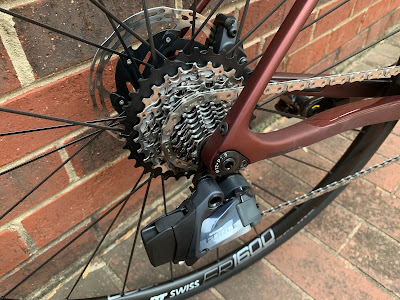
The next new feature to familiarize myself with was the shifters. The SRAM system has just one button per lever. The right lever is for upshifting, taking you to a smaller cog in the rear. The left lever is for downshifting. To shift the front derailleur you press both buttons at once; since there are only two chainrings the derailleur simply upshifts or downshifts based on the current location of the chain (you can reconfigure the buttons using the phone app but this is the basic setup). Using the left shifter to move the rear derailleur is definitely going to take some getting used to, but the left-down and right-up is very intuitive. It also helped a LOT that I had added a "Current Gear" field to my Garmin 530 bike computer. I could easily glance down and see what gear I was in, front and back. No more peeking between the legs and not quite being able to tell whether I had one more gear left to tackle the huge hill in front of me. With 12 cogs on the rear cassette, it's not an easy visual perception task to tell precisely what gear you are in, but the "Current Gear" field makes it a snap. 

I had chosen a hilly route, with grades up to 9 percent, so there was lots of opportunity to test the shifting, which, with now-fully-charged batteries, was smooth and instantaneous. The bike came with plenty of gears to handle the hills. The chainrings are 46 x 33, and the cassette ranges from 10 to 33 teeth (for you bike nerds, the configuration is as follows: 10, 11, 12, 13, 14, 15, 17, 19, 21, 24, 28, 33). I never felt the need to use the easiest 33-tooth cog, but I could tell it would have come in handy on some of my rides last summer where grades exceeded 17 percent. On the downhills I did use the highest gear a couple times but never felt like I was close to spinning out, even at 35 mph. I would say I could have easily continued to pedal and engage the drivetrain at 40+ mph. I could imagine a race setup where I would move to a 10 to 28 cassette, but honestly, at my level, it's probably not necessary. I'm considering buying a set of carbon wheels for a racing setup but if I did I think I would stick to the 10-33 cassette, or MAYBE a 10-30. 

Look at all those gears!

One initial disappointment with this bike is that while it is advertised as having fully internal cable routing, it doesn't quite ship that way. I was expecting the brake cables to run inside the handlebars and stem, then through the frame to the brakes. In fact, the cables were taped to the exterior of the bars, as with most bikes. They then route through an opening just under the stem into the steerer tube, and continue internally from there. It's just not quite as clean as I was hoping for. The bike is indeed set up for fully internal routing, but I guess they don't want to ship them that way because they need to remove the bars for shipping, and with internally-routed cables, there wouldn't be enough slack in the cabling to do that. That said, it's still a very clean look, and I don't think I'm going to go through the trouble of re-routing the cables right now. When I need to retape the bars in the future, then I might give internal routing a shot, but as you can see from these photos, the cabling is still very nice -- certainly the cleanest I've had on any bike to date. 


The cables exit the fork and chainstay in a particularly elegant manner, very close to the brakes. I really appreciate this detail:


These detail shots also show off the finish of the frame nicely. It's almost a half-matte finish. You can really see the finish in the photo of the chainstay above, where there is a protective plastic tape under the chain with a shinier finish, which contrasts to the rest of the frame in the same photo. I like the frame color ("Lava Rock Red") a lot. Understated, but not boring!

As I rode on, I was able to appreciate how the bike handled on corners, on rough pavement, and at speed on hills. Other than the stiffness I mentioned above that should be partially addressed by reducing tire pressure, it responded well to every situation. I made a point of getting out of the saddle on a couple of the climbs. At first I felt like the brake levers might not shaped perfectly for riding out of the saddle, as the top of the lever protrudes at a bit of an awkward angle. But then I tried gripping around the base of the lever instead, and I got the response I was looking for. I think the top of the lever is better suited to riding in an aero position, with the forearms parallel to the ground. Then the lever-top provides the perfect angle for hanging on as comfortably as possible in that stressed position. I might tweak the angle of the handlebars just a bit in the future to dial in this grip, but I think it's definitely something I will get used to. I could ride very effectively out of the saddle either gripping the base of the levers or the drops, delivering instantaneous power to the drivetrain.

As you might expect for a brand-new high-end bike, it rides VERY quietly. It's almost silent when you are pedaling, with no rattles of any sort even on a rough road. When coasting, the freehub doesn't deliver quite the "buzz" that some riders admire, but that doesn't seem to affect performance. The drivetrain engages almost instantly when you shift. The only occasional bobble I noticed was when shifting from the large to the small chainring. I think this might be unavoidable in this configuration where the small ring is so dramatically smaller than the big ring.

That's a big gap between rings!

But maybe it's simply a flaw in the SRAM system. I'd be interested to know if any readers notice a similar issue on their bikes. Otherwise the shifting was perfect. I certainly never experienced any chain rub, even when dramatically cross-chained. 

Overall, I'm extremely happy with this bike. It's beautiful, it rides well, and it will work for me in a variety of contexts, from racing to bikepacking to possibly even some gravel riding. It's raining today or I'd probably be out riding it rather than writing this review! The first real test of the bike's capabilities will be on May 1, when I'm signed up to ride in the draft-legal sprint duathlon at the US national championship. Expect to hear more about the bike then (and probably between now and then as I ride it more and have more thoughts).


Sunday, December 19, 2021

Race report: THP Winter 35k

When I thought I signed up for the THP Winter 35k in France, I thought I needed it as a qualifier for another race, which in turn I would need to qualify to run yet another race in France, the CCC by UTMB, a tough, mountainous 100k race I'm planning on doing in 2023. But that's a story for another day. As it turned out, I hadn't really signed up for the THP Winter race at all -- at least not according to the race director! But I did manage to do the race, which turned out to be even tougher than I thought it would be, even though it turned out I didn't need it to qualify for my other race, which I am, in fact, already registered to run in!

If that all sounds complicated to you, think of how I felt when I got to the front of what I was pretty sure was the right line at the start of the race, near the summit of Montange de Lure, in what was supposed to be the temperate South of France. The woman who checked runners in couldn't find my name on the list of registered entrants. She went to ask the race director, who in broken English asked if I had an email confirming my registration. I said I did, but there was no cell signal on my phone, but since I had already made my way to the top of this mountain 6,000 miles from my home, I would be happy to re-register. But of course that was also impossible, because she had no reception on her phone, so she couldn't fill in the necessary details online. In the end she decided I looked honest enough, and let me run the race with a promise to drop off 20 euros after I finished. 

By now there was just 15 minutes to the race start time, so I ran back to the car to drop off my race packet and attach my bib -- oh, did I mention they don't give you safety pins for your bib in France? You're supposed to have a race belt, which of course I hadn't brought along on this trip, so I stuffed the bib in my hydration pack and hurried to the start.

There were three events that day -- a 35k, a 20k, and a 10k. I lined up with the 35kers, who all looked much younger and fitter than me, and who all had micro spikes or yaktrax for their shoes, something I had also left back at home. Surely it wouldn't be too snowy on this race, and I had trekking poles, so I'd be fine, right?

I hastily snapped a selfie at the start line and got ready to go.

Ignore all that white stuff behind me... this will be fine

The started counted down 5,4,3,2,1 -- in English! [The only English I heard at the start], and then everyone took off. It was an uphill start, so surely everyone would take it easy, right? Nope, everyone started at a dead run.  You all know this is a 35k with 5,700 feet of climbing, right, I thought to myself. Apparently they did know, and they all knew they were fit enough to head up the 1,000 feet of climbing in the first 5 miles at a dead run. Before I knew it, I was in last place. 

Thankfully, I passed a couple women within the first half-mile. I wasn't in last! I passed another pair of runners, a man and a woman. Okay, maybe this won't be an utter disaster, I thought. But as soon as the trail leveled off and headed down a slippery descent, the man and woman zipped right by me again. Apparently, unless someone ahead of me completely fell apart, I was going to be the last male finisher in the race. By mile 2, there were no other runners in sight, and I was alone on the trail. A couple of small deer bounded in front of me, and I remembered that it was also hunting season in France. No worries, I was much too slow to be mistaken for a game animal!

For the first several miles, the trail alternated between steep ascents and steep descents, all in deep snow with tenuous footing. I'm not a great trail runner, but I'm an even worse snow runner. When I get nervous about my footing, I slow down. My descents were barely faster than my ascents. Eventually the trail worked its way up an exposed ridgeline. We would run along the ridgeline for the next several miles. 

The temperature was close to freezing, but all that climbing had warmed me up, so I stopped to remove my gloves and take a couple photos:

If you squint, you can see a runner up ahead

I'm in the mountains! In France!

In the first photo, in addition to the runner, you can see a mountain with some radar gear on the top; we'd all be climbing that mountain within a couple miles. The bigger mountains in the background are the Alps. We are technically in Haut Provence (the "HP" of THP Winter), a separate range. Haut Provence would be plenty for today!

Spurred on by the prospect of catching another runner, I dashed off down the hill, only to slip on an icy spot and land on my bare knuckles, scraping them up rather painfully. Fortunately all my digits seemed functional, so I carried on gingerly down the hill. Nora got a picture of the nasty-looking knuckles after the race.

Yikes!

I finally figured out that my only chance of catching anyone would be on the UPHILL portion of the race. Patience would be my mantra on the descents. Sure enough, after another short climb and descent, we began climbing the tallest summit of the ridge, to the Signal de Lure at 6,000 feet. There I soon made up ground on the runner ahead of me, and caught him about halfway up the final climb to the summit. At the summit, the snow was quite deep, and we had to make our way around a fenced-in military radar installation. I was worried the runner would catch me as the route got more technical, but thankfully there were some gravel spots where I could get traction on the descent from the summit, and I maintained my precarious position in fourth-from-last place. 

Surely as we descended from the ridge the snow would dissipate at lower elevations, right? Actually the opposite proved to be true; whenever we left the exposed ridge and went into the shady forests, there was even MORE snow. Every so often the trail returned to the ridge, and I stopped to get a photo of the view before we left the ridgetop for good.

These photos really make it look like there is not much snow. Trust me, there was plenty!

Here I am trying to look happy about how much snow there is

There weren't many people along the trail, but it was pretty cool to see anyone because nearly all of them clapped and shouted "Allez! Allez!" as I passed. So much nicer than the "good morning" you get when you pass hikers in the States!

Finally the trail dropped off the ridge for good, and I began to wonder if the promised aid station at 10k would really be there. I was already on Mile 8, with no aid station in sight. Down, down into the forest I descended, with the snow getting deeper and deeper. At least the 40-odd runners ahead of me had trampled the snow down a bit, but their footprints were uneven, which still made for difficult footing. 

Finally the snow seemed to dwindle, with even the occasional bare gravel stretch for 20 feet or so. But the thinner snow surface tended towards ice, so the traction was even a bit worse if there wasn't any gravel to run on. Down, down I descended, giving up all hope of an aid station, when at the 15k mark (9.3 miles) I rounded a corner and saw several cheery Frenchmen and women offering food and drink. I thought about accepting it briefly, but by this point I had figured out that I had plenty of my own food and water, and anything I took from them would only add to the load I was carrying in my pack. So I thanked them and went on without taking anything. They seemed so disappointed!

But now, at last, the trail was clear of snow. Even better, it wasn't a trail but a gravel road. Finally I could stretch out and run. I ran two solid miles in the time it had taken me to go a mile in the snow. I was actually getting hot! I decided to keep running until the trail headed back uphill, then take off my jacket and get some food. Sadly, that was only a half mile further along. I stopped and took off my jacket, then walked, eating a Lara Bar and figuring out how long my next climb was going to be. It would be 1,700 feet of vertical in about 3.2 miles.

I covered the first mile or so quickly, but then the trail got snowier and steeper, and it was difficult to walk fast. I tried to restrain myself from checking my watch every 30 seconds to see how much (or rather, how little) progress I had made up the mountain. I knew I'd be climbing nearly to the top of the ridge I had just run down.

Real-time location of Dave in this story

It never seemed like I was as far as I should be based on how tired I was. I looked up ahead but could only see trees and snow. Surely the ridgetop would come into view soon. Eventually, after seemingly hours of trudging uphill, it did come into view. I knew I would get close to the top but not quite there. Then I noticed someone hiking up the hill to my left, away from the ridgetop. Did the trail turn before it got to the ridge? And was that actually another racer? Was I finally catching someone? Amazingly, the answers were yes, yes, and yes! 

The trail did turn and I was perhaps 200 yards behind another runner. But before I could catch him, the trail leveled off and headed downhill, and, leery of my previous experience, I let him continue ahead of me (since apparently everyone in France descends in the snow better than I do). Now it was back down another precipitous, snowy trail, which once again seem to continue farther than I could imagine. The snow was deeper still in this narrow valley, and it appeared that only a single vehicle had been this way (along with the 40 or so runners ahead of me). This means the footing was every more precarious, and I had to slow to keep from falling.

When the snow finally started to dissipate, the trail was rockier than before and it was difficult to run on. Eventually I got to a runnable section, which again lasted a frustratingly short period of time. Then it was back up on the final climb -- another 1,800 feet over another 3+ miles, and then a short descent to the finish line.

I was surprised to come upon a second aid station about a mile into this climb, at about Mile 17 (it was supposed to be around Mile 12), where the volunteers were concerned about my bloody knuckles, and the runner I had seen earlier was stopped eating some food. I told the workers my hand was fine, and continued on uphill ahead of my rival. I was now FIFTH from last, with only 3.5 miles to go!

I trudged on up the hill as quickly as possible, though deep snow, then through a VERY slippery icy section where the snow was exposed to the sun and was melting. I passed two volunteers who told me there was just 1.5k to go -- less than a mile! Soon I was at the top of the final climb and only had a descent to the finish. But of course, this descent was steep and slippery, and soon my rival caught me (and very graciously asked if I was okay before proceeding ahead). 

Finally I emerged from the descent and could see the finish line across a field, only 200 yards away. There were actual people cheering us on in the middle of the field, and I started running (very carefully in my exhausted state), making my way across the field and up a short hill on pavement to the finish archway, where a very cheery DJ welcomed me to the finish. He must have been very bored, because there were probably only 7 or 8 finishers during the last hour of his shift!

Once we finished (and only then), we were awarded finisher shirts, and then could head for a refreshment table, where I had a cup of hot coffee and chatted with my rival. He said he hadn't been able to train on hills and that's why he was so slow on the climbs. I noted that there was no snow where I was from, so hadn't had any opportunity to train on that! The aid station volunteers wanted me to have more food, but I just wanted to get home, so I headed back to my car. I remembered I was supposed to get 20 euros for the race director, but of course, I had no cash in the car either, and besides, I was completely exhausted, and it was all I could do to take a picture of the waning sun from the parking lot before heading back to my hotel 8 miles down the road. 

Another photo with deceptively little snow...

I was a little disappointed in my 4th-from last finish, but in my defense, it seemed that many of the slower runners did not attempt the 35k distance. I looked up the results from the 20k, and 20+ runners had run a slower pace than me, even over that shorter distance. So maybe I'm not so slow on the snow.... Either way, it was a challenging day in some beautiful mountains, so regardless of how I did in the race, it was still a great adventure and a new and different experience. But I probably won't do a lot of running races in the snow in the future. I'll leave that to the young 'uns and stick to races with better footing. Or who knows, maybe I'll try an ice race, just for the heck of it!

Click here for my Strava record of the race.

P.S. I did check my email and I do have a receipt showing I paid for the race, so I promise I will email the race directer and let her know. Tomorrow.

P.P.S. The race director got back to me and of course there was no additional charge! So all's well that ends well!

Saturday, October 2, 2021

The Presidential Traver—or rather, Climbing Mt. Washington the hard way!

My buddy Carl and I had an epic adventure in the White Mountains yesterday. It didn't go as planned, but it's hardly an adventure if it does, right? The plan was to do the Presidential Traverse, a challenging 20-mile run / hike across the tallest mountains in New Hampshire, including the iconic Mount Washington, at 6,288 feet elevation, then descend to the other side of the range. Starting from just 1,300 feet, we knew there would be a lot of climbing. We knew the weather wasn't great, with a forecast of temperatures around freezing and 30-50 mph winds. But it was looking better than the alternative, which was to wait until the next day, when freezing rain was in the forecast, so we started out in the dark at 5 am and hoped for the best. 

At the trailhead

From the start, the trail was challenging, rocky, and steep. We shook our heads every time we turned a corner and saw another steep, rocky pitch to ascend. Carl stopped to take a picture of me climbing a typical section of the trail:

Oof!

It wasn't runnable, but we soon climbed up above 4,000 feet and arrived at our first serious challenge, Mount Madison. Now above the treeline, there wasn't really a trail, just a series of cairns in a steep, rocky ascent into the clouds. 

It was impossible to see how far we had to climb

As we climbed, the rocks got icier and icier, and the wind got stronger and stronger. I soon found my poles were useless as I needed to grab onto rocks with my hands and pull myself up, so I ditched them, knowing we would descend the same way. Carl stopped to change into warmer clothing but told me to continue on. After 100 yards, I stopped as well, knowing the wind would probably get stronger as we climbed. I took off my gloves and jacket and stowed them on the lee side of a cairn, hoping they wouldn't blow away. Then I stretched and contorted to put my technical running top on over my short-sleeved tee shirt. Then I fought the winds for several minutes to put my jacket back on. Finally there was even more struggling to put on my gloves and mittens. By this time, Carl was well ahead of me. I struggled toward the top, where Carl had stopped to take my photo, which should give you a good idea of the conditions up there. 

Epic!

At the summit of Mount Madison

At the top, we experienced our first full blast of wind, easily 50 mph. The descent was even more precarious as it's harder to find something to grab on to on your way down. Finally we made it back to the Madison Hut, which was closed for the season. We sheltered behind the hut and added all the layers we had. Once again, even in the lee of the hut, it was still a struggle to get the additional layers on. Our hands were frozen by the time we finished. We were both in shorts. I had a pair of tights that I could have added but my legs weren't cold and it would have been a pain to get them on and I would have gotten even colder as I did it. On to Mount Adams.

Adams was taller, icier, and rockier than Madison. The climb up was steeper as well. We would be descending a different route, so I stowed my poles on my pack. I hoped the descent would be easier than this! As we climbed, the route got steeper and steeper. It was a full-on, four-limbed scramble, before it finally leveled off a bit near the summit. Here Carl got another photo of me:

Even more epic!

The two of us atop Mount Adams

At the top, once again we were in the full face of the wind, but now we had to descend on an exposed ridge, scrambling across icy, jagged rocks that ranged from 1 to 4 feet in size. My right pole nearly fell off my pack and I struggled to strap it back in place. The wind was blasting me and my glasses fogged up. I was worried my hat would blow off. My nose was dripping incessantly, reminding me that I had forgotten to take my allergy medicine in the morning. A gust of wind blew a strand of mucus onto my glasses, which promptly froze across my field of view. I decided to remove my glasses and hat and plugged on, inching my way forward and downward, guessing at where to place my feet on the now-blurred surface of the icy rocks. After a couple hundred yards I decided it would be easier with poles and foggy glasses, so I put my glasses back on, removed my right pole from the pack and unfolded it. Then I went to get the left pole and saw that it was missing! It must have fallen off in the past hundred yards or so, but progress had been so perilous that I decided not to try to find the missing pole and went ahead with half-fogged glasses and one pole. Finally we made our way to a somewhat less windy spot and regrouped. [If you look back at the selfie from the top of Mount Adams, you will see that my left pole was already missing, so not going back was a very good call; it would have taken as long as an hour to find it!]

Just 5.5 miles in to our planned 20+ mile journey, it seemed unlikely that we would be able to finish. We knew there was a road and a cog railway at the summit of Mount Washington, 5 miles away, so we decided to make our way there and bail out.

Soon after this, we encountered the first hikers we had seen on the trip. They told us Mount Jefferson, ahead of us, was icy. We told them the Madison Hut, where they were headed, was closed, and Mount Adams was really rough. Then we each plunged forward in our respective directions. I was moving slower and slower, and Carl would walk ahead and then wait for me every quarter-mile or so. He was getting cold, and all this stopping wasn't helping the situation. The trail was relentlessly rocky, but thankfully not as icy as it had been on Mount Adams. Meanwhile I wasn't getting anything to eat, because I felt guilty every time Carl had to wait for me and so didn't stop to fuel up.

Working our way along the trail

At the base of Mount Jefferson, Carl figured out that there was a trail around the summit. It took us all of 5 seconds to decide we weren't going to summit Jefferson, so we went around it on a mercifully less-rocky trail (and by "less rocky" I mean "rockier than nearly any other trail I've been on"). 

Finally we started the climb up Mount Washington. The trail got rockier again, and we were concerned that it would get even icier than the others since it was 700 feet taller. It was definitely icier, and the winds were probably stronger than any we had experienced previously, but it was thankfully not as steep as Madison or Adams. The was some semblance of a trail through the rocks, and we saw some other hikers descending through the blasting wind. We could hear the sound of the cog railway chugging up the mountain, seemingly right next to us, but we couldn't see anything. Finally a train emerged out of the fog, less than 40 yards away! It was slowly chugging its way upward through the cloud, puffing a ribbon of smoke that was instantly transported away by the wind. More importantly, this mean the train was actually running that day, which meant we would have a way to get down off the mountain!

The steam train blasting up the tracks

The trail went right under the train tracks, which didn't seem right. I consulted the map I'd loaded onto my watch and saw that we had followed the wrong trail, which indeed did go under the tracks, but not to the top of the mountain. But we weren't far from the right trail, and I saw that if we hiked alongside the tracks, we'd soon rejoin the summit trail. Mercifully, the ground was soft and footing was firm next to the tracks; we guessed this was from the cinders spewed out by the steam engine. Eventually we regained the correct trail, which got icier with every step. Then this trail too crossed the tracks. I double-checked with my watch and saw that we were on the right trail, and so we stepped across. I was halfway across when I saw the lights of a train coming down the tracks toward me. I had visions of a Wile E. Coyote-style collision and hustled across. It was only when I was safely on the other side of the tracks that I saw the train was probably moving about 3 miles per hour! We waved to the passengers in the steamy coach, hoping we'd join them soon.

Finally we made our way to the top. I headed straight for the summit building, leaving Carl to take a summit selfie by himself. I was completely spent. We had climbed a total of over 7,000 feet, much of it in icy, windy conditions while scrambling over rocks. Suddenly we were in a world of tourists and tchotchkes. They looked at us like we were crazy, and I suppose we were, a little bit. But I wouldn't have it any other way. Besides, my bowl of clam chowder and cup of hot chocolate purchased at the summit cafe tasted SOOOO much better to me having worked my way [halfway] across the Presidential Traverse. 

I knew there was a van service that took passengers up the road to the top as well as the cog railway, so Carl inquired as to which would be the better option for us to get to the bottom. As it turned out, there was only one, the railway; the road had been closed due to the extreme weather conditions. The weather had been even worse than forecast, with an AVERAGE wind speed of 49.2 mph. We had felt it on the hike but convinced ourselves that it couldn't have been that bad, even though we felt like the wind could blow our form-fitting beanies off our heads, and our poles nearly got blown out from under us before we could plant them on the ground. The maximum wind speed for the day according to the Mount Washington Observatory was 77 mph. Carl found out we could ride the railway down on a space-available basis; we'd have to ask the operator if there was room. Then we'd be on our own to figure out how to get from the bottom of the railway to our car 10 miles away. There were no taxi services and Uber seemed unlikely in this remote spot. 

As we lined up for the railway, we noticed two women who looked to be in a similar predicament to us. They heard us talking about getting to our car and offered to give us a ride. 

"Really!?!" we said! "That would be awesome!"

"Well, we'll see how far it is when we get to the bottom and let you know."

On the ride down we chatted with some of the other passengers, and were amazed at how quickly the train descended below the wind and fog, despite its lethargic 3-mph pace. Soon we were in an autumnal wonderland, with stunning fall colors all around us. I only managed to take a quick selfie on the train.

Happy to be warm!

As we paid our fares, the two women told us they could definitely drive us, and we thanked them probably too many times to count. "We're Sarah and Sarah," they told us [names may have been changed to protect the innocent]. We introduced ourselves and chattered away. When we got to their car, they offered us beers, but we were too cold and sore (and old) to partake. They happily poured themselves some hard selzers (carefully disguised in thermal mugs), and we drove down the road to our waiting car. As we arrived at our car, we saw two women in hiking gear, hitchhiking. Sarah and Sarah told us we should pay it forward and give those women a ride. So we did. Turns out they had carefully dropped a car at the end of their planned point-to-point hike, but forgot to take their keys! Unlike us, they had actually completed the hike as planned; they just couldn't get into their car when they arrived! 

All this goodwill left us with a nice feeling after what was technically an unsuccessful trip. We had planned to run 20.5 miles and climb 8 peaks. We ended up running not one step and only summiting 3 peaks, taking 8 hours and 45 minutes for half a trip when the whole trip should have taken 12 hours. Somehow none of that mattered. We had summited Mount Washington in freezing temperatures and near-hurricane-force winds. We had done something epic; just not the epic something we thought we were going to do. It was a very good day.

Monday, August 9, 2021

Race Report: The Sheep Mountain 50k

Sheep Mountain is a rather unassuming name for a peak. In fact, in Colorado there are dozens of mountains with that name. But I had been looking for an ultra that would fit into my travel schedule this summer, and Sheep Mountain 50k is the one that worked out for me. This particular "Sheep Mountain" is near Fairplay, Colorado, where the race starts. It's 12,800 feet tall... not too big as Colorado mountains go, but plenty big for a flatlander from North Carolina. I have tried to run at this elevation before, and I knew it would be a challenge for me, especially as the path took me above 12,000 feet, where I usually start to get altitude sickness.

Fortunately the race is only above that height for a couple miles. Unfortunately, the rest of the race is all above 10,000 feet! It starts in Fairplay, and gradually winds its way uphill towards the big ascent of the mountain. The trail doesn't quite take you to the summit, but it peaks out at nearly 12,500 feet! Here's the elevation profile (from my Strava record of the race):

After you reach the top, you descend nearly to the start elevation, then climb back halfway up the mountain before returning to the start / finish line. 

I had been in Colorado for two weeks before the race, but only spent 4 days in Fairplay at 10,000 feet. The previous 9 days were in Basalt, at 6,500 feet. That's a decent elevation, but still doesn't quite prepare you for the conditions nearly 2 miles above sea level. According to my Garmin, I was acclimated to an 8,000 foot elevation when I awoke on race morning. That's not bad, but of course I'd be running up to an elevation 4,500 feet above this! Despite having run this far a few times, I'd never been an official finisher of a trail 50k. 

I got to the start area about 5:30 am, and sat in my car like most of the other runners, trying to stay warm on a 45-degree morning. At 5:50, we all jumped out of our cars and walked up to the start line. After a short talk from the race director, we were off! 


There were maybe 150 runners, most of us running the 50k, but maybe 30 or 40 doing the 50-miler (they added an extra loop starting at about the 15-mile point). The first 5 miles were a gradual climb up a smooth gravel road. I ran easily at a 10-ish-minute pace, walking whenever the grade steepened too much. 

The road was gradually getting rougher and a little steeper. Then suddenly a group of 15 or 20 runners was running towards me. "Turn around," they said, "we missed the turn." It hardly seemed possible to get lost along this road, but the actual route took a left turn and we all had missed it. The course had been well-marked with pink ribbons but clearly someone had removed them at this spot. Fortunately I had only run an extra half-mile or so, but it still sucked to miss the turn. A friend told me the women's winner went an extra 2 miles!

Moose sighting!

Back on course, the road continued to get rougher and steeper, until we finally crested and descended a very rough road to the first aid station, officially at Mile 7 (though my watch read 7.5). After a half mile on a smooth gravel road, we turned onto a singletrack trail. The trail headed upward, then across a difficult section of scree composed partially of petrified wood. There was no way to run on this section; the rocks were too loose and uneven. Fortunately that ended after about a half mile, and we were again running on singletrack through forest. 


Around Mile 10, the big climb began. It would be 2,000 feet over 2 miles, switching back and forth up Sheep Mountain. About halfway up, I got passed by an old guy. "Another graybeard?" he said, "Might I ask your age." I told him I was 54. "You're no graybeard! I'm 67!" And he charged ahead. 

Not long after that another guy passed me and I said "Can you believe that guy is 67?" 

"Well, I'm 69," he replied. 

Yep, that's a 69-year old leaving me in his dust

As the 69-year-old zipped ahead of me, I plodded my way up the ever-steeper slopes, now once again a crude trail made of piled-up scree. I could see runners hundreds of feet above me on another switchback, and was disheartened to realize that I'd have to climb that high as well. Finally I reached the high point of the trail and stopped to take a photo. 


A hazy day near the top of Sheep Mountain

I had been told that we'd have a spectacular view of Pikes Peak from Sheep Mountain, but sadly it was so hazy from all the forest fires across the west that I could barely see the valley at the base of the mountain. Next was a steep 2,500 descent to nearly the same elevation as the start line. Much of the trail was the difficult, non-runnable scree I had been laboring up on the ascent. Eventually I reached a forest road that was a little easier, and after a half-mile or so of this I reached the aid station, where the friendly check-in guy asked me if I had had enough rocks. I told him I thought I had, and he said "good, you're in for a lot more of them!"

A trail marker in the scree

After I had my fill of cookies and stocked up on water, I continued down the mountainside. Fortunately it wasn't the scree I had been laboring through, but just a very rocky jeep road. Still difficult to run on, but not nearly as challenging as scree. Eventually the road leveled out, and I reached the third aid station, at Mile 16.8 by my watch. At this point I was having difficulty running at all, even on relatively flat, even surfaces. I filled up on water, cookies, and chips, and then headed off again. The trail rolled on through the woods, up and down gradual hills. Not being able to run, I just hiked as quickly as I could, trading places with a couple other runners who looked to be about as beat up as me. Eventually the trail markers clearly indicated I should be turning left, while the map I had uploaded to my watch clearly indicated I should be  continuing straight. I decided to follow the trail markers, while my watch beeped in protest. 

This trail headed back up Sheep Mountain, and I knew from looking over the official course map before the race that that was what we were supposed to do, so I must have made a mistake with the map I uploaded to my watch. In fact we climbed halfway back up the mountain, before joining up with the trail we had climbed up on before. The course was a big, misshapen lollipop, with the first and last 10 miles or so as the "stick" and the middle 11 as the "candy": 

Now it would all be familiar territory. I was dreading the one last scree field before we moved back onto roads for the 8 miles to the finish. I made my way across the petrified scree and onto the road, where another couple runners passed me. I told myself it was time to start running again, but every time I tried, my body wouldn't cooperate. Finally I arrived at the last aid station, at Mile 25.8 by my watch, where I allowed myself a 10-minute break, eating as many cookies and drinking as much Coke as I could before heading back out on the road. 

7 miles to go, and now it would all be gravel roads. After a steep climb out of the aid station, it would be mostly downhill. The road surface gradually improved, and I did manage to run a bit -- 1 minute on, 2 minutes off. 4 miles to go, and  there was an unmanned water stop where I refilled a flask, just in case. With 3 miles to go the lead 50-mile runner ran passed, looking solid and steady at probably a 9-minute pace while I could barely manage a walk. I noticed I had phone service and texted Greta to let her know when to expect me at the finish line. 2 miles to go, then 1 mile to go. Surely I could run the last mile, couldn't I? Nope. At this point I was just walking. With a quarter mile to go another man passed me, also walking, but faster than I could. He was maybe 50 yards ahead of me as we approached the finish, and he sprinted to the end. 40 yards from the end, a photographer approached me and said "show me what you got." 

"This is all I got," I said, and I walked to the finish. Greta was there, and snapped a picture of me walking across the line. 

I had gotten my first official finish at a trail ultra. A really tough trail ultra -- I definitely didn't make this easy on myself. I was absolutely spent. My body didn't know what to do with itself. I didn't know if I wanted to eat, drink, or take a nap. Greta drove me back to our rental condo and I decided what I wanted to do was sleep. "Not before you take a shower," Greta said. Reluctantly, I stumbled into the shower, then took a 45-minute nap, and woke up hungry, still not knowing what to eat. I finally choked down a potato and went to bed, dreaming of anything but running up the side of a mountain. 

If you're interested,  here's the Strava record of my race.

Sunday, May 23, 2021

Brief Race Recap: Duathlon Nationals 2021

I have spent the spring focusing on a fast 5k time and haven't really had time to seriously train for multi-sport, but I did really want to do this one race, the draft-legal Sprint Duathlon National Championship in Tuscaloosa. The race is a qualifier for the world championship. I had qualified for 2020 worlds in a non-draft-legal event, but of course the 2020 race was cancelled, so I wanted to try again, this time to qualify for the 2022 world championship in Australia. 

We had a bit of a scare driving to the Sunday race on Saturday, because we needed to arrive by 4:00 pm to pick up the race packet. I had given myself a 2-hour cushion, 9 hours instead of the expected 7, in case of bad traffic, but we got a bit of a late start, then got caught in a 90-minute traffic jam. All the sudden my GPS was estimating we would make it with only minutes to spare. So all bathroom breaks were cancelled as we tore across Georgia and Alabama trying to make it to the race on time. I made it to registration, just barely, but I was starving, dehydrated, and badly needed to pee, all at the same time.

Two dinners and many glasses of water later, I finally felt human again and went to sleep dreaming about porta-potties. 

On race morning things went a bit smoother, except for the part where I forgot my cycling glasses and so was constantly worried about my regular prescription glasses sliding off my face as I walked nervously around the transition area wearing my required facemask (despite already having received my vaccine).

Finally we all lined up at the start and were allowed to throw away our masks. Soon we were off, somewhat socially distanced as they started us in groups of 5, spaced apart by a few seconds each. This little bit of spacing actually mattered quite a bit as this was a draft-legal race, so the idea is to find a pack to ride with on the bike section of the race so you can conserve energy for the run. By spreading us out from the start, the officials were making it harder to employ the usual strategy on the ride.

I decided to go for a conservative 6:45 pace on the run so I would have something left for the ride. Even this pace felt pretty difficult for me, probably because of the non-ideal pre-race drive the day before. I ended up running closer to a 7:00 pace and headed out on the ride. 

As I feared, I didn't find a pack to ride with and could see only  a couple riders ahead. I caught one of them, then another rider caught us, and we had a group of three. Until we hit the first hill, then one of the guys dropped away, and now there were just two of us. But we could see a pack of 7 or 8 riders perhaps a quarter mile ahead. Me and this guy (I later found out his name was also Dave) worked together and started to reel that pack in. We made good progress on the climbs but they would always pull away on the flats and downhills. Finally at about Mile 8 out of the 12-mile ride, we were on a big climb, and I made up my mind to bridge the gap. I caught them right as we crested the hill, and Dave was with me. Then it was going to be easy cruising until the finish. 

It didn't take me long to realize that these guys were ahead of us because they were really good runners. My only chance to beat them would be to force them to work harder on the ride, so I took the lead and continued to push the pace. They stayed together as a pack, though, so we all rode into transition together.

As I feared, I had little energy left for the second run. I was struggling to run even 8-minute pace. The whole pack of riders passed me, most of them patting me on the back and thanking me for a strong ride. I guess I was the sap who worked too hard on the ride!

Finally I made my way to the finish, and the group of riders was all there. They all congratulated me on my ride and Dave thanked me for pushing him so hard -- he ended up on the podium in his age group. Greta got a picture of the two of us:

Glad to have met a new friend

I ended up 8th in my age group. That qualifies me to compete at the 2022 World Championship! Plus I had a lot of fun on the ride chasing down that group of riders. Maybe in 2022 I'll do a little more work on strategy, and maybe a little more duathlon-specific training, and see what I can do at the championship. Either way, it was a fun event and I'd like to do more draft-legal racing in the future.