Sunday, September 4, 2011

Previewing the Blue Ridge Relay

I spent the whole day yesterday driving the length of the Blue Ridge Relay course -- the race I'll be competing in next week. The BRR is a 208-mile, two-day relay race for teams of 4 to 12 members. There are 36 legs to the course and most teams have 12 members, so typically a runner will be responsible for three legs of the course.

My team, Team D.A.R.T., has 10 members, which means six of us run four legs and four of us run three legs. Our team is renting two passenger vans to support the runners. Each van has 5 runners, and just one van is "active" at a time, so Van 1 runs legs 1-5, then hands off to Van 2, which takes legs 6-10, and so on until we are finished. The runners must proceed in order, after we've done 10 legs, runner 1 completes Leg 11, and we continue in this manner for the rest of the race. You're not allowed to change the order of the runners during the race, unless someone is injured, in which case they are removed and the runners complete the rest of the legs in their original order minus the one injured runner.

The course wanders through the backroads of Virginia and North Carolina, from Grayson Highlands State Park in Virginia to Asheville, NC. Somehow, I talked my wife Greta into joining me as I drove the length of the course. She proved invaluable as a navigator; there are lots of turns on twisty mountain roads, and it would have been easy for me to get lost without her. After a two-hour drive, we arrived at Grayson Highlands at 11:00 a.m. -- coincidentally the same time D.A.R.T. be starting the relay next Friday morning. The park is well-manicured, and the visitor center is near the top of a 5,000-foot peak. Here's the one photo we managed to take during the entire day, a third of a mile up a trail at the mountaintop:
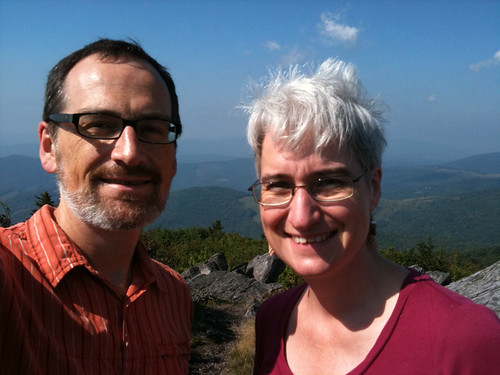
BRR Start
I don't think they're starting the race all the way up here...

The first leg of the race plunges 1,000 vertical feet, 4.2 miles from the visitor center to the park entrance. The lucky runner is Kurt Graves. He won't be so lucky later on when on leg 31 he must climb 1,430 vertical feet in just over 5 miles! After Leg 1, the course winds down quaint country lanes, along gravel roads, up mountains, down the other side, and back up again. After an hour of driving we had completed just 5 legs. This was going to take awhile! We decided to stop for lunch in West Jefferson, NC. In fact, my van, Van #2, could do worse on race day than to have lunch at the same spot.

The next leg, let 6, would be my first. The run is entirely on "Buck Mountain Road" and "Bald Mountain Road." As you might guess, it involves a lot of climbing. It starts with a 200-foot climb, then a steep descent on a gravel road, through Mile 2.5. Mile 2.5 to 4.5 involves 400 feet of climbing, including an 8% grade for the last mile. Yikes! On the official race scale (Easy, Moderate, Hard, Very Hard, Mountain Goat Hard), this counts as "Hard."

The first "Very Hard" leg isn't until Leg 10. Mark Ippolito will run this one, which is 8.2 miles long. It features another 400-foot climb with another 8% grade, but this leg is 8.2 miles long compared to my 5.2-miler, so I guess that's what makes the difference. After finishing our drive-through of this leg, at about 2:15, we did a quick calculation and determined that if we tried to drive all 26 remaining legs, we'd not only be utterly exhausted, we'd miss our 8:15 dinner reservation. We decided to skip Van 1's legs and go straight to the start of leg 16, my next leg. This "easy" 4.2-mile leg includes one 200-foot climb, but otherwise it's mostly downhill. I'll be running it at around 11 p.m. When we arrived at the start of Mark Ippolito's second leg, Leg 20, we realized it was going to be a very windy road, and we were still running short of time, so we skipped ahead again, this time to leg 26. It's a "Moderate" 4.5-mile route with about 374 feet of climbing. The navigation isn't difficult either. I'll be running this one at 5:00 a.m. after attempting to sleep in a church parking lot, so that may be my biggest challenge. The next few legs covered mostly rolling hills and didn't seem too difficult. But it was around 5 p.m. now and we couldn't figure out a way to skip Van 2's legs 31 to 35, so we went ahead and followed them as well.

Kurt's leg 31 is an absolute beast of a run, 6.5 miles long, with a non-stop, 1,430-foot climb for the last 5 miles, a solid 6% grade the entire way. Next Dave Moore takes the bracelet and runs downhill for 9.4 miles, nearly all of it on gravel roads, a 2,000-foot drop at 5-7%. That's tough on tired legs! Then Stephanie has an 800-foot climb with 13% grads for the last mile -- another "Mountain Goat" leg. Dave Fischli's Leg 35 doesn't look much easier to me, with 951 feet of climbing in the first two miles. Finally, he'll hand the bracelet to me and I'll take the captain's privilege of running the final leg. The first mile or so is uphill, then I start a 5-mile descent to Asheville, a drop of 1,276 feet. It's fairly steep in some places, and is considered "Very Hard." I'm hoping my legs won't be so tired that I can't cruise down these hills at top speed. The road changes quickly from a forested hillside into urban streetscape, where hopefully my teammates will be waiting to greet me!

Take-home lessons:

  • This is a fantastically beautiful run. There is drop-dead spectacular scenery through much of the race, and most of it is rarely seen by tourists because it's on little-traveled backroads.
  • Whoever is driving, especially during the early legs of the race, will need a navigator to help with directions. There are tons of twists and turns and missing one could be fatal.
  • Distances are critical. Often the only way we spotted a turn is because we knew it was coming 0.8 miles after the previous one. Fortunately the race directors have put together a fabulous package of instructions for drivers and runners, so as long as you follow their directions you should be fine.
  • The distances are given in distance from the previous turn. But runners should probably also carry cumulative distances. (In other words, if turn 1 is at 0.7 miles and turn 2 follows 0.8 miles later, the runner's instructions should point out that this is 1.5 miles into her/his leg.) This will match the display on their GPS.
  • Even if we screw up and get lost a few times, we'll probably still have a fabulous time. This is going to be a tremendous race.
Details of today's run are below.

Thursday, September 1, 2011

Tempo, Tempo, Tempo, Tempo

Today's workout called for tempo runs of 18, 13.5, 9, and 4.5 minutes, separated by easy runs of 4, 3, and 2 minutes. My tempo pace is around 7:00 per mile, so I knew this would be a tough one. Between the tempo runs, rest intervals, and warm-up/cool-down, it adds up to over 12 miles. Normally I'd carry water and perhaps a couple gels on a run this long, but I didn't want to be burdened, so I set up a route that would bring me past my house after the warm-up and 18-minute tempo.

My left hamstring is still feeling a bit sore, but massaging the hamstring and my calf seems to help a lot, so I felt like I could complete this run okay. My warm-up was downhill and I didn't feel great. When I got to the point where I was supposed to start my first tempo run I was at the bottom of a steep hill: Patrick Johnson Lane, where I was running in the opposite direction yesterday when I fell. That didn't bother me so much as the thought of running a 7-minute pace up a steep hill, so I decided to continue my warm-up run to the top of the hill. Even so, I was winded when I reached the top, and now I'd have to start my 18-minute tempo, on what was actually still a slight incline. I managed a 7:19 pace for the first mile. I was determined to do better on the next mile, even though I'd be heading up the notorious South Street incline, a hundred vertical feet in 2/3 of a mile. I completed the mile, on Main Street, in 7:04. Relieved, I slowed down and was ready to hit "lap" on my timer, when I realized I still had another 4 minutes of tempo-pace running to do. Somehow I found some more gas in the tank and completed another 0.54 miles at a 6:56 pace. Then I slowed down for the easy rest jog home.

My planning wasn't perfect, so instead of a 4-minute cool-down, I got about 7 minutes, plus the time it took to head inside and take a sip of water. I headed back out on the road and warmed up for a block before picking up the pace for my 13.5-minute tempo run. This time, Mile 1 started with a slight uphill, then finished with a nice, long downhill. I had picked some inspiring music to run by and turned up the pace: 6:45. Mile 2 was a slight uphill, but the music kept me going, and I completed it in 6:46.

My 3-minute break took me up a hill and back down, so I wasn't sure how I'd do on the 9-minute tempo that was scheduled next. I was running the first mile at a solid 7-minute pace when, 5:19 in, I found myself back at the bottom of Patrick Johnson lane. I decided to hit the "lap" button right then and charge up the hill, to see what pace I could manage on the hill. It's a short but steep stretch, and I made it to the top in just 1 minute, at an 8:00 pace. I had 2:40 left in my 9-minute tempo, so I decided to see how much time I could make up. As I ran, I monitored my average pace for the lap, within a minute it was down to 7:30. Then it hit 7:20, then 7:15. I only needed to run at tempo pace until the lap time read 3:40, and at 3:20, my pace was 7:10 for the lap. Surely there was no way to get the average pace down to 7:00, was there? I picked a driveway about 50 meters ahead and ran for it at full speed, figuring I'd arrive right at 3:40. I was right, and when I pressed "lap" I was stunned to see that my average pace for the lap was indeed 7:00!

I walked for about 30 seconds to catch my breath, then jogged for another 1:30 before starting on my final 4.5-minute tempo run. I was running downhill, so even though I had barely recovered from the last tempo, I was holding steady at a 6:45 pace. Then I hit a greenway with rolling hills. I only let myself look at the timer every 60 seconds or so, focusing on good form and a consistent stride. I kept up the pace all the way to the end of the run, a 6:45 for my final tempo leg. I let myself walk for 60 seconds, then started back up South Street at my 9:00 "easy" pace, which seemed anything but easy after the workout I had just put in.

I've often found that the cool-down run is the toughest part of these hard workouts, and today was no different. It was all I could do to avoid stopping and walking on the two-mile run home. I did stop for about 20 seconds to say hi to my wife, who was walking in to work, but that doesn't count, does it?

Details of today's workout are below.

Wednesday, August 31, 2011

The good and the bad

The good: A cool preview video of the Richmond Marathon. This really is getting me pumped up!


The bad: I had an easy 12-mile run scheduled today and things really weren't feeling good from the start. I've got a sore hamstring that gets a little worse every day. It's not actually to the level of real pain yet, but I have this sinking feeling that it could be soon. Besides that, I just wasn't feeling right for today's run. The plan was to meet up with the DART group for the usual 6.39-mile run, then run back home the long way, repeating 5 miles of the loop and finishing at my house.

Chad, Chris, Rodney, and Jeff were there, and I knew Chris was going to want to run faster than I would. Fortunately, he ended up running along with Chad and Rodney, and I ran with Jeff, who's an ultrarunner just looking to log some miles. Still, I didn't feel great for the entire run. After we finished the first 6.39, I joined Chad and Jeff for tea. Then Chad and I headed back out again -- Chad was doing 13 more, and I was doing 5 more. About 3 miles in, as we headed down a steep hill on Patrick Johnson Lane, I stumbled over a small swell in the road. I tried to catch my balance, but couldn't, and could feel myself falling, almost in slow motion, face-first towards the pavement.

As I fell, I couldn't help thinking about Washington, the dislocated shoulder, and the pain in my other shoulder, the one I landed on, that still hasn't completely gone away. I consciously tried to avoid landing on any major joints. I ended up with my arms almost in a Superman position, extended in front of my face. The palms of my hands hit the ground first, scraping along for six inches or so until I collapsed onto my left side. I scraped my palms, my left elbow, and somehow, my left buttock was scraped worst of all. But nothing is dislocated, and all my joints appeared to be fully functional.

Chad asked if I was okay, and I was actually okay. Yes, the scrapes stung, but I was going to be fine. In fact, after a couple minutes composing myself, I was able to hop right back to a run with Chad at the same pace we'd been running.

Still, I'm starting to wonder if I have some intractable case of clumsiness. I've never heard of anyone falling as much as I seem to, on pavement. I guess there's not really anything I can do about it other than try to be careful.

Details of today's run are below.

Tuesday, August 30, 2011

A dilemma

My workout plan calls for me to do three 70-mile weeks over the course of an 18-week schedule. That's my peak mileage on this plan, and it's fairly important for me to do high mileage this time around because I think logging the miles is the best way for me to avoid bonking in the late stages of a marathon.

Here's my dilemma: This week is one of those weeks, but my other running plans are intruding on my opportunity to put in the miles. On Saturday, I'm planning to drive up to the Blue Ridge so I can preview the route of the following week's Blue Ridge Relay. I'm our team captain and I've never done this race before. I don't want to get lost in the middle of the night, so knowing the course is important. I'll be spending the night in Asheville so my Sunday run will have to be there. On Monday I'm leading a preview of Davidson's Run For Green half-marathon. Mondays are normally rest days for me.

Without those interruptions, I'd be running 16.4 miles on Sunday, a fairly tough workout calling for 70 minutes worth of marathon-pace running and 10 minutes worth of tempo running. And don't forget I'm running 23 miles in a challenging relay less than a week later.

So if I were to stick perfectly to my running schedule this week, I'd follow a hard Sunday run with a half-marathon, albeit at a fairly relaxed pace. And I'd have to do my hard run in unfamiliar Asheville.

Alternately, I could just put in a few easy miles in Asheville and count Monday's run as part of my 70-mile week. I'd miss out on a hard workout but I'd still be putting the miles in. Then I could move up next week's hard workout (usually done on Thursdays) to Tuesday, so I'll still be fresh for Friday.

I think this second choice will be the plan. I'll miss one tough workout, but I think the challenging race next week will make up for that.

Details of today's workout are below.

Wednesday, August 24, 2011

New PR!

I wasn't trying for a PR this morning; it just sort of happened. On the docket was a 6-mile tempo run, at roughly a 7:30 pace. On Wednesdays we normally have a group run, so I was hoping I'd interest someone in running a little faster than usual. But when I showed up at the CVS after a 1.39 mile warm-up run, only Chad and Chas were there, and they were planning a 12-miler. So I'd be heading out by myself.

I took off at what felt like a good pace, but after a quarter-mile or so I noticed I was running at a 6:45 pace, quite a bit faster than my plan. I eased up a bit and finished Mile 1 in 7:13. I felt good, wasn't even breathing hard, so I decided to try to maintain that pace for Mile 2, which has a moderate hill. It was a cool morning, probably cooler than it's been all summer, and it was still dark at 6:15 or so as I headed up the hill. In the distance, I heard someone yell "Dave!" Could it be Chad and Chas? Had they decided to do a tempo after all? I looked up and down the road but didn't see anyone. "Dave!" the voice shouted again. It was definitely behind me, so I turned around and headed back down the hill. Within a few yards I could see Rodney, running up the hill at breakneck speed. Apparently he had seen Chad and Chas running the other direction and they told him he'd have to run fast to catch me. I turned around and started back up the hill with Rodney, who was breathing quite hard. We ended up finishing Mile 2 in 7:31.

Then about a half mile into Mile 3, Rodney said he'd need to stop for a bathroom break. He said he'd try to catch up to me again, but I shouldn't wait on him. So I kept going, finishing the mile in 7:00, and passing Jeff going the other way. Mile 4, with an uphill finish, went by in 7:09. If I could keep this up for uphill Mile 5, I'd have a pretty good run. About halfway through the mile I passed Todd and Dave running the opposite way and they joked that I was going too fast. Mile 5's split was 7:07 -- I was speeding up!

Mile 6 starts with an uphill as well, and I struggled to maintain that same pace, but as I crested the hill I could feel my legs moving faster. Almost home! I finished Mile 6 in 6:55. I wasn't sure how far I had backtracked to meet Rodney but I figured I had less than a half-mile left at this point. I didn't want to go into an all-out sprint but figured I could at least pick up the pace a little. I finished up what turned out to be the final .46 miles at a 6:38 pace.

That's a 7:07 average pace for 6.46 miles, actually faster than my 10K PR pace. I think I could have run the loop even faster because I wasn't going especially hard for the first few miles. I guess all the warm-weather training this summer helped, and now that things are starting to cool off, I'm hopeful that there will be a lot more PRs.

Details of today's run are below:

Saturday, August 20, 2011

Race Recap: The Springmaid Splash 10K

The Springmaid Splash is not your typical race. For one thing, it's the shortest race I've ever needed to stop and walk in. For another, it involves four knee-deep river crossings. There are half-mile stretches where the trail is completely covered with mud. At 58:30 for a 9:26 average pace, it's the slowest I've ever completed a 10K race.

But given the challenging trail conditions, I'm quite happy with my performance in the race, and most importantly, I had an absolute blast.

The race is held at the Springmaid Mountain Resort, an idyllic little piece of the Blue Ridge Mountains that seems to move at a slower pace than the world around it. I drove up with a group of runners that included Todd Hartung, Chad Randolph, Chris Alexander, Eric Reiner, Emily Hansen, Sarah Keen, and Marisa Wheeler. Despite the early 5:20 a.m. departure and the two-hour drive, everyone was in great spirits and looking forward to the run.

You have to park a half-mile from the starting line, but there was a great system of buses to take us to the start, where we quickly picked up our race materials and checked our bags. There were only six porta-potties for about 500 runners, but fortunately being a guy it was easy for me to pee in the woods before the race started.

We only had time for a quarter-mile warm-up jog to the starting line, in a big grass field mown to about 6 inches long. While this might seem a bit rough, it was actually pretty much the best running surface we'd have all day. After a blessedly short speech with a warning to stay on the trail, we were off.

I had looked up an elevation profile of the course before the race and I knew about the four river crossings, but other than that I had very little idea of what to expect. Most of the runners were doing a 5K, but we all ran together for the first mile or so, so as you might guess it was fairly crowded. After about a quarter-mile, the grassy field narrowed and we were all running along a single-lane gravel road. Every 50 yards or so, there was a giant mud patch the width of the road, and there was little to do but run straight through the ankle-deep goo. A woman wearing a fairly flimsy-looking pair of sandals twisted her ankle and fell to the ground in front of me. I decided there wasn't much point in stopping for her; there seemed to be plenty of race officials around and we weren't much more than a half-mile from the start.

Then we got to the first river crossing. I've forded rivers during hikes, but never in a race, and I wasn't exactly sure how to approach it. Generally when you're hiking, you take a lot of care not to fall down since you don't want the stuff in your pack to get wet. I decided to take a cue from the other runners, who seemed to just plunge in and high-step across. The water reached to about mid-calf and wasn't cold, but it definitely slowed you down. Several runners passed me, but eventually I made it to the other side and resumed running without incident. The second crossing followed shortly thereafter, and was a bit deeper, nearly knee-high. I made it through and tried to maintain a reasonable pace.

A river crossing from the 2007 race

But what exactly was a reasonable pace? For my first mile, on flat but rough terrain, I managed an 8:06 pace. That's slower than my planned marathon pace and much slower than my 10K PR pace of 7:09 per mile. For mile two, we began to head uphill. At first the hill was quite manageable, but gradually it got steeper. I resisted the urge to walk, and kept going as best as I could. Finally we crested the first hill and started heading down again. But I knew from the elevation profile I had seen that a bigger hill was yet to come. Elevation gain for Mile 2: 226 feet. Pace: 9:23.

In Mile 3, it turned out, there were two major hills, a hundred-footer and the first part of a 300-footer. Both of these hills had stretches steeper than anything in Mile 2, and I slowed to a walk for the steepest stretches. As soon as things leveled out a bit, however, I was able to leap back to a run and despite the 276-foot gain in Mile 3, my pace only slowed to 11:16.

Mile 4 started with the last of the big hill, then plunged steeply downward. The trail was heavily rutted and given the sweat dripping down my glasses, it was hard for me to see in places. I did the best I could, but a couple people passed me on this section, including a woman who seemed to be running insanely fast for these conditions. Mile 4 stats: 142 feet up, 279 feet down, 9:27 pace.

Mile 5 had even more climbing, but also more ferocious downhill sections. The speedy downhill woman actually slipped and fell about 20 yards in front of me, then somehow got back up and kept running. Somewhere in this section, Chris Alexander passed me, but I managed to keep him in my sights. He was running up every hill, while I walked the steepest sections and then ran as soon as things leveled off a bit, and this meant he never got too far ahead of me. Mile 5 stats: 153 feet up, 231 down, 9:28 pace.

Finally, Mile 6. It started with a muddy descent back down towards the river. The footing was terrible, but it was worse if you tried to slow down. I was concerned my feet would slide out from under me, so I just ran as fast as I could. Somehow I made it to the bottom of the hill and the third river crossing. I had passed a few guys (including Chris) in this section, but a couple passed me back during the crossing. On the level section after the crossing, I passed one of the guys again. We reached the final crossing and somehow I managed to make it across without getting passed. I saw a couple runners struggling ahead of me, and I still seemed to have gas in the tank, so I passed them, trying to look as strong as possible as I did. Mile 6 stats: 0 feet up, 122 feet down, 8:19 pace.

The last 0.2 miles ended up being .34 according to my Garmin, but they were on fairly good trails or mown grass. I focused on good form and made sure no one passed me as I strode through the finish line. Todd, Eric, and Sarah had already finished and congratulated me soon after I crossed the line. Chris was only about 30 seconds behind me, and Chad followed shortly after that. Emily followed soon after, and Melissa, who had run the 5K, was already done.

My time was good for 72nd place out of roughly 200 10Kers (the official results haven't been posted yet). Generally I do better relative to the field, but I think the challenging nature of this course scared away less-die-hard runners, so this was a very tough field of runners. As an indication of how tough the field was, Sarah was the only runner in our group to get an age-group award. Great job, Sarah! Here's the whole group of us post-race:

Left to right: Sarah, Marisa, Emily, Chad, Me, Eric, Todd, and Chris
All in all, this race was a lot of fun. The trail was always challenging, but always runnable (or walkable as the case may be). I'd definitely run it again.

GPS plot of the race is below.

Thursday, August 18, 2011

Running "naked"

For the past two days I've been in Atlanta, while my GPS watch was back home in Davidson, NC. But I was supposed to run nine-plus miles each day in Atlanta. Oops.

I didn't even have a digital watch to time the runs with, just an analog watch that fortunately had a second hand.

On Wednesday, I had an "easy" 9-mile run on the docket, so I mapped out a course on Gmaps-Pedometer and ran it. But since I didn't know where one mile ended and the next one began, I had to pace myself based on feel. I started the run and took a look at my watch: 7:15 AM. If I ran at my planned 9-minute pace, I should be finished 81 minutes later, at 8:36 AM. As it turned out, I finished at 8:30, which meant that my actual pace was about 8:23 per mile, just a touch faster than planned. Oh well!

Then today I had intervals on the docket: 8 X 1,000 meters at a 6:27/mile pace. A friend pointed out to me that Atlanta's Piedmont Park has a handy website with distances for popular running routes. The "active oval loop" was 0.7 miles, which is 1,126 meters. Close enough for me. A little math convinced me that a 6:27 pace is equal to 4:30 over 0.7 miles. I could time that on my watch, right?

I arrived at the park and saw that the active oval was on roads that had quite a few cars on them. I decided to modify my plan and use the gravel track around the fields, a .52-mile route. Completing this in 3:15 should be the equivalent pace, just for 800 meters rather than 1,000. But halfway through the loop I saw a bigger problem. A television crew was filming a commercial on the far end of the track, and I'd not only be running right through their shot, the crowd of extras and crew was so vast that running was impossible. Amazingly, I finished this first loop in 3:15 anyways, but I decided to move back to the street for the remaining 7 intervals.

As it turned out, all the vehicles belonged to the TV crew, and they were being quite courteous to all the joggers/bikers/dog-walkers in the park. I ran the first interval pretty hard but based on my analog watch's second hand, I was still too slow: 4:50. Maybe the website was off on the length of the loop? Or maybe I was just slow.

Somehow I did manage to improve my time over the succeeding intervals. I don't remember each time, but I know I gradually got better, with times ranging from 4:45 to 4:37. For the last interval, I gave it an extra push and finished at 4:29. Of course, I was completely exhausted and drenched with sweat. Then I went back to my hotel room and painstakingly traced the route on Gmaps Pedometer. Ha! It wasn't .70 miles, it was .7185 miles.

That means my paces were as follows:

4:50 -- 6:43/mile
4:45 -- 6:36/mile
4:37 -- 6:25/mile
4:29 -- 6:14/mile

Since most of the intervals were in that 4:45 to 4:37 range, I was actually right on target. Not bad!

I definitely felt a little bit like I was naked without my GPS trainer for the run, but I'm pleased that I managed to adapt. I've actually had the trainer for less than a year, so it was really just a matter of jogging my memory of how I was doing things before. The GPS is a convenience, but if you don't have it, it doesn't mean you can't train effectively.