Tuesday, November 24, 2020

Race Report: The Brolympus / Sonic / DART Virtual Ironpalooza

 Three weeks ago, I had to cut my 16-mile run down to 10 miles due to excruciating pain from Morton's Neuroma (a nerve irritation between the 3rd and 4th toes. WAY more painful than it sounds!). Two weeks ago, during my last "Superbrick" workout (a long run following a long ride), the pain was starting to get to me in the first MILE of my 90-minute run. Somehow I hobbled my way through and finished that workout, but I decided to take my podiatrist up on his offer to give me a cortisone shot a week before my virtual Ironman race. A week ago, I was in his office getting shot up for the second time in less than a month. On Sunday, despite not having run more than 14 miles since May, and no more than 16.5 in one push since January, I somehow managed to complete 26.2 miles after swimming and biking and became an Ironman! Well, sort of.

Crossing the "finish line" (from Dawn's video)

An Ironman is 140.6 miles of swim, bike, and run. But Ironman competitors are picky about who or what they call an "Ironman." Some folks don't consider it an Ironman if it is not an Ironman® brand race. Some won't even call an Ironman-brand finisher an "Ironman" if they happened to be in a race that was shortened due to logistical / weather issues. I was registered for Ironman Arizona but leery about traveling across the country during Covid times -- especially since social distancing meant that I would have limited support from friends and family (not to mention the official race organizers) during the race. In the end the race was cancelled just 10 days before it was scheduled to occur. So instead I asked my run, bike, and swim buddies at home in Davidson, NC to support me in my own personal virtual Ironman. I'd swim in Lake Davidson, bike in loops around Davidson, and run up and down the main road out of town and along a greenway in Davidson. Even though it may not technically be an "Ironman," I was amazed at how my friends came through for me.

I was careful about one thing: To make sure that each event in the Ironman covered at least the regulation distances: 2.4 miles (or 4,224 yards) for the swim, 112 miles for the ride, and 26.219 miles for the run. I also did not stop the clock at any point, just like in a real race. Transitions, potty breaks, traffic lights, and mechanical issues would be included in the total time. 

I started the swim at 6 am on a 46-degree morning. Since morning temps can drop well below freezing here this time of year, I was glad that it wasn't too cold. The water was probably around 60 degrees (my usual lake temperature reference web site has been on the blink lately so I don't know the exact temp). It was cold enough that I decided to go with a neoprene swim cap instead of the usual thin silicone one. I had tried it just once when the water temps were in the upper 60s and it was too warm, so I was hoping I wouldn't get overheated.

My buddy Tristan would accompany me in his kayak, and we were joined by Tristan's partner Noa, and another run buddy, Chad. We were quite a spectacle cruising across the lake in the morning darkness. Tristan's boat was festooned with lights, and Chad and Noa sported bright headlamps, so I had excellent guidance in the dark. 

Tristan and Noa with Chad in the background. I might be there somewhere but I have no light

Since GPS watches are rather unreliable in the water, I had Tristan carry mine on his boat. We charted a course straight north from the beach outside his condo; I would rely on Tristan to tell me when to turn around at the halfway point. I was hoping to swim at about a 2:30/100 yard pace, which would have me finishing in an hour and 45 minutes. I had swum this course three times before, so I knew what landmarks were at which points along the way, but it was still disconcerting to not know my time and pace. I stopped Tristan a few times to find out how far and fast I had swum. I seemed roughly on track at the turnaround point -- 53 minutes -- but I knew I would probably slow down a bit on the way back. It was a lovely morning with a gorgeous sunrise, which Tristan captured in this awesome photo:

The water was this smooth for the entire swim

As we approached the beach, Tristan asked if I wanted him to let me know when I had hit the exact distance. I could then stop and run along the waterfront to the spot where I had left my sandals. That seemed like a good idea, and we stopped about 30 yards short of my starting point. Swim time: 1:54:12 -- a little slower than I hoped but not bad. The shoreline was uneven here, so I tripped and fell back in the water, losing my goggles. "Leave the goggles," Tristan shouted. "We'll find them later!" I seriously doubted we would, but I figured a $5 pair of goggles was a small loss for a day I had already invested an unmentionable amount of money in. I finally made my way to my sandals, which I struggled to put on for the 50-yard run to my bike. I didn't want to step on a rock or something and aggravate my Morton's Neuroma before I even started the real run, but I probably wasted a couple minutes in this effort. Finally I got to my bike and was able to change in the Adventure Van, which was not Tristan's van but which he had in his condo parking lot (long story).

I stripped naked, lubed up, and put on my cycling gear, then headed outside to pee before getting on the bike. My swim-and-bike buddy, Finnin, would be accompanying me for the first half of the ride. Long-time run and swim buddy Hope was there to collect all my gear and drive my car to the town green, where she and run buddy Dawn would set up the aid station for the bike and run. Transition time: 14 minutes. 

A good ride is the key to a good Ironman. Most decent swimmers can complete the swim relatively easily (I'm a slow swimmer but still didn't have much trouble with it), and you can walk giant chunks of the run and still finish before the cutoff time -- as long as you finish the ride in a reasonable amount of time. 112 miles on a bike is a serious chunk of distance, and there are lots of ways to mess it up. You can ride too hard and have nothing left for the run. You can go too slow and take too many breaks. You can crash, or have mechanical issues. You can neglect your nutrition and have nothing left for the end of the race. Your bike can be improperly fitted, or too aggressive in its setup, making the ride painful and setting yourself up for failure. 

I have a pretty aggressive setup on my triathlon bike. I bought it for sheer speed and aerodynamics as I tried to get faster on shorter events where these things matter more than comfort. But it was also designed to go the distance in a full Ironman, so I had trained myself to get used to the aggressive riding position, gradually gaining the ability to ride 100+ miles in the awkward aero position. 

On my bike during a much shorter time trial (Photo: Dustin)

My plan was to try to average about a 19.5 mph pace, using a power meter to monitor my efforts. Over 200 watts was definitely not going to be sustainable on a ride this long, so I watched and dialed it back when I started pushing too hard. However, on my training rides I always stopped the timer for traffic lights and breaks. This time the clock would keep running, so I wasn't sure I would be able to maintain that pace when all the little stops were averaged in. The course was four loops of about 27 miles each (the first was a little longer to make sure I had the required 112 miles). I also needed to consume about 36 ounces of Gatorade and a Clif Bar during each loop to make sure I had enough left in the tank for the run. 

Finnin and I kept it close to the 19.5 mph pace for the first lap. But then we had to stop at the aid station to restock with Gatorade. I also needed to unwrap a Clif Bar and start eating it because I knew I couldn't do that while riding. When we got going again, our average speed was down to 19.2. Then we had bad luck with traffic lights and slowed a bit more. About 10 miles into the second loop, Finnin says "Dave, I hate to say this but I really need to pee!" After 48 ounces of Gatorade, I needed to go too. I had scouted the bike route for this purpose but there really weren't many places to stop that were out of public view. I had gotten permission to use the bathroom at Davidson College Presbyterian Church, but that was 17 miles away, near the aid station. But I did remember a spot about 4 miles ahead along an industrial section of road where peeing in the trees probably wouldn't offend anyone's sensibilities. We arrived at the spot and it was surrounded by deep mud. Somehow we found a place to lay down our bikes and rushed into the trees to get some relief. Now our average speed was down to 18.8 mph. I had a sinking feeling I wasn't going to be able to build that back above 19 mph for the rest of the ride.

A few miles later I started work consuming my second bottle of Gatorade for the loop. Only it wasn't Gatorade, it was water! I was the one who packed the bottles, so it was my fault, but I wanted to make sure the mistake wasn't repeated. "Finnin, do you have a phone on you? Can you call Dawn at the aid station and make sure we get two bottles of Gatorade?" He did, but he had to stop to get it out of a Ziplock baggie, so he told me to go on alone to the aid station. He knew he wouldn't be able to catch up to me after a stop. At the aid station, Nicole was planning on joining me as ride buddy, and Finnin would be finished anyways. I soldiered on to the aid station where Nicole joined me.

Dawn (who was there ALL DAY) resupplying while Nicole joins for Laps 3 and 4

Finnin, Dawn, and Kathy at the aid station after his ride was done

I was slowing down a bit but managed to keep the average pace around 18.8 for the ride. After a couple of technical issues (fortunately easily resolved) and witnessing a near-collision between two cars, Nicole and I completed lap 3. Only one lap to go, and two more riders -- Shawn and Morgan -- would be joining us. At this point, after over 100 ounces of Gatorade / water, I really needed to pee again, so I headed up the steps to the church next to the aid station. The church pastor, Peter Henry, was waiting for me at the door. "No need to mask up; there's no one in there!" he said. He had waited after the virtual service ended just to let me in! We headed off for the last lap, our average speed down to 18.5 mph after the bathroom break. While my body was starting to break down a bit, I was cheered by our new companions. Shawn got an awesome group selfie during the ride (per Ironman rules, I did not draft behind Shawn -- notice he is off to the side, not in front of me!).
Whee!

I counted down as the mileage got closer to 112. We cheered when we passed Mile 100! Then we were 5 miles away, just one big climb left. Then we were done! Bike time, 6:03:49; pace, 18.51 mph. We were just a tad over 112 miles at 112.51. Megan snapped a great photo as we arrived at the tent, and my coach Jen had the perfect comment!
Yep.

There was a great crowd of people waiting for us and cheering us in. Amber had set up a little privacy tent for me to change in, so I headed inside and stripped off my bike kit and struggled into my running gear. I needed to wear toe socks to stem the Morton's Neuroma, so it definitely took a bit longer than it would have otherwise. Transition time: 10 minutes. Just a little marathon to go.

7 people joined for the first loop: Chas, Ian, Cessy, Megan, Carl, Amber, and Jeff. Then later on the loop Lori hopped in, and David followed on his bike. 

So far, so good!

The plan was to maintain a 10:18 pace as long as possible, including a built-in 1-minute walk break for each mile. If I could sustain that for the whole marathon, I'd finish it in 4.5 hours. If I slowed a bit, I might still squeak in under 5 hours, both very respectable marathon times for an Ironman. This whole section of the race was in the town of Davidson, and people were out on their porches cheering us on, and honking as they drove by. It was like one big town party, except for the part about me struggling to keep pace and keep my gimpy foot from lashing out in excruciating pain!

I held on to the pace for the entire first loop, stopping at the aid station for a super-refreshing cup of Coke and grabbing some Golden Oreos to munch as I started on Lap 2. After one bite of the Oreos I realized that was a bad idea. Fortunately Chas, who planned on pacing me for the entire run, was happy to take the extras and toss them in the next trash can along the route. Carl and Chas stayed with me on Lap 2, and we were joined by Robert and Joey, with Ben hopping in for a bit as well. I eventually abandoned my 1-minute-per-mile walking plan and started to walk on nearly every uphill, as well as some downhills. 4.5 hours wasn't going to happen; at this point it was just about managing my effort and my pain. It started to drizzle a bit, and it was also getting dark. We passed the halfway mark with a cheer, then headed back up the hill into town. Robert dropped back to make a phone call, and we all wondered what that was about, but we soon found out. He was calling a friend and band-mate who lived along the route. The guy was on his front porch rocking out the guitar solo from "Ironman" by Black Sabbath. It was an awesome moment!
A not-so-awesome picture of the awesome moment, taken from Carl's video. You had to be there!

About 20 yards after passing the Ironman house, I stumbled over a small lump in the sidewalk. Normally this would be a non-issue, but we were now over 15 miles into a run after 114 miles of biking and swimming, and I took a couple of awkward steps before collapsing to the ground. I managed to fall partially onto someone's lawn but I scraped up my hand and my knee, and landed awkwardly on my other hand, which bruised my rib cage. The whole procession halted, and Chas encouraged me to get up slowly and try walking for a bit. I walked for maybe 10 yards but the adrenaline from the fall made me feel strong, so I started running, much to everyone's amazement, including mine. Soon we were back at the aid station, where I donned a headlamp, gulped down another Coke and took one for the road.

For this loop, Chas and Joey continued on with me, and we were joined by Shawn and Chad (both coming back for more after helping earlier on), and Natalie (who took all the uncredited photos in this post!). My running pace had slowed, but I was inspired by this being my last loop. Just 8.75 miles to go! I knew my friends were posting photos and updates on Facebook, but I wondered if my wife Greta knew where we were. She was planning on being there for the finish. "Does anyone have a phone on them?" I asked. Natalie offered hers, and she texted Greta for me, giving an incredibly optimistic estimate of our finishing time. After 3 miles (Mile 20!), I choked down my 5th gel of the run. They were beginning to be difficult to stomach. Natalie said she had some GU chews, and I said I might try those for my next fuel stop, in 3 miles. After another 3 miles, the chews did the trick, and we headed up the last big hill, 3 miles to go!
Power-walking the Irma Grind

I found that I didn't need to walk as much as I had during Lap 2. I was able to run longer between walk breaks. We were SOOO close! A mile from town, Natalie's husband and three kids were on the side of the road cheering "GO DAVE!" With 3/4 of a mile to go, some neighbor kids I've never even met had chalked "DAVE, YOU ARE AN IRONMAN" on the sidewalk. As we approached the finish, Chas reminded me that an actual marathon is 26.219 miles, not just 26.2. And since GPS results are sometimes rounded down, I should run 26.23 miles before stopping my watch, just to be sure. At this point, Thomas had run out from the aid station to meet us and check if anything was wrong. We sent him ahead to let them know we were on our way. Chas figured I would need to do an extra lap around the town green to be sure of the mileage, so Thomas told everyone I wouldn't be quite done when we arrived. 

Finally we were at the green, and dozens of people were cheering in the night! I did my extra lap around the green and my watch still said just 26.19 miles. There was chaos as the cheering group had set up a tape for me to run through! I turned back out the way I had arrived to add on the extra 0.04 miles, then reversed course, and plunged through the tape as my watch clicked over to 26.23. Nicole summoned a deep-throated voice to yell "DAVE, YOU ARE AN IRONMAN!"

Breaking the tape - from Thomas' video

Then I saw my Greta, who gave me a huge hug despite the fact that I was a sweaty, stinky mess. It was a great moment, and Dawn got a great picture of us:
This makes it all worth it!

I had finished, and I was surprised to find that I could still stand up! I had a big cup of Coke, and another. People kept asking if I wanted a beer or a slice of pizza but Coke was the only thing that seemed remotely palatable. Finally I collapsed in a chair. I was done! The run ended up taking 5:06:24, the slowest I've ever completed a road marathon -- and I was fine with that. Overall, my time was 13:16:38. The official cutoff for most Ironman races is 17 hours, so I had plenty of time to spare.

People have asked me if there is somewhere I can submit my result to make it "official." The folks at Ironman Arizona haven't provided a way to do that, but honestly, I really don't care. I had an amazing experience, with the support of an incredible set of friends, and I wouldn't trade that for anything. 

I did figure out that the actual total mileage I swam, biked, and ran was 141.16 miles -- a little longer than the official distance of 140.6. I think I might get a custom "141.16" sticker for my car, and then people can wonder what that is all about.

Click below for the Strava records of my race:

Monday, August 31, 2020

My first century of the century!

Prior to Friday, I had done two century rides in my lifetime -- both back in the 1980s during high school and college. Now that I'm training for a full Ironman, I will need to do several more, culminating in the 112-mile ride during the event itself. Since the race (Ironman Arizona) isn't until November (and it will likely end up being a virtual event), I wanted to give myself a challenge for my first century ride of the cycle. So I picked the course of the Blue Ridge Brutal, a race that happens every year about this time (in non-covid years anyways).

As the name suggests, it is a brutal event, with a total ascent over 7,000 feet in the Blue Ridge Mountains. Here's the elevation profile of the ride:


You'll also notice that the biggest climbs are mostly at the end of the ride, which makes for an extra challenge. Somehow I managed convince my friend Chris to do the entire ride with me, and we started in West Jefferson, NC at 8 am.


It was easy going for the first 8 miles or so, and even the first climb didn't seem so bad. Then we hit our first really major climb around Mile 15. This climb sent us up, up, up onto the Blue Ridge Parkway, where we would be riding for the next 20 miles. We huffed and puffed our way up this climb and agreed to stop when we reached the summit, just past Mile 17. I wanted to remember to keep up with my chosen nutrition source -- Clif Bars chased with Gatorade Endurance, so my plan was to stop every 15 miles or so to make sure I ate some solid food. I also took a selfie with the Blue Ridge Mountains in the background.


It was a slightly hazy day, about 70 degrees, which is quite cool for North Carolina in August. The temps were forecast to rise only to about 79, with a 40 percent chance of rain. Just about as perfect as you can get this time of year! The next section of the Blue Ridge Parkway was glorious, with long, fast downhills and relatively short climbs. Traffic was much lighter than we expected as well. Since we were self-supported, I had searched the route to make sure we could stop to buy supplies along the way -- especially WATER! The first stop was planned for Mile 37, but it was about a mile off our course, so when we spotted a store right on the Parkway at Mile 25, we took the opportunity to stop there instead. I knew there was another store at Mile 45, and if we filled up here we could easily make it to Mile 45 without an extra side trip.


That's Chris's bike on the left, with my ride behind. After our stop, we continued along the Parkway for another 10 miles or so, with stunning views on both sides. We had some fantastic descents and enjoyed very light traffic, so it was a bit of a disappointment when we had to leave the Parkway and return to the Real World with its tractor trailers and annoying dudes in pickup trucks. When we arrived at the gas station / store at Mile 45, we were ready for a break! 

I bought a gallon of water and a Kit Kat bar, and Chris and I filled our bottles, with only maybe a liter to spare in the jug. We chatted with a local who asked where we were going, and when we explained the route he said "you are better men than I am!" 

"We haven't done it yet," Chris noted in response! 

"You'll make it," he called to us as we rode off.

If you look at the elevation profile, you'll see that there are several "small" climbs of 2-300 feet in the section from Mile 40 to Mile 70, and while none of these took too much effort, added together they took a significant toll. At Mile 70 we would arrive in the town of Jefferson, very near our starting point in West Jefferson. But of course we couldn't just stop -- we needed to continue for an additional 32 miles! That said, I had found a coffee shop online in Jefferson and was looking forward to an iced coffee to propel me on to the finish of the ride. It was just a couple blocks off the official route, so we headed down the main road in town to find it. Unfortunately, when we arrived, the shop had closed down! We had to settle for the local drug store, where we bought more water and some cheese and peanut butter crackers. The crackers really hit the spot, and soon we were ready to make our final push to the finish. 

After a somewhat-annoying busy road out of Jefferson, we finally turned onto a less-traveled road and were able to ride comfortably and enjoy the local scenery. This fellow (and his tractor) have probably seen better days, though! 


Gradually the grade increased and we headed up the biggest climb of the ride. The road got steeper and steeper, and then it started to rain! Somewhere around here the Garmin route that I had downloaded from the Blue Ridge Brutal site started to fail me, so we reverted to Plan B, which was a route loaded onto Chris's phone using the Ride With GPS app. The phone would tell us when to turn, and it worked pretty well as long as it wasn't too noisy when you needed to hear the directions! As we headed up the hill, Chris started to have mechanical issues with his bike. His derailleur would skip when he was in the lowest gear -- just in time for the steepest gradient of the course. My Garmin has a "gradient" field and I could see we were hitting 14 and 15 percent. I couldn't imagine trying to ride that hill in second gear -- I was getting out of the saddle in my granny gear! Finally I made it to the top as the rain began to pour harder. Chris arrived a couple minutes after me, having had to walk the steepest section of the hill. 

We took a moment to refuel, then began the descent as the rain really started coming down hard. My bike has rim brakes, so I feathered them often to try to dry them off. If this hill was dry, we probably would have hit 40+ MPH on  it, but in these conditions we didn't feel comfortable going much faster than 20. The rain was coming down so hard that it smacked painfully on my cheeks. With the noise of the bikes, we couldn't hear Chris's phone directions, so we began to worry that we might miss a turn. Then I remembered my third backup route-finding plan, a printed cue-sheet with mileage. My Garmin was still accurately recording mileage even though the route-finding was off, so we stopped and figured out where our next turn was on the cue sheet. Here's what the sheet looked like after the ride -- it was soaked even through a ziploc bag! This is a reminder for everyone to make sure you laser-print a cue sheet. An inkjet printout would have been completely illegible if it had gotten this wet!


The rain continued, harder and harder, as we headed up yet another huge hill. We rode through yellow patches of runoff from gravel driveways, through puddles, rain completely soaking us. At one point it was raining so hard that we were riding up a river, an inch or more of water flowing down the road at us. I tried to imagine that I was riding faster by focusing on my speed compared to the water rather than the pavement. Chris saw it the opposite way, as if the river was pushing him backwards instead of forwards. Finally we crested this hill and headed down again. Only one more big hill and then we would be finished! 

At Mile 88 we began the final major climb, 750 feet of vertical. The rain had subsided a bit but we were still getting drenched. Fortunately it wasn't quite as steep as we had feared, and two miles later we were at the summit. From here it was rolling-to-downhill, all the way to the finish. We turned onto a familiar road -- the same road we had started on! Only a mile to go! Unfortunately it was an uphill mile, but knowing we were nearly done fueled us, and finally we turned into the parking lot where the car was waiting. 

I was pleased to see I had remembered to pack some icewater to drink at the finish. I swilled down a liter in just a minute or two. Here's the obligatory photo at the finish, looking somewhat worse for the wear:


30 minutes later we were enjoying burgers and beer at a local brewery! Having finished my first century in over 30 years, I felt like they were well-earned!

Monday, December 16, 2019

Race Recap: The Kiawah Island Half Marathon, take 3

Regular readers of this blog (are there any regular readers of this blog?) will recall that I've been trying to qualify for the New York Marathon for over 8 years. Yes, you can get into the NY Marathon via lottery as well, but since I've gotten REALLY close to qualifying three times, it's now a quest for me. I don't want to run NY unless I qualify.

This time around, I changed up my training strategy and focused on high mileage to the exclusion of nearly everything else. During the 8 weeks prior to the my taper, I averaged 62 miles per week. I peaked out at 75 miles in a week. That's just over two miles short of a half marathon, EVERY DAY. So running a half shouldn't be too hard, right? In the month of November, I ran 294 miles, my biggest month ever.

Fast forward to December 14, the day of the Kiawah Island Marathon. I needed a sub-1:32 half to attain my goal. That's a 7:01/mile pace. The plan was to run 7:05s for the first two miles, then get as close as possible to 7:00/mile through Mile 11, then pick up the pace at the end if I had anything left.

Lots of friends were running this race, including Mike and Dawn, who had both just run the Philadelphia Marathon and crushed it, Mike using a similar training plan to me. Mike said if he had anything left in his legs, he would try to pace me for the first 5 or 6 miles, but he didn't think he could maintain a 7:00 pace the whole distance. Dawn said she'd be behind Mike for sure.

As the race started, Mike was nowhere near me, so I looked for other runners to follow who were running a similar pace. Unfortunately I didn't manage to lock in to anyone running a consistent pace. Or maybe I wasn't consistent. There was a familiar group in my general area, but no one who I felt like I could just get behind and just run without thinking.

Still, my paces for the first miles were pretty solid, and the running felt pretty comfortable. The temperature was in the lower 50s and the road was wet from overnight rains, so the only real issue was a slight lack of traction in my two-year-old Nike Vaporfly 4% shoes -- the ones Kipchoge used for his first (failed) attempt to run a sub-2-hour marathon. 

Miles 1 and 2: 6:53, 7:00. A little faster than planned but not terrible.

Miles 3 and 4: 6:56, 6:59. Still a little too fast but I was running comfortably, so no big deal

Miles 5 and 6: 7:03, 7:08. Starting to slow down a bit, but no big deal, especially since I had banked a little time. Now all I needed to do was keep a consistent pace to the end.

Then about a quarter mile in to Mile 7, I looked down at my watch and saw I was running a 7:58 pace. What? It didn't feel like I'd slowed down. I picked up the pace, just trying to get into a rhythm again. A minute later I looked down again. 7:35. Still too slow! Argh! I gave everything I had and looked down again a minute later. 7:25. Push it, Munger! Somehow all I could manage was a 7:21 for the mile. Maybe I could pick it up again in Mile 8. 

A quarter mile into Mile 8 I peeked at my watch again and for the first time saw a pace that started with "8". Really? This is my "easy" training pace. Runners were starting to pass me. I really was going that slow. I simply couldn't will my legs to work faster. By the end of the mile I was able, barely, to get my pace back down into the 7s, with a pathetic 7:39. 5 miles to go.

Mile 9 is my least-favorite mile of the race, when the course follows a dirt access road to the beach, then passes in front of a luxury hotel for about 200 yards, and takes another dirt access road back to the pavement. This is the only part of the race where you get to see the beach at all, which, I suppose, is why they do it. None of the roads are on beachfront -- why put a road where you can build a $6 million home? The rest of the course is on lovely oak-lined streets, but not on beachfront. For me, the quick view of the beach isn't worth it slogging up a muddy road during a race. If you want to see the beach, take a walk on it before or after the race. Anyways, in front of the hotel there's an announcer who calls out your name and hometown. A few seconds after I passed the announcer I heard "Dawn from Davidson North Carolina." Uh-oh. Dawn was supposed to be way behind me! In no time, Mike and Dawn both passed me, urging me to join them. But I had nothing, and I had to let them run ahead without me. Mile 9 was my first mile in the 8s, 8:00.

After that things just went from bad to worse.

Mile 10 and 11: 8:03, 8:12. Ugh.

Mile 12: 8:21. Maybe I'd be able to pick it up for the final mile.

I did pick it up, but only barely, with an 8:17. I couldn't even muster a sprint up the finish chute, and several runners passed me on the way to the line. I plodded through, stopping my watch at 1:38:30. Officially my time was 1:38:27, worse than I had done in this race two years ago on a warm, muggy morning. Today the weather had been fine and I still hadn't managed a decent race. 

I can't really say why I wasn't able to perform. My training had gone well, I think I tapered sufficiently, and I had no injuries. Sometimes you just have a bad day. It was a very different training protocol from what I'd used in the past and maybe it's just not the right type of training for me. Next year I'm going to take a break from my pursuit of a NY qualifying time and focus on duathlon and triathlon, with the year culminating (if all goes well) in my first Ironman in November. Stay tuned!

Below is my Strava summary of the race.

Tuesday, August 6, 2019

The Four Pass Loop

Note to self: When planning to do a 27-mile trail run in Colorado, at elevations mostly above 10,000, you probably want to do a little more training than running trails once a week at basically sea-level.

That said, I'm in Colorado for two weeks this summer, and I was determined to do an epic trail run. A friend had done the Four Pass Loop near Aspen a couple years ago. I was going to be near Aspen! Why not try that? The Four Pass Loop is pretty much what it sounds like -- a run (or, for sane people, a hike) of 27 miles circumnavigating the Maroon Bells while crossing four passes, each over 12,000 feet. This map of the route from The Hiking Project makes it seem quite reasonable:


The hills are barely noticeable! Until you realize the elevation starts at zero. You're over 10,000 feet for nearly the entire route. Here's an elevation profile that gives a better sense of what you're up against:


That's from my Strava record of the loop. The hills are steep, and they get steeper as you get closer to the top.

I was warned about Colorado afternoon thundershowers (and I'd experienced a few of them in my 6 days in Colorado prior to my trip), so I started early: 4:51 a.m. to be exact. If I completed the loop in 10 hours, I should be well ahead of any storms. As it turned out, that would be a very big "if"!

Things started out pretty well and I made good time on my way to the first of four passes, Buckskin pass. It was topped with a massive cornice and I took a detour to make my way around it.

Beautiful views abounded
Atop Buckskin Pass - the first of four 12000+ passes
Now it was down a steep but manageable trail before starting the climb to the next pass. Even this early in the run, the passes were starting to blur together in my mind...what was this one called? I had to look it up just now to report that it was "Trail Rider." On the way up to Trail Rider, I passed a huge, reflecting lake -- Snowmass Lake.

Postcard-perfect reflection on Snowmass Lake
It was a bit more of a grind to make it up to the pass, probably mostly owing to my not being properly trained / acclimatized for this adventure. I ate an Uncrustable while chatting with the 20-somethings on the summit. When I explained my plan, a woman asked how old I was. When I told her I was 52, she said "you are a BADASS!" I didn't feel very badass at the moment -- especially since I was still only 10 miles in to my 27-mile day. A lot can happen in Miles 10-27. And it did.

Obligatory selfie near Pass #2
The descent from Trail Rider was seemingly never-ending. I was maybe halfway down and hikers on the way up were asking if they were almost there. Uh, no. Finally I made it to the bottom and forced myself to run on the runnable sections of the trail, which were much more common here at the valley bottom. This would be pretty much the last running I did on the loop.

I was running along a fairly big creek at the valley bottom and figured eventually I'd have to cross it. Soon I was knee-deep in water. Not a terrible ford, but I knew this meant I'd be starting to climb again soon. Sure enough, the trail began winding up into the forest. I'd checked my elevation at the river -- about 10,100 feet -- which meant I'd have over a 2,000-foot climb to pass #3. At least along the way there was some spectacular scenery:

Massive waterfall at Mile 13.5 -- a nice sign that I was halfway through the loop!
Stunning vistas -- and foreboding clouds
After I passed the waterfall I came to an avalanche-damaged area. Here the snow had broken trees like toothpicks and compacted to rock-hard. The trail was nowhere to be seen. Fortunately there were some footprints and broken branches to guide my way, and eventually I found the track. I passed through another avalanche area, and then some steep snowfields. Fortunately footprints were cut into the snow and I could make my way past. Then it was up, up, up through meadows with dense foliage. I scanned the ridge ahead of me but could neither spot a pass nor figure out the trail crossed it. Eventually as I got closer to the top, I saw some hikers above making their way around a snowfield. I slowly made my way up the steep slope, cutting switchbacks on occasion to avoid snowfields, making my path even steeper. I had to stop a few times just to catch my breath. Finally I was at the top of Frigid Air Pass, 12,400 feet up. It wasn't so much a pass as just the spot where the trail crossed the ridge. Some hikers there assured me that my descent would be steep as well. Great.

Pass #3!
I knew I would need to stop for water between Frigid Air and Maroon West pass, so as I descended I looked for a good stream. I found one after about a mile and sat down to pump water. I was hungry but none of my food sounded good. I was also getting bitten by mosquitos. And was that thunder I heard in the distance? I decided to force down an Uncrustable as I started hiking again. My stomach didn't appreciate it, but at least I had fresh, cold spring water to wash it down. The trail "only" descended 1,000 feet between Pass #3 and 4, which meant I would have one last climb, 1,000 feet, and then I'd be finished with climbing for the day. As the thunder grew nearer and I began my final ascent, I checked my mileage on the watch. 19.7 miles, 7.3 to go. Assuming the watch was accurate.

As with all the climbs, the hike up West Maroon Pass grew steeper and steeper as I neared the top. I found myself stopping for breath twice every switchback. Running was a distant memory; I would have to hike this one out. I did some calculations and figured out that if I could average 30 minutes / mile I would finish in 13.5 hours, just before 6:30 pm. At least it would still be light!

The rain started to fall during my final approach to West Maroon. I was wearing a short-sleeve shirt and had a water-resistant jacket and gloves in my pack. I decided not to stop to put on the jacket until I started getting cold. If it rained hard, it would soak through the jacket anyways, so I didn't need to worry about getting wet; the jacket would just be for warmth. My rest breaks got closer and closer together. It felt like I was just inching my way towards the summit. I could see people lingering at the top. I wondered why they would hang out there when thunderstorms were approaching.

Finally, I crested West Maroon Pass. I had kept telling myself I'd be "sofa king glad" when I got there, and now I was finally there. I barely stopped to check the view, only allowing myself 30 seconds to take the final selfie of the trip.

The one and only Sofa King atop Pass #4!
The rainfall gradually increased in intensity as I made my way down the trail. A boy and his mom were hiking down ahead of me and didn't seem to know they should let me pass, so I decided to take the time to throw on my jacket. I caught up with them as they reached a steep snowfield. I could tell they were going to be a train wreck heading down the precipitous slope, so I cut down a rocky slope next to the snowfield and was finally able to pass them.

I had chosen to do the hike counter-clockwise because the trail down from West Maroon wasn't as steep as it was on the way down from Buckskin. While this was true, the trail was very rocky and overgrown with bushes. And the rain fell harder and harder. I approached a raging creek and hoped I wouldn't have to ford it. No luck. I plunged across the icy rapids, using my poles to steady myself. The current was so strong that the poles were vibrating from the force of the water. I sank in above my knees on the uneven creek-bottom, and leaned into the current to stay upright. The water wasn't quite icy cold, but it still chilled my skin quickly. I pushed through and hoped I wouldn't have to cross that creek again! Nothing to do but keep going. I felt hungry but nothing sounded good to eat. Plus I'd have to stop to get food out of my pack, and then I'd be even colder. I looked at my watch -- 22 miles down, 5 to go. Assuming my watch was accurate.

At one point, the trail leveled off and I thought about putting my poles away. Maybe it would be easier from here on out. As if to mock me, the trail got rougher and muddier. Then I hit another avalanche area -- the worst one of the trip. Somehow I made my way through and found the trail on the other side. 23 miles down, 4 to go. The usual assumptions apply.

Next the trail veered left and I saw that I was going to have to ford the raging creek again. What else could this day bring? As if to answer me, it started raining harder. I was definitely cold now, and I'd have to ford the creek again, getting even colder. Somehow I made it through that and clicked through Mile 24. Just 3 miles left. I hoped.

More mud, more rain, more slips and slides ensued. Mile 25. I was starting to doubt whether I could really be 2 miles from the trailhead. I caught up to a couple who had been moving quite quickly ahead of me despite wearing backpacks. The man turned to me as I passed and said "Are you by chance going to Aspen?"

"Yes."

"Do you think you could give us a ride? We missed the shuttle."

"Sure," I said. I couldn't imagine someone finishing a hike like this and then having no way to get home from the trailhead. "By the way, do you know how far it is to the parking lot"?

"I think it's 1.4 miles from Crater Lake."

We were actually in sight of Crater Lake, which buoyed my spirits. Then there was a lively discussion among the three of us as to what point, exactly, on Crater Lake the mileage was measured from. Having company made the time pass quicker, and we plunged forward, getting closer and closer to the parking lot, and dry clothes, and a heater, and home.

As we approached the end of the trail, we started to see tourists in flip-flops making their way up the trail. I guess Dad had decided this was the day they were going to see Maroon Bells, and DAMMIT, they were going to SEE them!

Finally we were off the rough trail and onto the smooth, pebbled path alongside Maroon Lake. It couldn't be far now! And then I was unlocking my car, and letting my new friends in, and grabbing my dry clothes, and changing into them. I was shaking with hunger. I was driving down the mountain, glad that the hardest thing left in my day would be deciding what to have for dinner.

After I dropped my new friends off at their hostel in Aspen, I decided on pizza. I had a 30-minute drive to our rental house, so I called Greta to ask her to order pizza. In 30 minutes, I'd be home, and warm, and eating hot pizza and drinking cold beer. It was a good day.

It wasn't a great run, though. I had been hoping to finish in around 10 hours. It took 13 and a half. I hadn't run at all after about 15 miles. I think the elevation got to me, and the technical nature of the trails. Yes, the rain and avalanches and fords slowed me down too, but not by 3 and a half hours. In the end, none of the numbers mattered much. I had an epic experience, got to see some spectacular scenery, and came back in one piece. That said, here's the Strava record of the run.

Monday, April 15, 2019

Race Recap: The National Sprint Du—Er, the National Supersprint Duathlon Championships

The National Sprint Duathlon Championships has been my "A" race for the spring. All my training efforts have been directed to doing well in this one event. So as the race approached, naturally I began keeping tabs on the weather—and the weather looked bleak. Thunderstorms all day on Sunday the 14th, with the worst of them at around 2 pm, just an hour after the race was scheduled to start.

But I knew that things could change, and it was still possible that a window would open up during which we could race, so I packed my bike up Saturday and drove down to Greenville, SC where the race was to be held. My main goal was just to improve on my performance from 2018, where I had finished 11th in my age group. To that end, I had resolved to lose 10 pounds so I'd be faster on the run, and work on transitions and starting the second run quickly off the bike.

Well, the 10 pounds never did come off, but my run training had gone well and I was feeling good about transitions and running faster after hard rides. So maybe I'd have a chance to improve on last year.

On Sunday morning the forecast for the afternoon was still looking grim. While many participants (including, hopefully, me) might be able to finish before the worst of the storms rolled in, my event included age-groupers as old as their late 80s, who might take more than three hours to finish. Soon we all learned that our already-short sprint was going to be made even shorter, effectively a supersprint, to ensure everyone could finish before the thunderstorms arrived. Instead of a 5k run, 11-mile ride, and 2-mile run, we'd be doing 2k, 4 miles, and 1.375k. A very short race indeed! Now transitions would take on an even greater importance in the event, so I decided to not even change into my biking shoes for the ride; I'd wear my racing flats throughout. This meant I wouldn't have to run on wet ground in stocking feet for over 50 yards from my bike rack to the mount point, and I wouldn't have to try to slide wet shoes onto my feet while I rode onto the course.

Getting ready to go near the start
Before the race started, a squall whipped through the transition area, knocking several bikes (including mine) off the racks. All the athletes (including me) poured back into the transition area to re-load their bikes. In the end I managed to balance it on there, and fortunately there wasn't another squall before we got going.

I got some strides in before the start, and then everyone lined up to race. I was in wave 3 (men age 50+), behind the younger male and female athletes. There was only a light drizzle during the run, but we sloshed through puddles to get to the start, and had to run through a small drainage stream once we got started. I felt okay, but probably hadn't warmed up quite enough for the short run, and so was only able to manage a 6:29 pace for the run. I should be able to do better than that for such a short distance. I whipped through the transition zone, slid my helmet on, and ran to the bike mount line. I was on my bike in 1:01 -- a big improvement over my 1:35 transition from last year!

My strategy of staying in my running shoes began to pay off almost instantly, as I passed 4 or 5 riders who were trying to slide their feet into their shoes on our way out of the park. We turned onto a highway that had been closed off for the race and I picked up the pace, passing several riders as I went. There was a nasty headwind, but not too much rain. I could only manage 15 mph or so on the uphill sections, but picked it up to the mid-20s on downhills. So many hills in just 2.1 miles! I was passing quite a few riders in this section, and was only passed once. Finally we arrived at the turnaround, after which we'd have a tailwind all the way back. We'd been warned that our brakes wouldn't be very responsive, so to be extra careful on the turnaround. Result: I was probably too careful and had a hard time getting back up to speed. Also, I forgot to downshift and took a second to find the right gear. All these mistakes add up when you're only riding 4.2 miles!

Eventually I got back on track and was able to maintain a faster pace on the way back -- in the 30s on downhills and high teens on uphills. I was giving it an all-out effort, gasping for breath at every moment. Then we turned back into the park and once again I was able to pass several riders fiddling with their shoes. I averaged 21.3 mph for the ride, which was slower than the 21.7 average I had managed the previous year on a much longer ride. The rainy and windy conditions probably had something to do with this, but I also think it's due to the slower section inside the park, which constitutes a proportionately longer part of the ride on the shortened course. If you exclude that section, my speed for the ride jumps to 22.3 mph (compared to 22.2 mph last year in better conditions).

I executed a perfect flying dismount and headed for my bike rack. I threw down my helmet and took off, again saving time because I didn't need to put my running shoes on. T2 was 51 seconds, compared to 1:17 last year.

On the final run, I felt quite a bit stronger than I had last year, and was able to run pretty quickly right out of the gate. It wasn't quite as fast as Run 1, but I was doing a solid 6:40 pace. We climbed a tough hill to get out of the park, and a runner passed me. I looked down at his calf and saw a "53"—he was in my age group! I couldn't let him pull away! So I picked up the pace and hung right behind him, gasping for every breath. About 200 yards from the finish, he seemed to slow a bit, so I tried to pass him with authority. I turned into the park and ran as fast as I could down the hill. There was just one sharp right-hand corner and maybe 50 yards of chute left in the race. As I rounded the corner, "53" whipped past me on the inside. DAMMIT! I tried to keep pace with him but it was no use; he beat me across the line by one second!

I ended up in ninth place in my age group -- two placings better than last year. It's hard to compare the two performances, though, because the distances and conditions were so different. I had saved a full minute in transition -- there's no question of the improvement there -- but I was technically slower on the ride (even though I was faster on the "real" section on the open road). I was hoping for a better performance, but I'm still pretty happy with what I did. 

At the finish after the race. You can see it has been partially destroyed by the winds!
I've got another duathlon in two weeks, in Cary, NC. Assuming the race goes as planned, that might be a better place to assess where I am compared to last year.

Oh, and one more thing: Apparently my performance in this race means that I have qualified to be on Team USA in the world championships in the Netherlands in 2020. I'm seriously considering joining the team and trying my hand at an international championship. Stay tuned!

Details from yesterday's race are below:

Monday, July 23, 2018

Brief Race Recap: Lake Hickory Triathlon

After spending the first half of the year focusing on ultras, for next season I've decided to get back to my strength: shorter running races and duathlons. So naturally that meant the first race I signed up for after the Amalfi Positano Ultratrail was the Lake Hickory TRIathlon. I mean, my friend Rob needed to do his first tri, and the swim was only 400 yards, so it was almost like doing a duathlon, right?

In the spirit of mastering shorter races, I had spent some time over the past month practicing transitions. My goal was to get my transitions under 1 minute, and I mastered the half-flying mount, putting and taking off my bike shoes while riding, and doing a full flying dismount. Then I got a look at the Lake Hickory bike course and had second thoughts about putting my shoes on during the ride. It proceeded gradually uphill from the transition zone for about a quarter mile, then hit a STEEP uphill. If I couldn't get my shoes on before then, I'd be riding barefoot for nearly the first mile. Since my bike was only about 30 feet from the bike exit, I decided I'd be better off putting on my shoes at the bike, and then mounting at the line. Here's my setup in the transition zone:

As minimal as I dared!

I went out for a quick warmup ride and run, then headed to the start, where I posed for a photo with my novice buddy Rob:

Rob may be a novice triathlete, but he's got me beat in posing for race photos! Thanks to Nicole for the photo!

I was in the second start wave, and I decided to hang back a bit since I'm a relatively slow swimmer. This turned out to be a bit of a bad idea, because I spent most of the swim trying and failing to pass other swimmers. While the race website listed the swim as 400 yards, my watch recorded 565 yards. It sure seemed farther than 400 yards! Needless to say, my swim time of 10:55 was a bit disappointing, and it placed me in sixth place out of seven in my age group. I'm hoping the course really was long, because I don't want to believe I can only swim 400 yards at a rate of 2:44/100! Here I am exiting the swim.

Mainly glad I'm finished with the swim! Nicole van Baelen photo

The first transition was definitely not going to be under one minute, not so much because of my lack of skills, but the fact that the swim exit was about 500 feet from the transition zone. I got to the bike as quickly as possible, slipped on my shoes, and ran to the mount line where I executed a perfect half-flying mount. My 1:36 T1 ranked me second in my group. Much better!

The ride was a challenging one: A double loop with over 1,000 feet of climbing in just 16 miles. I made it past the steep ascent out of the transition area and then focused on picking off all those faster swimmers ahead of me. One by one I zipped by them, my average speed climbing from 18 to 19 to 21+ miles per hour. The course included lots of long, gradual ups, with few flat sections, and steep, relatively technical downhills. Every downhill seemed to have a sharp turn at the bottom, so it was difficult to carry speed onto the uphill sections. Still, I was definitely doing better than most riders. No one passed me on the ride, and I passed dozens, including many who were wearing my age group number.

Finally I was on the steep downhill to the finish. I had taken care to remove my shoes before I got to this section, so I could concentrate on controlling my speed and dismounting at the proper spot. Final pace for the ride: 21.3 mph, the 10th fastest bike leg in the entire field and 2nd in my age group. I nailed the flying dismount and scooted to my rack, where I quickly slipped on my shoes. I did have to take a moment to wipe the gravel off my feet, but I still made it to the run start in 56 seconds, just under my 1 minute goal. Here I am starting the run:

Ready to pound the pavement.

The 5k run started up the same steep hill as the ride, and I accelerated as quickly as I could up the hill, picking off a couple of runners as I went. My target pace for the run was sub-7:00 per mile, but these hills were making that pace a challenge. The first mile featured 108 feet of climbing, and the best I could manage was a 7:36. Mile 2 offered some relief, but there was still 56 feet of climbing. I ran down a hill to an out-and-back, which meant I had to run up the same hill. On the way down I saw a guy walking up; surely I'd be able to pass him at some point. I let that be my motivation as I churned back up the hill.

Unfortunately, after climbing out of the dead-end, we were turned down yet another downhill out-and-back! I chugged back up this second hill, clicking off a 7:22 Mile 2. There was yet more uphill in store in Mile 3, but here at least I finally caught up to Walking Guy, who was telling another runner he had severe stomach cramps. Thanks, dude, you just ruined my killer instinct by making me feel sorry for you! Not sorry enough to stop and help or anything, but sorry nonetheless. Finally I rounded the last corner and was able to head downhill toward the finish line! I finished Mile 3 in 7:20. Within sight of the finish line, I picked it up to 6:34 for the final 0.2 miles; my watch had the course a bit long, so my overall time for the run was 23:38; not bad but not the 21 and change I was hoping for. Again that was the second-fastest in my age group. Here's a shot of me crossing the finish line:

Fortunately the ambulance would prove unnecessary!

As you might guess, the two second-place finishes on the ride and run put me second overall in my age group. Even without the poor swim, I would have finished second to the winner, Frederic Six, who was first in all three disciplines! Fellow DARTers Rob and Glenn finished soon after, in their first and second triathlons respectively. Rob ended up getting second in his division (Masters Novice), and Glenn was happy with his result as well. Here I am on the podium with my award and the other winners:

Congrats to all! Rob Marcus photo.

No race is complete without a post-race meal, and Rob and I were able to find a good one in a local diner on the way home. Fabulous burger and tater tots! Eat all the calories! Even if it's just a sprint!

Details of my race are below.

Tuesday, May 29, 2018

Race Recap: The Amalfi Positano Ultratrail

As I was running the Amalfi Positano Ultratrail yesterday, I spent some time going over the recap I was planning to write today. I had plenty of time to think about it: I spent over 11 hours on the trail. One thing I WASN’T thinking about, ironically, was how close I was to missing the final time cutoff at Capo Mauro, 43 kilometers in to the 50k race—runners were required to check in here by 5 pm, 10 hours in. Surely I could run what was essentially a marathon in under 10 hours!

I had signed up for this race six months ago on a bit of a whim. There was this movie online that made the race look absolutely incredible. I convinced my wife Greta and our friend Suzanne to go along: “we’ll make a trip of it! We’ll visit all the parts of Italy we’ve never been to.”

Before I knew it, the trip was booked. Then, a few days ago, again before I knew it, I was in Italy, getting ready for what I hoped would be the race of a lifetime.

And again before I knew it, I was at the confusing, frantic start of a race where 90% of the participants spoke a language I hadn’t studied for 30 years. The announcer was trying to relay important information to us, in Italian, when it became clear that the few Americans and Brits in the field weren’t getting it. Finally an Anglophone was found, and he explained that we needed to get our bibs scanned manually at the start line—there was no actual starting mat! I rushed up to get scanned, then lined up at the start.

Me with a bunch of Italian guys
A few minutes later, we were off. The first mile was on the paved streets of Agerola, high above the Amalfi Coast that gave the race its name, giving the runners a chance to spread out before we hit singletrack.

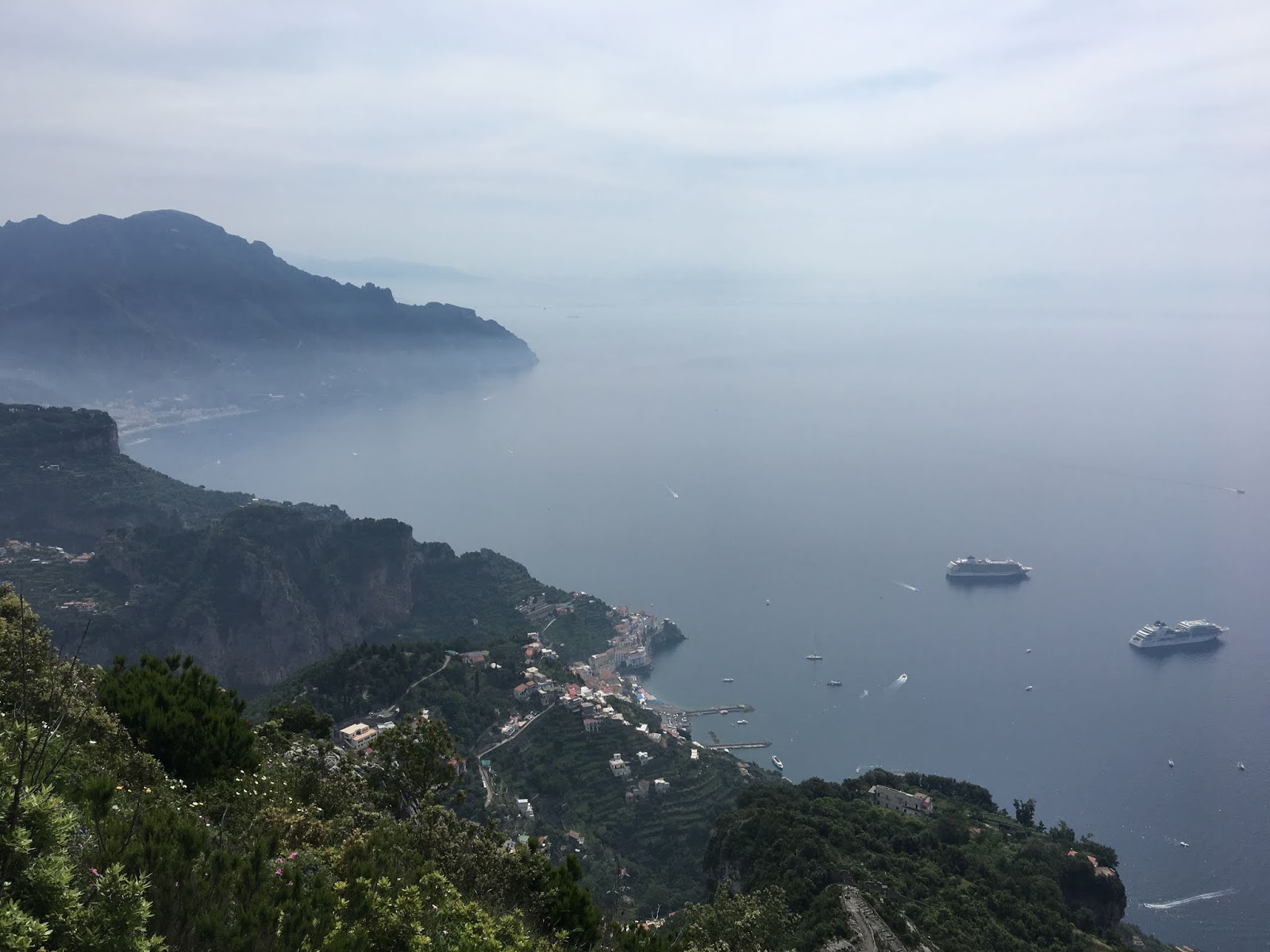
Not long after hitting the trail, we were rewarded with our first spectacular views of the coast, 1,500 feet below, shrouded in mist.

Whoah!
Soon we would be down there, right at sea level, with barely time to catch our breath before heading up, even higher into the mountains above the dramatic Amalfi coast. The race's organizers practically boasted about its imposing 3,060 meters of vertical gain (and loss) over the course of the event. As Brolympus would say, that's 10,039 feet in American! Here's the elevation profile provided in the race packet:

I modified the profile (in green) to add the elevation and distance to key landmarks
As you can see, the race features two major climbs and three big descents, with a lot of "small" hills in between that would be imposing in their own right in any other race. As it turned out, the apartment we had rented for the week of the visit was situated just above the aid station at 10.5 km, so Greta and Suzanne decided to form an impromptu cheer station there. I was supposed to text them when I reached the Fiordo di Furore 8.7 km in to make sure they arrived on time. When I arrived at the Fiordo, a haunting, narrow inlet flanked by steep cliffs, my hands were so sweaty that I couldn't operate the touchscreen on my phone. I was about to give up when I remembered that I was carrying some dry paper towels in a ziploc as an emergency supply of toilet paper. That did the trick, and I was able to send a brief text: "At bottom," which was enough to alert them that I was on the way.

Before I got to the Fiordo, I descended a seemingly endless staircase. "The longest staircase I've ever seen" according to my new running buddy, a nice fellow from Bristol, England, whose name I never learned. We made our way to a narrow parapet above the coastal highway, where we crawled through a hole in a bricked-off wall that was supposed to indicate the trail was closed, before proceeding along the route. On the other end of the parapet we crossed through another "trail closed" barrier. Apparently this is how Italian trail runners roll.

We climbed another steep trail out of the Fiordo before emerging onto a paved road. It was here, the day before, that I met another runner on my shakeout run. She was a little freaked out because a sketchy-looking guy seemed to be following her as she previewed the course. I offered to run with her to a nearby cafe -- the same cafe, it turned out, that would be our aid station on the following day. She told me she had previewed nearly the entire course over the previous three days. She wouldn't be able to do the race itself because she and her new husband had to leave that day, so they had run it on their own instead. This paved road, a gradual uphill, turned out to be the fastest, flattest part of the entire course. It lasted about a mile.

At the end of this mile was the cafe / aid station with my personal cheering squad. Greta and Suzanne were cheering not only for me, but for every runner who passed. I stopped and chatted with them for a few minutes, then grabbed some water and took off. Greta documented the visit:

Approaching the aid station

Saying arrivederci!

Now it was on to the first big climb: 873 meters to the top of Monte Murilo (that's 2,864 feet for my metric-impaired readers). The first part of the climb was on a manageable trail, but soon it turned nearly straight up the side of the cliff. It was at this point that I remembered my friend Carl telling about his recent, extremely technical ultra back home: "It's so steep that if you stop to take a rest you have to hang on to a tree." My response as I made my way up this barren slope was "what tree?" It was so steep that I questioned whether I should have hauled my trekking poles along. Why bother when you can just reach out and touch the hillside directly in front of you?

Somewhere on the steepest hill I've ever raced up....

At one point I ran into another pair of the few English-speakers on the trail: two British guys. I passed them and headed up a steep gully. Here the trail was not only steep, there were sticker bushes choking the path. As I finished ascending the sketchiest section, the two Brits emerged above me: They had noticed that the real trail actually looped around this section. "Need a hand?" one of them asked as he passed. Next I caught up to a group headed up an even steeper gully. As I arrived, the Brits again noticed that the actual marked path turned off to the left, avoiding this difficult pitch. I charged past all six of them and headed up the marked path, making a mental note to look for course markings EVERYWHERE.

Every ten minutes or so, I checked the elevation on my watch. Only 1,500 feet? Really? Then "Only 1,700 feet? Really? And so on until I was at a panoramic viewpoint seemingly overlooking the entire Amalfi coast. I stopped to take a couple pictures:

That's Amalfi!

I'm on the Amalfi Coast!
Here the course circumnavigated the top of Monte Murillo before finally arriving at the next aid station (15.5k), where the course split between the 30k and 50k routes. I was checked in with an official time stamp and was able to sample a full Italian aid station, which included apricot tarts (which I didn't try), raisins (which I did), and bread with honey (which sounded better than it tasted). Since according to my trail map there were several water stops before the next aid station just over 10k away, I only took on about a liter of water. My Grand Canyon partner Rich will be glad to hear that there was also Coke -- but lukewarm, not ice cold. Since I knew I had a big descent ahead I tightened my laces and continued on.

The descent started fairly technical and ended on a long staircase, some parts very rough and others well finished. Down, down we went, until finally entering a town above Amalfi and heading back up. I hadn't spotted any water stops but wasn't too concerned since I knew more were coming. The trail wound up and down, past waterfalls, over creeks, but still with no official water stops. Were we just supposed to fill up at the creek? I didn't have any kind of water purification device, and it seemed like there were plenty of livestock in the area so I guessed the water was not safe to drink. Here are a few photos from this seemingly-endless section of trail.

Deep in the forest

Amalfi...so far away!

I'm in the mountains! In Italy!

According to my watch I should have been at the 26.8k aid station a while ago, but the long descent to the station hadn't materialized. I began rationing water, taking just a tiny sip every ten minutes or so. I was definitely never completely parched but I certainly wasn't comfortable with the amount I was drinking. Finally, the descent began, and in another mile or so I arrived at the aid station. I was officially over halfway done with the race but I wasn't ready to "count" it until I finished the massive climb that was ahead of me: From 277 to 1,009 meters, or a climb of 2,400 feet.

This climb started with -- you guessed it -- more stairs. At this point I was much more tired than I had been previously, and the sun was fully overhead, baking me and the other runners. I was also carrying a full 3 liters of water because the map indicated we'd have no water for the next 10k. Taking this all into account, I allowed myself to take intermittent breaks. At one of them I stopped to take a photo of Amalfi behind:

Stairs above Amalfi
When we finally left the stairs and headed back onto trails, I took a look at my watch and saw that we were still depressingly far from the top of the climb. I knew we'd reach a summit and then run along a relatively flat stretch before reaching the aid station, but for now we ran through a dark forest, up technical trails, up and up some more. Finally I saw we were at an elevation of 3,100 feet and figured this must be the top, but we just kept climbing. I reminded myself that 1,000 meters was more like 3,300 feet. Not yet, Munger!

Eventually, finally, the trail leveled off. But now this meant I needed to be running. It had been so long since I'd been on a runnable stretch that I had to remind myself how to do it. Slowly, one step at a time, I started running. The trail got more and more runnable, until finally it was an actual road! A gnarly, unpaved road, but a road nonetheless. After a series of 25-plus-minute miles, I was finally running sub-16 miles. I even knocked out a sub-14 mile! I laughed at myself for being happy about a 13:xx mile. The 36k aid station arrived quickly, and I became more optimistic about my prospects. Just 9 miles left! To get an official finish, you needed to come in under 12 hours; I was now at 8:40. I had 3:20 to run 9 miles. Surely I could manage that, especially since the rest of the course was flat-to-downhill. All I needed was 20-minute miles, and I'd finish with 20 minutes to spare.

Naturally, as soon as I left the aid station I hit another monster hill. A 200-meter hill looks flat on an elevation profile that goes up to 1,200 meters! I did the mental math as I went, and my prospects looked worse and worse. But I consoled myself by knowing the last mile would definitely be on a flat road. Even if I lost 10 minutes to my 20-minute average, I could make it up on the last mile.

Unfortunately it wasn't just the uphills that were challenging in this section. The downhills were gnarly and rocky. I couldn't pick up speed anywhere. I was running 25, 27-minute miles. Finally I arrived at the last aid station, and the attendant there stopped me. He made a phone call. In broken English, he told me my race was over. They were cutting me off. I missed the cutoff by 8 minutes. I said I would make my own way to the finish, even if it wasn't official. They said no, I needed a medic. A medic? I felt fine. No, I told them, I'd continue on.

As I left, an older man, probably in his 60s, followed me. "La macchina. Ti guiderò in macchina."—I'll drive you in the car.

"No," I said. "Puo finire." I figured I'd easily leave this guy in my dust as I headed down the trail. Unfortunately he proved more adept than I anticipated (either that or I was really just that lame). The trail, as always, was quite rough, and the footing was unsteady. Then I stumbled on a rock and toppled into a spiny bush. I was fine, just a couple scrapes, but my calf immediately cramped up. Nothing I couldn't stretch and run on, but the man became more insistent that I give up.

"Hai bisogno di un medico," he said.

"No, no medico," I replied.

I kept moving, but began to wonder what the point of it was. Whether I "finished" or not, I would not be an official finisher. I had run for over 10 hours in some of the most beautiful scenery I'd ever witnessed. I'd still have that experience, no matter what. I decided it wasn't worth arguing about in a foreign language. I'd stop. The man had indicated that the car was a short ways down the trail, where the refreshments were set up. We continued down for a few more minutes and arrived at the refreshment table, which was already being broken down.

As I sat there filling up on bananas and water, another runner came by. He was much more insistent on finishing, and continued on. Then an Italian woman arrived. She chatted with the aid station workers, then addressed me in English: "Dave, come on, you can finish. I will run with you to the finish."

I was surprised that she knew my name. "No, I said. This is it for me." She stayed for a few minutes, chatting with the workers, then convinced another runner to go with her to the finish. I hung out for a few more minutes, then asked the workers in broken Italian how long it would take for the car to leave and drive me to the finish. He said he had to wait for all the other DNF runners to arrive. I figured that might take an hour or more, so I decided to make my way to the finish. It had become apparent that there was a shortcut I could take on the roads, so I packed up my stuff and told them I was going. No one tried to stop me.

Just as I left, a goatherd arrived in the station with 100 or so goats. They were heading down the same road I would travel. While the goats and their herd dog sauntered down the road, the goatherd stopped to chat with the aid station volunteers. So my return to civilization began in the middle of a herd of goats. They were wary of me as I ran down the road, and eventually I started to overtake them. The skittered off the side of the road into the forest, parting so I could pass. When I passed the herd dog, he looked back at his disjointed herd as if to say "what is up with these stupid animals? It's just a dumb human running by."

The road was smooth and paved, and I was able to run easy 11-minute miles back to the start, about 3.2 miles -- saving myself 1.3 miles and more gnarly trail. I was able to snap one last picture of the glorious Amalfi Coast before descending into the town of Agerola:

The view west as the Amalfi Coast fades into the mist
Soon I was back at the start / finish, where confused race officials grilled me on the status of the other runners. How many runners were still out there? Was I running with them? I tried to explain that they had gone on the trail and I'd taken a shortcut, and that there were probably other runners behind us. Then the medic arrived and asked to check me out. I told her I was fine, and she seemed to believe me. Another man asked if I wanted to eat something -- I could walk with him over to the refreshment table. But between us and the food was my car. It sounded much better to get in the car and head back to my lovely rental apartment with a view of the coast. I sent a text to Greta and told her I'd be there in 30 minutes. There was pizza and beer waiting for me. I couldn't imagine a better end to an amazing, wonderful, challenging, confusing, intense, incredible day.

Postlog
My watch tracked the distance I ran on the course as 28.13 miles, plus 3.22 miles to the finish, for a total of 31.35 miles -- just over 50k. I ran 10:08 on the course and 35 and change off the course  -- a total of 10 hours and 43 minutes. My watch doesn't seem to want to communicate that 28.13-mile run to my phone and the "official" online sources of Garmin Connect and Strava, so I can't break down the stats of the run much beyond that right now. I'll be able to sort it all out when I get home. I don't think at my current level of fitness I could have run much faster. I'm just not a great runner on technical trails, and there was a ton of technical running on this course. I think if I had done a lot more hill work in training I could have completed the climbs faster, and maybe made up that elusive 8 minutes to avoid the cutoff, but I'm not letting it bother me much. I still got to do an epic run in a beautiful place, so I'm very happy with that. Now I get to enjoy another week and a half of vacation before heading back to the real world. I'll see you then.