Monday, June 12, 2023
Race recap: Comrades Marathon
Sunday, February 26, 2023
Brief Race Recap: Ellerbe Marathon
My main focus this spring is training for the Comrades Marathon, a race with a storied history that began before anyone had settled on the distance for a "Marathon." The Comrades course distance, at 89+ kilometers, didn't prove popular enough to become a standard, but the name stuck. I'm registered for the 2023 edition on June 11, and I started my training regimen for it last December.
When you are training for a race this long (this year's edition should be close to 56 miles), a run-of-the-mill 26.2-mile marathon is a training run. So when my friend Chas invited me to join him at the race, I figured it would make a good mid-cycle training run, and hopped on board. I've done the Ellerbe Half Marathon but never the full, so it would make a nice notch on the belt as well.
Comrades requires a marathon or longer as a qualifier. This time is also used to set your starting corral for the race. I had already qualified at New York, but my time of 4:34:50 put me in corral 7 out of 8, and with over 15,000 runners in the race, it would take a long time for me to even cross the start line. With a hard 12-hour cutoff based on the race start gun, I would need every advantage I could get to be awarded a coveted finishers medal. So I set my "A" goal at Ellerbe to be sub-4 hours, which would move me up to Corral 4. The "B" goal was sub-4:15, which would still place me in Corral 5, and that would be a heck of a lot better than Corral 7!
I haven't been specifically training for a marathon, Ellerbe is very hilly, and I didn't taper for this race, so I really had no idea of what I was capable of, but 4 hours seemed possible -- that works out to a 9:09 pace per mile, and most of my training has been at that pace or faster. My longest run, however, was a 19-miler at a 9:23 pace, both shorter and slower than if I had been doing focused training for a 4-hour marathon.
Ellerbe is a small, friendly race in a small, friendly town in central North Carolina. There were about 70 runners each in the marathon and the half marathon, which started an hour later. The course has lots of hills, and the marathoners must run it twice. It's a "lollipop" course with a 2.5-mile "stick" you run at the start and the end, and an 8-mile "candy" loop in the middle. The stick part is nice because you end up seeing both marathoners and half-marathoners coming and going. The loop is where most of the hills are.
| The course |
The race starts in the middle of the road out of town. You run behind a police car for the first couple miles, and then you're own your own in the countryside. My plan was to run comfortably around a 9-minute pace on the flats, pick it up a bit on the downs, and put in an equal effort on the climbs. The first several miles trend downward, so I was around an 8:40 pace and felt very comfortable. Peter Asciutto (of "Idiot Run" fame) was out of the course and got this photo of me and another runner a couple miles from the start:
After a while I chatted a bit with the runner in blue, and he was also shooting for a sub-4. But when the serious hills started a couple miles later, he pulled ahead of me as I didn't want to overdo it on the climbs.
I noted that the really big hill finished up around Mile 7, which would be Mile 20 on the second loop of the course. If I could stay on pace through that point, I would have a shot at my sub-4 race.
Throughout the race, there were friendly volunteers. Though the course wasn't closed, there was very little traffic, and what cars we did see were extremely courteous. The whole town seems to come together for this event.
![]() |
| Another Peter Asciutto photo -- I think around Mile 11 |
The course flattens out near the end of the loop, with just a couple gradual uphills heading into town. But at this point I started to notice that my watch wasn't quite agreeing with the mileage markings painted on the road. My watch ticked off the miles a few hundred yards before each marker, and the difference seemed to increase with each mile. Despite this, I made it to the turnaround at 1:58 -- two minutes to spare on my quest for sub-4.
This time around, however, the 8:40 paces didn't come quite so easily on the flats, and my uphills were in the 9:30s and 9:40s. I did some figuring in my head around Mile 18, and it looked like I'd need to average about a 9:20 pace for the rest of the race to finish under 4 hours. I made it up the big hill before Mile 20, but even after this point, the course was hillier than I remembered. I was keeping my pace in that range or faster when I was running, but I needed to stop for water at the aid stations, and that slowed me down quite a bit. I ran Miles 21-23 at 9:35, 9:20, and 9:32 pace. And my watch was getting farther and farther behind the mile markers.
When my watch clicked through at 24 miles, my elapsed time was 3:37. If my watch had been accurate, I would have had almost 23 minutes to run the last 2.2 miles -- a comfortable 10:18 pace. By the time I got to the actual 24-mile mark, I only had 18 minutes left. This would have necessitated an 8:11 pace, and I was in no condition to run that fast. Realizing that sub-4 was impossible, I let myself slow down. I ran Mile 25 in 9:58 and 26 in 11:26. I crossed the line at 4:05:28, with my watch reading 26.63 miles. It doesn't seem like much, but that extra 0.4 miles meant there was no chance of me reaching my goal.
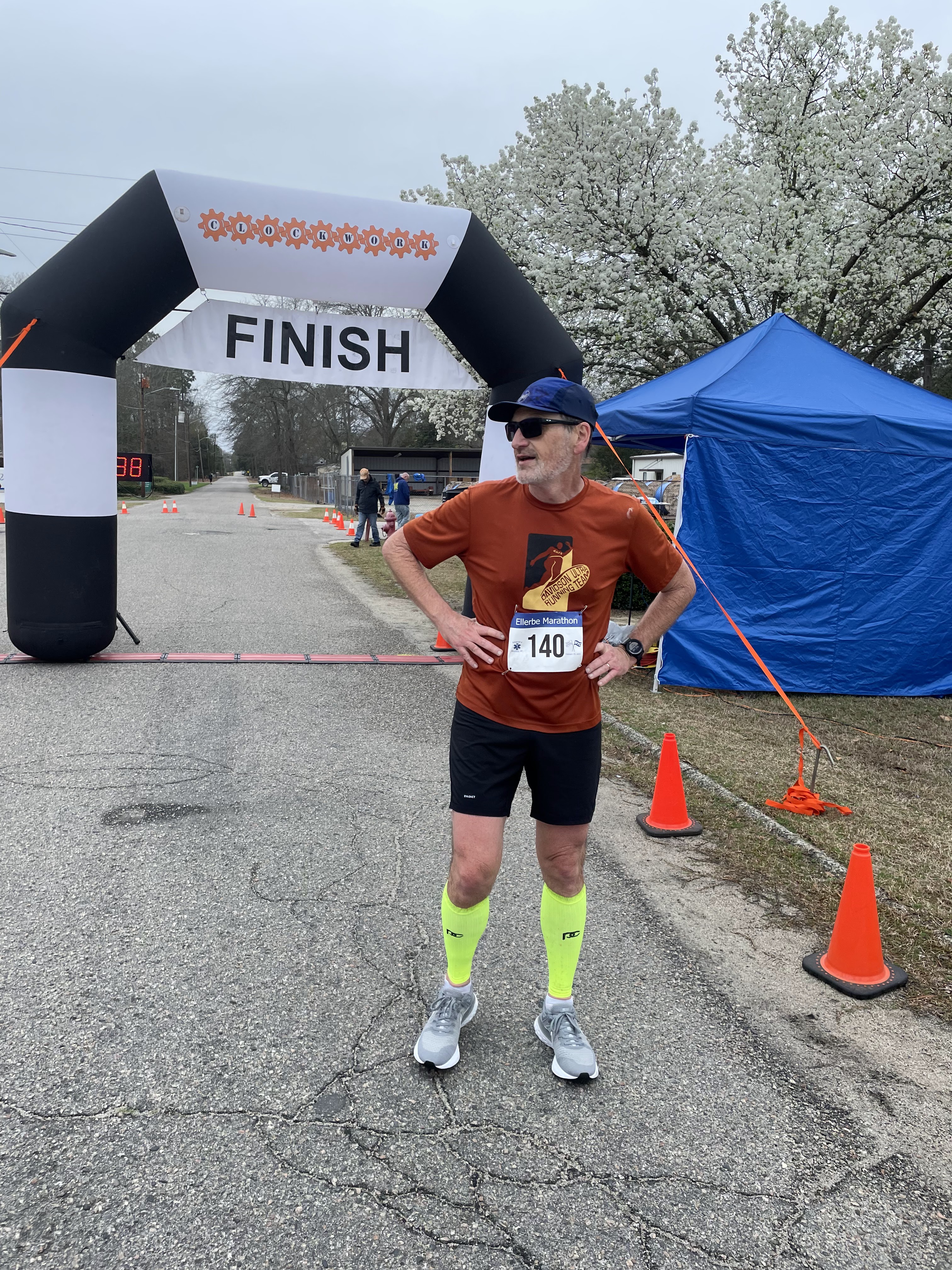
Chas (who had finished first overall with an impressive 3:10:13) took a photo after I crossed the line that pretty much sums up how I felt at the time:
| Happy to be done, but also kind of annoyed |
But now, thinking back on the race, there really isn't anything I would do differently. I'm not training for this race, I'm training for Comrades. This is my fitness level right now, and it's where I need to be. I was able to run 6 miles the day after the race (something I would never even attempt if this was a normal marathon) as required by my training plan. I'll continue to put in more miles, and there will be weekends down the line where I run 38, 40 miles — much more than this weekend's 32. If all goes well, I should be able to finish Comrades in June, and go farther than I've ever gone in a day before. If I finish it (or if I don't), I'll write about it here... and then move on to the next challenge! Stay tuned!
Sunday, January 8, 2023
Brief Race Recap: The South Mountains Half Marathon
After my difficult DNF at the Val D'Aran 55k, I pretty much decided to give up on trail racing. If I couldn't complete that race, there was no way that my ultimate goal of finishing the UTMB CCC 100k was going to be possible, even assuming I could qualify for the race in the first place.
But if there is one thing I've learned over the past 12 years of running, it's that I shouldn't ever say "never." So in a move that surprised no one, I signed up for another trail race -- the South Mountains Half. In my defense, it's "only" a half marathon -- albeit one with over 2,700 feet of climbing and some tricky trails. Add in a cold drizzle on race morning and all of a sudden it's not exactly an easy race. Here's the elevation profile.
As you can see, the race is basically two big climbs and two big descents. Other than a big staircase in Mile 7, it's all quite runnable. I didn't have a specific plan for the race other than "don't die," but after starting off the race and heading up the first big hill, it seemed like a pace of 5 miles per hour, 12 minutes per mile, might be sustainable, so that's what I tried to do.
Using a run / walk strategy, I made my way up the hill that spanned miles 1-4 in 48 minutes, pretty much right on target. I passed quite a few runners on the way up the hill, but then the route turned onto a long, downhill singletrack trail. Downhill is definitely my weakness on trails, so I focused on looking a few steps ahead and trying to maintain a steady clip even over obstacles. But the trail was wet and covered with slippery leaves, and I didn't want to injure myself for what still would be my primary focus this season, long road races. Inevitably I started to hear footsteps behind me, and I let two runners pass. A few minutes later, I was letting some more runners pass. Another runner was behind me, but I didn't think he was gaining much ground. But after a couple minutes of him right on my tail, I let him pass as well. "You'll probably pass me back on the next climb," he said. As he tore off ahead of me, I wasn't so sure of that. I managed to make my way down the 2-mile descent at around an 11:30 pace, so I was still on target for a sub-12 pace for the race. Here there was an aid station, and I refilled my water bottle and grabbed a fun-sized Snickers for the road.
Next was the climb up High Shoals Falls, 600 steep steps. I knew there was no way I would be doing this at a 12-minute pace, so I just tried to climb quickly and steadily. I finally arrived at the top on a runnable trail, and resumed a similar pace. Mile 7 had 520 feet of climbing and I finished it in 17:30. The next couple miles were also mostly uphill, but still very runnable. I tried to give myself reasonable mini targets, like "just run for 3 minutes," then let myself walk a bit to recover. I picked off several runners, including the guy who had passed me on the big descent, who gave me an "I told you." I said I was sure he would pass me on the upcoming downhill. I got through Mile 8 in 13:57 and Mile 9 in 11:38.
Then I turned onto the Shinny Trail, a steep, singletrack descent for the next 2.5 miles. The first bit of it wasn't too bad and I managed a 12:48 pace. But then the trail got steeper and more technical. Once again several runners passed me, including the guy I'd been trading spots with for the entire race. "I told you so," I said.
"You'll get me on the next climb," he replied. Unfortunately there were no climbs left in the race, so I didn't see him again until the finish. My pace for Mile 11 was a slothlike 14:48 while descending 380 feet.
At the bottom of the Shinny trail, you cross Shinny Creek several times. Because I was going so slow, I was starting to get cold, and now my feet were getting wet. I knew the trail would soon be getting easier, but I wondered if I could take advantage of the easy trail with cold feet and legs. Fortunately, my legs did respond, and I was able to run a respectable 11:27 for Mile 12. Now I was on the easy tourist path with just a quarter mile to run, and I picked it up even more, finishing at an 8:44 clip. I crossed the line, high-fived Brandon the race director, and headed to the hut in the parking lot, where they were serving delicious hot chili. My friends had already finished, much faster than me, but I was happy with my efforts and the fact that I didn't die!
Overall my time was 2:39:08, which works out to a 13:03 pace by my watch. But watches are notoriously inaccurate on trails. While my watch logged 12.19 miles, the official course length is 13.3 miles. Assuming that's accurate, my actual pace works out to 11:58, which means I beat my goal pace. I'll take it!
Thursday, November 10, 2022
Race recap: The New York Marathon
But after a summer spent hiking across Spain, when I arrived home at the start of September, I was out of shape for running. I set up an aggressive plan to train for the race, but it was too aggressive. After a long flight across the country to visit relatives in mid-September, I could barely walk! It turned out I had acquired runner’s knee, a common affliction for people who try to ramp up their training too fast.
I took the week off of running, then visited a personal trainer, who told me that I could probably rehabilitate fast enough to finish the New York Marathon, but it would be very difficult. I had six weeks to do it.
I took a conservative approach to my training, with no speed work, lots of stretching and strength exercises, and very gradually building up my mileage to a long run of 18 miles two weeks out from the race. I was running slowly, but I could at least run a relatively decent distance. It would have to do.
Two weeks later, I was in New York, waiting to board the Staten Island ferry for the race. After 10 years, I was finally here, but the weather was not good. It was already over 70°, and was forecast to get up to 75. I generally do best in races at around 40°, so this was almost as bad as it could get.
![]() |
| Outside the terminal |
![]() |
| Inside, with a few thousand friends |
![]() |
| Craziness! |
![]() |
| In the corral |
![]() |
| I'm on a bridge! Running a marathon! |
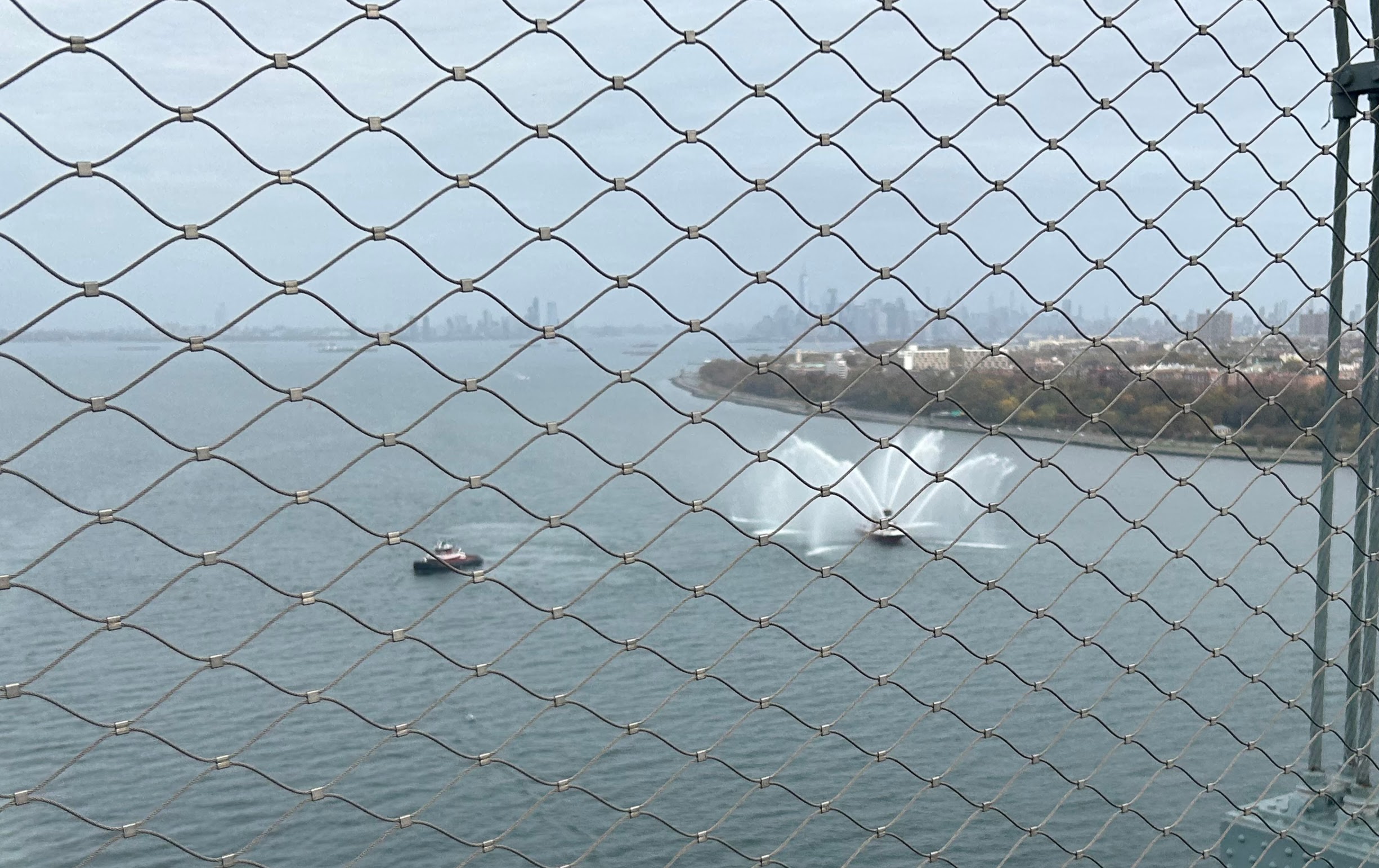
![]() |
| A fireboat with the Manhattan skyline in the distance |
![]() |
| Me taking a selfie without stopping. It can be done, people! |
![]() |
| Not as many trees. Other than that, pretty similar to Davidson ;) |
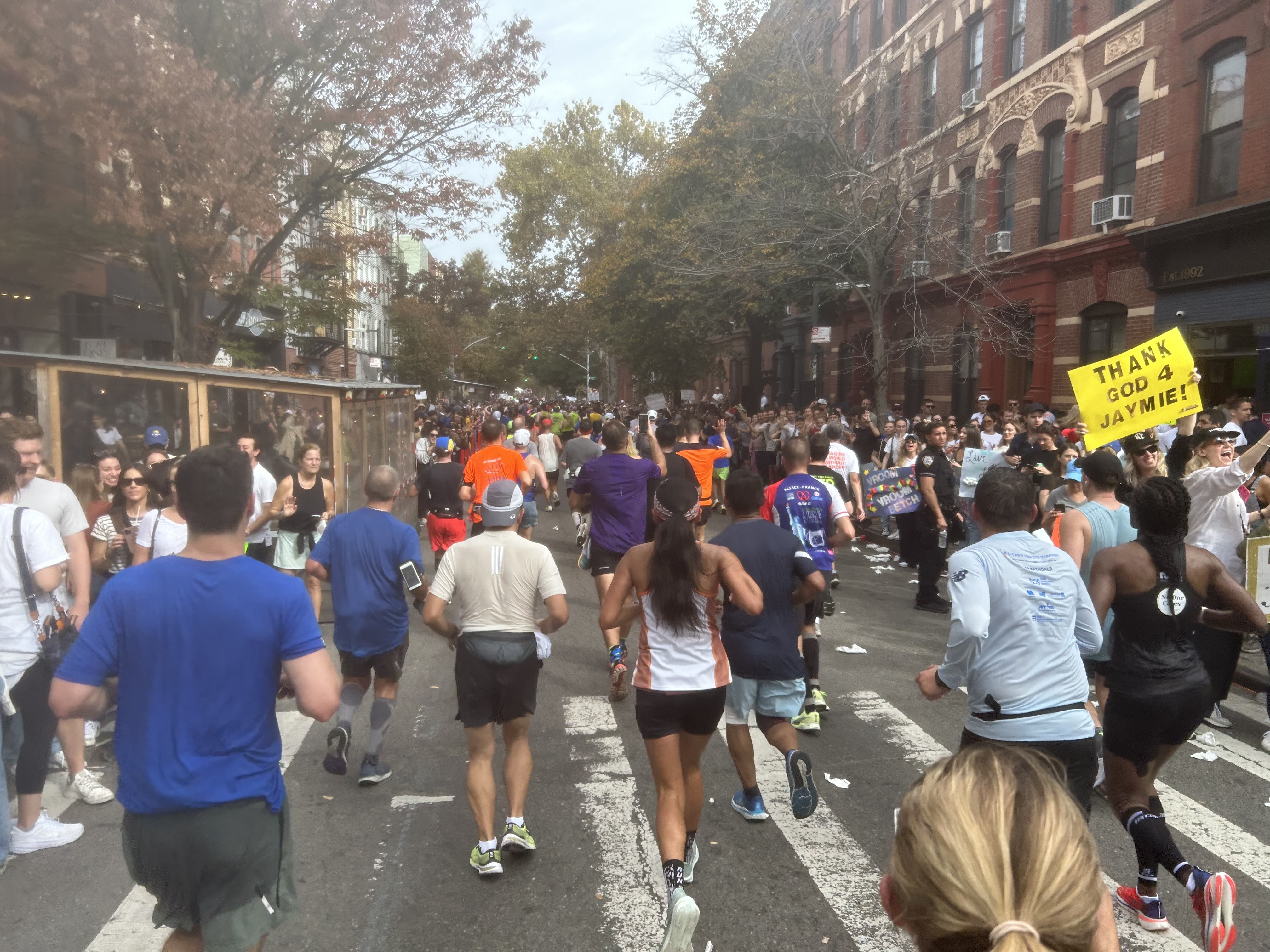
As we got closer to the center of Brooklyn, the crowds got bigger and rowdier. The course was taped off with police tape, but no one paid any attention to that, and fans were out in the middle of the street.
![]() |
| We were getting funneled through a narrower and narrower corridor |
![]() |
| Running up First, getting cheered by a few hundred thousand friends |
Tuesday, July 26, 2022
Race report: Val d’Aran PDA 55k
Meanwhile my wife Greta wanted to go to Spain to walk the Camino, a 500-mile traditional pilgrimage route. The stars aligned this year and we decided to do both. First up was Val d’Aran. Me and running buddy Joey signed up for the 55k (34-mile) PDA race (short for Peades d’Aigua, which means Water Footsteps in the Aranese language). We knew the course would be challenging, with 10,000 feet of climbing and 11,000 of descent and a 13-hour time cutoff.
But I felt I had done enough bleacher and hill training to prepare myself for the pounding I would take on this challenging course. So we all flew to Spain, taking care to put all our race essentials in carry-on bags and checking only non-essential gear. That turned out to be a great plan as the airline did end up losing our bag!
Two days later we were at the start of the biggest trail race either of us had ever taken part in, with over 1,500 participants!
There were three emcees at the start, hyping up the runners in Spanish, French, and English. It really was exciting to be a part of such a huge event! Joey was in the first wave at 7:30, so I watched him start and then quickly lined up for my own start at 7:45.
Before I knew it, we were off and running through the picturesque streets of Salardú before heading out for the trails. The first mile or so was paved, but soon we began heading up into the proper mountains that loomed above the valley. Here’s the elevation profile of the race:
| [Map from 2023 edition; might be a bit different] |
We had 2 hours to get to the first aid station at Bahns de Tredòs, 500 meters (1500 feet) above the start line. I had made a cheat sheet—a little card with all the important data from the race, most importantly the pace per mile I would need to make it to each aid station before the cut-off time. Overall I would need to average about 20 minutes per mile—not a problem on a flat, smooth surface, but often a challenge on steep, rough terrain.
There were so many runners in this race that occasionally the trail would get backed up with runners as the runners ahead encountered a difficult bit of terrain. At one point I was at a complete standstill waiting for the runners ahead to climb the first really steep section of trail. I was shooting for an 18-minute pace, and despite the halting nature of the pack, I easily hit that goal as I arrived at the first aid station. My plan was to get some Isotonic, an electrolyte drink that was We supposed to be at every aid station, and see how that went down since I had never tried it before. However there was a lot of confusion at the station, with so many runners and different languages spoken, and I ended up with lemonade.
On the way out of the station, we had a flat-ish, runnable road for a quarter mile or so, so I took the opportunity to get some actual running in. I must have stumbled over a pebble, and before I knew it I was flat on my face. “I’m fine,” I shouted to no one one particular. A fellow picked up my hat, which had fallen off, saying “here you go, mate,” so I guess he was Australian. I didn’t get a chance to talk to him though, for he soon dashed off ahead of me.
It wasn’t long before the course got steep and technical again. At each difficult pitch, the group slowed to a near-standstill. I tried to take the opportunity to get some calories down, but the lemonade wasn’t agreeing with me. In hindsight I should have consumed some of the gels I had in my pack. I was worried about running out, but at this point I should have been focusing on the energy needed to get to the next checkpoint, which could end up being my last if I didn’t get the energy I needed to move fast enough.
This was a beautiful area, with several gemlike lakes. I kept thinking I should take a photo, but I didn’t want to let anyone pass me, lest I get caught behind them at the next traffic jam. There were also several race photographers along the course. As it turned out, this was a good call. The race photographers got some really great shots!
Meanwhile I still needed to make sure I got to the next aid station on time. I had to make it to the Colomers aid station by 1:00, 5:15 after the start. This was about 14.5 miles from the start, again needing about a 20 minute per mile pace. But it also involved over 3,000 feet of climbing and 2,000 feet of descending from the previous aid station. Very little of these trails was runnable, so I basically had to power hike this terrain at what would be quite a brisk walk even on level pavement.
On the climbs I could easily hold my own, but whenever we started descending, a herd of runners would soon be on my back, and I felt obligated to let them by. After summiting the Coth de Podo at 8,500 feet, it was basically a non-stop descent to the Colomers aid station at 6,400 feet.
| Steep! |
By the time I made my way to the station, I was within a few minutes of the 1:00 cutoff. I was still unable to find any of the Isotonic energy drink so I just scooped up a bunch of the (very good) chocolate provided, filled up with water, and grabbed a couple of granola bars for the road.
Next aid station was Mount Romy, 7.5 miles away, and I needed to average an 18:00 pace to make it there by the cutoff at 3:30 pm. Fortunately it was a decent gravel road heading out of the aid station, and I took the opportunity to eat a granola bar as I walked briskly uphill. Unfortunately this didn’t last long, as there was a tape across the road and trail markers arrayed straight up the side of a mountain. I was exhausted, and this route seemed so steep that I could hardly imagine climbing it at all, let alone at an 18:00 pace. I briefly considered walking back to the aid station and dropping out. But I had to give it a try. I started up the hill.
The hill was so steep that I could touch it if I extended my arm straight out. At least the footing was relatively good; it was basically stepping up on tufts of grass. A few hundred feet up this climb and we were stopped by rescue workers escorting a runner down. She was moving under her own power but needed two rescuers to help her down. When they passed, I kept moving. Eventually we reached a trail with more reasonable switchbacks, but it was still a very steep climb. My pace had slowed to 40:00 per mile, and I needed to be moving at an 18:00 pace!
This continued on for an excruciating long climb. Surely we must be close to the top. Cresting yet another ridge, the woman ahead of me screamed “no! No, no, no, no, no!” She was speaking Spanish, but somehow I got the gist of her sentiment. I made my way over the ridge and my suspicions were confirmed: there was another huge climb ahead of us. At this point, I was defeated. I stepped aside a took a little break. I needed to average an 18:00 pace and I was doing a 45-minute pace. There were still nearly 5 miles to the aid station and I had just over an hour to get there. But still, it was absolutely beautiful in these mountains and I was absolutely thrilled to be here. I decided to just focus on enjoying the run, and not worry about pace. I took another break, took a photo, and continued on, letting others pass if they wanted to.
| Endless climbing |
I reached the next summit, Tuc Salana, at 2:19. I had until 3:30 to get to the aid station at Mont Romies, over 5 miles away and 2,000 feet below. First would be a punishing descent, the steepest I’d yet experienced in the race.
| It was steeper than this looks! |
Slowly I picked my way down, logging a 30-minute mile and leaving me just 40 minutes for the next 4 miles. Mercifully, the trail flattened out and I was finally able to run a bit. Perhaps if I had been better with my nutrition I could have run more than I did. I began a pattern of running two minutes, walking one minute, and kept it up for a couple miles. Eventually I had to go to one minute in and one minute off, but I was actually passing some people. I pulled off a 12:30 mile and a 13:40 mile—but I needed 10-minute miles. Then we were done with the flat section and the trail once again turned downwards. My pace slowed.
Finally I arrived at Mont Romies, 30 minutes too late. My race was done. I took in some water—lots of water—and began to wonder how I was going to be transported off the mountain. Then I overheard the race timer telling another runner they weren’t actually stopping anyone from running here. We could try to make it to Arties, 5k away, before the cutoff—but we now had just 25 minutes. I don’t think at that point I could have run a flat, paved 5k in 25 minutes, let alone a 5k on steep, technical, rocky trails. But it was also clear that no one was going to give me a ride!
I was blistered, beaten, and exhausted, but I started down the trail. I’d like to say that after a few minutes I started to feel better, but I really did not. I just made my way down, another 1,800 feet of descending, until the trail finally flattened out a bit as I neared town. I was running through the streets of an alpine village, and folks sitting in cafes were cheering me on. But it was too late. I trudged into the aid station, and the race timer smiled and gave me a thumbs down. I was 35 minutes past the cutoff. He cut the bar code off of my race bib and sent me into the aid station to recover. I drank a couple warm Cokes as I texted Greta and asked if they could pick me up. Hopefully we could still see Joey finish the race.
Thirty minutes, a liter of water, and a beer later, and we were at the finish line waiting for Joey to finish. The race was hard on him too, but he finished the race, well ahead of the cutoff. At least one of us was able to experience the thrill of finishing the toughest race either of us had ever attempted. I was a little disappointed that I couldn’t join the ranks of finishers, but I’m truly glad for the experience. Look for me next at a ROAD marathon. How does New York City sound?
Monday, May 2, 2022
Race Report: 2022 Duathlon Nationals
Two months ago I qualified for the New York Marathon, running a 7:15 pace over 13.1 miles. Two weeks ago I wrapped up my training for the Duathlon Nationals with a hilly 5-mile tempo run at the same pace. So why, now, could I barely hold that pace over a flat 5k?
I was in Mile 3 of the first run at the draft-legal sprint duathlon national championship in Irving, Texas. It was a hot afternoon but the course was flat. I had already adjusted my expectations for this event. I just needed to be in the top 18 in my age group to qualify for the 2023 World Championships in Ibiza, Spain.
While 2 weeks ago I had been feeling strong, today was an entirely different story. In the intervening week, I had come down with a nasty cold. A week ago I went through a box and a half of Kleenex in a day. Six days ago I dragged myself to the drugstore to get a COVID test and more Kleenex. The test was negative, but the cold was hitting me hard. Four days ago I finally felt good enough to go for an “easy” run that wasn’t easy at all.
The next day I went for another run that felt a little better, and I decided that I just might be able to make my way to Texas and give this race a shot.
Arriving in Texas on Friday for my Sunday race, I was still going through Kleenex at a prodigious rate. The spring allergy season wasn’t helping matters, and I doubled up on meds. I set up my bike and rode to the race start to pick up my packet — it was a hot and humid afternoon, and the weather only looked to get hotter over the next two days. I retreated to my hotel room to cool off.
Saturday’s shakeout run felt a little better but I could tell there was no way I would be racing this event at the pace I could have easily done just two weeks ago. I settled on a goal pace of 7:00 per mile for the first run, only barely faster than my recent half marathon.
The format for Nationals was a 5k run, then a 12-mile ride, then a 2-mile run. Now, 2 miles into the first run, even that 7:00 pace was slipping away. “C’mon, Munger,” I told myself, “just get to the ride. Then you can catch someone’s draft.”
I finally arrived at the transition area and was able to locate my bike quickly. To save time in transition, I had put flat pedals on the bike so I could ride in my running shoes. That worked great, and I ran to the bike mount line and hopped on. There was another cyclist just ahead and I accelerated as rapidly as I could to try to catch his draft. It was no use—I couldn’t catch up. I decided to relax and wait for someone to catch me. In a minute, another rider passed me and I jumped onto his wheel.
I was able to hang on and recover a bit. After a minute, I passed him and said “30-second pulls?” He said okay, and we were a team. Another rider passed us and we joined him with the same offer. But clearly this guy had overextended himself just to catch us, and we dropped him. After a couple miles with my new teammate, I was starting to flag on my pulls. I told him I wasn’t sure I could keep this up.
“Just do what you can,” he said. “Whatever you can do will still help me.” So he started pulling for a minute at a time while I did 30 seconds. Then a group of four caught up to us and we hooked onto them. They had one really strong rider, and my buddy was very strong, while me and the other three guys were a little weaker. We would hang on for dear life when the strong guys were pulling, then get a bit of a rest when one of us pulled.
I managed to hang on to this group until we were about a half mile from transition. Then I let them go on ahead while I prepared myself for what I knew was going to be a slog on Run 2. Thanks to the drafting, I ended up with an average pace of 21.5 mph for the ride. Still weak from my cold, there’s no way I could have done that on my own!
As I dismounted, I realized just how much the hard ride had taken out of me. I hobbled with my bike to my slot in the transition area, removed my helmet, and headed out for the run. Since I didn’t have to change shoes, I was ahead of my cycling group, but I figured this wouldn’t last long in my condition. There was an aid station just outside the transition area and I stopped to walk for 5 seconds to make sure I got some water. I dumped the rest of it over my head, which offered a bit of relief from the 88-degree afternoon heat.
My pace at this point was barely faster than a 9-minute mile. Slower than my usual “easy” pace. Surely I could at least get down to an 8-minute pace. A couple of the guys from my cycling group had passed me, so I focused on keeping them in sight. I passed through the first mile in 8:15. Not great but at least it was an improvement. I took another 5-second walk at the aid station to get some water and dump more over my head, then plodded on. I could still see one runner from my cycling group just ahead. “Hang on, Munger,” I told myself.
I tried to pick it up for that final mile, but the best I could do was maintain the same pace. It would have to suffice.
I ran through the finish and managed to stay standing to get my medal and let a volunteer drape some cold, wet towels over my shoulders. The guys from the cycling group were there, and I thanked them for pulling me along. Then I went off in search of shade, where I could collapse and check the results.
I was 10th in my age group, which would probably qualify me for worlds, but there was a caveat. I’m in the 55-59 group, but current 54-year-olds would also be eligible for my age group at the 2023 worlds. I went to the USAT tent to check my qualifying status, and they told me I had made it — as the 16th qualifier out of 18!
I know I could have gone much faster if I had been 100% healthy going into the race, but I’m proud of this effort. I gave it everything I could at the time and I made the team for worlds. I’ll take it!
Details of my race are on Strava, linked below.
Monday, February 28, 2022
Race Report: The Wilmington Half Marathon
I have been trying to qualify for the New York Marathon for a long time. A really long time. Because I'm better at [relatively] short-distance races, even though it's tougher to qualify for than Boston, because New York allows you to qualify with a half-marathon time, it has always seemed tantalizingly possible for me to do. Rather than rehash the many times I have tried this, I will just offer the links to my posts about [most of] my attempts.
2011: Bridges Half Marathon: Needed a 1:30, ran 1:31:38.| Yeehaw! |
| YESSS!!! |