Whenever I meet a runner at a group run for the first time, the first question that inevitably crops up is "are you training for anything in particular?" For me, for the past three years, the answer has always involved the word "marathon"--without any modifiers. My focus has been nearly exclusively on marathons. Not half-marathons, not ultra-marathons, just marathons.
Now, that's about to change.
For fall of 2013, I'm not signing up for any marathons. I will, of course, be racing, but the races will be non-marathon distances. My next big race is the Blue Ridge Relay, where I'll be a member of team Stache and Dash Remixed. This will be my first time running the race with a 12-member team. It'll be a far cry from last year, when we ran it with 6 runners, and for me it will also be a different from 2011 when I ran on a 10-member team but still had to run an extra leg. The standard 12-member team divides the 36 legs neatly into 3 legs per runner. With a 10-member team, half of the runners must complete 4 legs, and with a 6-member team, if all goes according to plan, each runner does 6 legs in just over 24 hours, each leg averaging about 6 miles (In our case, it didn't, and I ended up running 7 legs and 35 miles).
So this year what I'm hoping for is a nice, uneventful 3-leg Blue Ridge Relay where I run a total of 3 legs, about 16 miles. I have put in a bid for the notorious "mountain goat" leg, which involves a 1,300 foot climb, but that should not be nearly as difficult as previous years (including last year, when I ran the "mountain goat" as my sixth leg!).
Later in the fall I'll be working on short-distance (for me) races: 5Ks and half-marathons. I'm still hoping to qualify for the New York Marathon by running a sub-1:25 half-marathon, so I've registered for a race I've done before, the Kiawah Half Marathon, which I ran way back in 2007. I didn't particularly like the course back then because it was a fairly boring, flat course which didn't offer much in the way of beach views. This time around I'll be happy to stay away from the windy beach and just focus on PRing. The other thing I didn't like about the course as a middle-of-the-pack runner is that it was very crowded. This year, if all goes well, I'll be near the front of the pack and that shouldn't be much of an issue either.
I'm also going to run our local half, Charlotte's Thunder Road Half Marathon, which is a hilly race and not likely to yield a PR unless I'm in absolutely fantastic shape. But my plan is to get myself not just into 1:25 half-marathon shape, but instead more like 1:23 shape, so if I'm firing on all cylinders, I should be able to PR and possibly qualify for New York here in Charlotte.
I am also going to run one or two 5Ks, most notably the Big South 5K, where I PRd last year and am hoping to PR again.
That's my fall schedule in a nutshell. I'm starting off by training for the hills of the Blue Ridge, so today I ran up the stadium bleachers at Davidson College 60 times. Didn't feel too bad; maybe next week I'll go for 80! Details of today's workout are below.

Tuesday, July 23, 2013

Monday, July 15, 2013
Race Recap: The Grandfather Mountain Marathon
The most striking image I can give you of the Grandfather Mountain Marathon is probably this one:

It's the elevation profile. As you can see, it involves a whole heck of a lot of uphill. The race starts at the football stadium for Applachian State University in Boone, NC, at an elevation of 3,300 feet, then climbs about 1,000 feet to McRae Meadows at the base of Grandfather Mountain, where there is another sports venue -- it's the site of the annual Scottish Highland Games. But there's more than just 1,000 feet of climbing in this race, because there's also about 1,600 feet of descending -- so the total ascent is over 2,600 feet.
Since a typical "hilly" marathon might involve 500 to 1,000 feet of climbing (Boston, for example, has 783 feet of climbing), this is indeed a very hilly race. Naturally, that's what attracted me to it -- that and the fact that it is practically in my own back yard. My running buddy Chad Randolph has run it 10 times, and his friend Ricky Reeves (who introduced Chad to running) has run it 20 times. Ricky's wife Betty drives them to the start and picks them up at the finish every year, and was happy to bring me along for the ride.
For this year's July 13 marathon, I'd be running it for the first time. Chad and I showed up at Ricky and Betty's place at 5:00 a.m. in Miller's Creek, NC, and about 45 minutes later, we were parking at the ASU stadium, where hundreds of runners nervously awaited the start. Here's a shot of me and Ricky getting ready to run:
This was an old-school marathon, with no chip timing, no flashy bands or fireworks, and a real starting gun to send us off with a bang. Before the start I ran into another running buddy, Sam Mishler, who asked if I had a plan for the race. Did I have a plan? That's like asking if one might expect to see explosions in the latest "Die Hard" movie. Of course I had a plan. I pulled this laminated slip of paper from my pocket:

I had carefully charted out the elevation gain and loss for each mile of the race, plotting out my planned paces for each. If I hit my targets, I'd finish in 3:41:36. If I beat them by just a bit, I'd do better than I did in the comparatively-flat Boston Marathon this year, 3:39:26. That was my "stretch" goal, with a backup goal of finishing sub-4-hours.
The plan was to run downhill / flat miles at an 8:00 pace, uphill miles at a 9:00 pace, and mixed miles at an 8:30 pace. Chad's bit of advice was this: If you make it up the steep gravel hill in Mile 17 and still feel like you've got something left, you're going to have a good day. Sam, meanwhile, was hoping to run the race a bit faster than me -- he was shooting for a 3:30 finish.
We started by running two laps around the App State track. It was a bit crowded here and Sam and I had placed ourselves rather far back from the starting line, so I spent those laps dodging runners, trying to get closer to the front. When we finally hit the roads, things opened up considerably -- as I knew they would -- there would only be 381 finishers in the race (due to a hard limit placed on the event by the US Forest Service). For the first several miles I was comfortably under my target pace.
The first big hills started at Mile 3, and my 9-minute pace was still quite comfortable. But I knew I needed to reserve energy for later, so I resisted the urge to go faster. At Mile 6 I saw Sam stopped at his wife's car and wondered if he was all right; he had had a muscle strain during our 8-mile run the previous Sunday, and I guessed that's what was bothering him.
About a mile later, he caught up with me, and said he was thinking about dropping out at Mile 10. At Mile 8, he pulled up, limping, and I figured that would be the end of the race for Sam. Too bad, because he had been running very well up until a week ago.
Mile 8 was the first major downhill, and again I resisted the urge to go fast -- I wanted to make sure I had plenty of legs left for the hills to come. A couple folks passed me here, but I passed them back on the uphill Miles 10 and 11. Now the field was really starting to thin out. It was a damp, misty morning, and the air was so thick that my glasses kept fogging up. Finally I just took them off completely and put them on top of my hat. My vision is about 20:300 (-5 diopters), but I could still see better without the glasses than with them on. The only problem came when I was approaching a sign telling the runners where to go -- I could see there was a sign there but couldn't see which way the arrow was pointing. I had to run up until I was nearly right on top of it, then finally figured out where to go.
Around Mile 11, we hopped on to the Blue Ridge Parkway, where we could really cruise on some downhill miles. Betty was there to ask if I needed anything, but I was doing just fine. I had started with four vanilla GUs and two lemon-limes, so I had all the fuel I needed, and there were plenty of water stops along the way, so hydration wasn't an issue either.
Runners were now few and far between. Every once in a while I spotted a runner ahead, and this spurred me on to keep up the pace. I probably passed someone every half mile or so on this stretch. There were some lovely lakes and a campground, really gorgeous scenery. We had also been explicitly warned not to run tangents on this part of the course, so I did my part and stayed left. I saw several rangers on the road, and apparently they can kick you out of the race if you don't follow the rules, so I was glad I did!
At Mile 15 the route left the Parkway and headed up the rough gravel road Chad had told me about. But it wasn't a hill, it was flat. Would the hill come later? I passed a runner and kept on moving. Finally just after Mile 16, the road headed steeply uphill. Four runners were walking on this stretch, but I felt good so I decided to keep running. I passed all four by the time I got to the top. But when we reached pavement, I saw that the hill kept going up! I gritted my teeth and kept running. Fortunately things did level out around the Mile 17 marker. Mile 17 was my slowest of the day, 9:39, but I had climbed 289 feet -- the single biggest climb on the course.
I looked at my pace card and saw that for Miles 18 to 22, a five-mile stretch, I was supposed to run 8:30 or 8:00 for each mile. That meant it was relatively flat, but I was now really starting to feel worn out. I managed to keep up that pace through Mile 18, but by Mile 19 I decided to give myself an extra 30 seconds per mile. If I did that for the last six miles, I'd only be 3 minutes slower than my original plan. Plus, I had banked some time earlier on, so I felt like I should easily break 3:45 for the marathon.
Well, not exactly easily. Everything seemed to come harder at this point. My legs ached, I was breathing heavily, and the elevation (or just my exhaustion) was starting to get to me.
I told myself I could walk when I reached Mile 22. But as I passed the marker, I could hear cheering and I figured there was an aid station just ahead, so I toughed it out another third of a mile, then walked through the aid station as I downed two cups of water. There was another aid station around Mile 23, and they told me there'd be another one at Mile 25. I decided to take a walk-break halfway through 25, which was the last big uphill mile. Then I saw the aid station -- it was actually at the halfway point of the hill, not the top. I had passed a couple runners on this stretch, but I stopped and walked again when I got my water, and they passed me again. When I started running I passed them back.
Soon I was running the final, flat Mile 26. I heard footsteps behind me and figured it was one of the runners I had just passed. I couldn't summon up any more strength and decided to let him pass me. But it wasn't a him, it was a her, my friend Phyllis Neriah. She's a solid ultrarunner and must have just been getting warmed up about this point! She chugged on by and I hoped she would be the last person to pass me.
Soon I could hear the familiar whine of bagpipes and I knew the finish was near. We passed by the main entrance to Grandfather Mountain and were directed onto a rough gravel road. Then we had to run down a steep, very rough road for about 100 yards. As the pain seared through my quads, another runner passed me -- a fellow I hadn't seen since I passed him in Mile 10. Once again I didn't have any strength to pass him so I let him go.
Then we ran back up another steep gravel road towards the track, and the noise got louder. Soon we were on the track, which was like no scene I had ever seen -- the track was lined by hundreds of tents, each festooned with the regalia of a different Scottish clan. There was a large grandstand with hundreds of fans sitting there, clapping politely. I decided to see if I could egg them on, so I raised my arms and pumped my fists, and they responded with hearty cheers. Sam's wife Steph was there to capture the moment:

Soon I was across the finish line with a respectable time of 3:42:45. That was not quite as fast as I had run Boston, but it was a much more solid, even effort. I guarantee you that everything else being equal, it's much harder to run a 3:42 at Grandfather than it is to run a 3:39 at Boston!
My time was good for 48th overall, 7th in age group, out of a pool of 381 finishers. I'll take it! Here are the official results.
After accepting congratulations from Phyllis and Scott Salger, the two runners who had passed me in the final mile, I achingly made my way down to the hospitality tent to get some refreshments and watch for Chad and Sam.
As it turned out, Chad finished in 3:48:05, just after I left the finish area, so I didn't see him until he popped in to the hospitality tent. We chatted for a while and I asked him if he had seen Sam. He said he caught up with him on the hill at Mile 17, on the gravel road, and walked with him for a while. Apparently he hadn't been able to get in touch with Steph, so he had just kept on going. Chad let him borrow his phone to try to call Steph, but he wasn't able to get a hold of her. Then, Chad said, he ran on, so we figured Sam had probably finally dropped out around Mile 20.
The next thing we saw was Sam running by us. "SAM!" we both yelled. I struggled to my feet and limped towards the finish line, but he had already finished and was heading gingerly down the road to the hospitality tent when I caught up with him.
"What happened?" I asked. "I thought you were dropping out at Mile 10!"
"I was," he replied, "But I never saw Steph, so all I could do was keep going." He walk-ran the entire last 16 miles of the race, and finished in a very respectable 4:02, in 104th place, ahead of 277 other runners. As it turned out, Steph took his instructions at mile 6 to "go ahead and meet me" to mean she should go all the way to the finish line. He meant for her to just drive a few miles ahead to see how he was doing. Oops.
Then we all sat in a group on a blanket provided by Betty, eating Betty's Fig Newtons, and watched the rest of the field run by up the gravel road towards the stadium. Ricky finished in 4:10, and after that Chad and Ricky called out to many of the other runners in the field because they've both done the race so many times. Here are some of us near the finish:
After that, all that was left was to grab some gigantic sandwiches in Boone, and head home. A very satisfying race -- and a special thanks to Betty and Ricky for making it all so easy!
If you're interested in my detailed race info, splits, etc., see below.

It's the elevation profile. As you can see, it involves a whole heck of a lot of uphill. The race starts at the football stadium for Applachian State University in Boone, NC, at an elevation of 3,300 feet, then climbs about 1,000 feet to McRae Meadows at the base of Grandfather Mountain, where there is another sports venue -- it's the site of the annual Scottish Highland Games. But there's more than just 1,000 feet of climbing in this race, because there's also about 1,600 feet of descending -- so the total ascent is over 2,600 feet.
Since a typical "hilly" marathon might involve 500 to 1,000 feet of climbing (Boston, for example, has 783 feet of climbing), this is indeed a very hilly race. Naturally, that's what attracted me to it -- that and the fact that it is practically in my own back yard. My running buddy Chad Randolph has run it 10 times, and his friend Ricky Reeves (who introduced Chad to running) has run it 20 times. Ricky's wife Betty drives them to the start and picks them up at the finish every year, and was happy to bring me along for the ride.
For this year's July 13 marathon, I'd be running it for the first time. Chad and I showed up at Ricky and Betty's place at 5:00 a.m. in Miller's Creek, NC, and about 45 minutes later, we were parking at the ASU stadium, where hundreds of runners nervously awaited the start. Here's a shot of me and Ricky getting ready to run:
 |
| Double bonus points if you can guess the year of Ricky's awesome Boston jacket! |

I had carefully charted out the elevation gain and loss for each mile of the race, plotting out my planned paces for each. If I hit my targets, I'd finish in 3:41:36. If I beat them by just a bit, I'd do better than I did in the comparatively-flat Boston Marathon this year, 3:39:26. That was my "stretch" goal, with a backup goal of finishing sub-4-hours.
The plan was to run downhill / flat miles at an 8:00 pace, uphill miles at a 9:00 pace, and mixed miles at an 8:30 pace. Chad's bit of advice was this: If you make it up the steep gravel hill in Mile 17 and still feel like you've got something left, you're going to have a good day. Sam, meanwhile, was hoping to run the race a bit faster than me -- he was shooting for a 3:30 finish.
We started by running two laps around the App State track. It was a bit crowded here and Sam and I had placed ourselves rather far back from the starting line, so I spent those laps dodging runners, trying to get closer to the front. When we finally hit the roads, things opened up considerably -- as I knew they would -- there would only be 381 finishers in the race (due to a hard limit placed on the event by the US Forest Service). For the first several miles I was comfortably under my target pace.
The first big hills started at Mile 3, and my 9-minute pace was still quite comfortable. But I knew I needed to reserve energy for later, so I resisted the urge to go faster. At Mile 6 I saw Sam stopped at his wife's car and wondered if he was all right; he had had a muscle strain during our 8-mile run the previous Sunday, and I guessed that's what was bothering him.
About a mile later, he caught up with me, and said he was thinking about dropping out at Mile 10. At Mile 8, he pulled up, limping, and I figured that would be the end of the race for Sam. Too bad, because he had been running very well up until a week ago.
Mile 8 was the first major downhill, and again I resisted the urge to go fast -- I wanted to make sure I had plenty of legs left for the hills to come. A couple folks passed me here, but I passed them back on the uphill Miles 10 and 11. Now the field was really starting to thin out. It was a damp, misty morning, and the air was so thick that my glasses kept fogging up. Finally I just took them off completely and put them on top of my hat. My vision is about 20:300 (-5 diopters), but I could still see better without the glasses than with them on. The only problem came when I was approaching a sign telling the runners where to go -- I could see there was a sign there but couldn't see which way the arrow was pointing. I had to run up until I was nearly right on top of it, then finally figured out where to go.
Around Mile 11, we hopped on to the Blue Ridge Parkway, where we could really cruise on some downhill miles. Betty was there to ask if I needed anything, but I was doing just fine. I had started with four vanilla GUs and two lemon-limes, so I had all the fuel I needed, and there were plenty of water stops along the way, so hydration wasn't an issue either.
Runners were now few and far between. Every once in a while I spotted a runner ahead, and this spurred me on to keep up the pace. I probably passed someone every half mile or so on this stretch. There were some lovely lakes and a campground, really gorgeous scenery. We had also been explicitly warned not to run tangents on this part of the course, so I did my part and stayed left. I saw several rangers on the road, and apparently they can kick you out of the race if you don't follow the rules, so I was glad I did!
At Mile 15 the route left the Parkway and headed up the rough gravel road Chad had told me about. But it wasn't a hill, it was flat. Would the hill come later? I passed a runner and kept on moving. Finally just after Mile 16, the road headed steeply uphill. Four runners were walking on this stretch, but I felt good so I decided to keep running. I passed all four by the time I got to the top. But when we reached pavement, I saw that the hill kept going up! I gritted my teeth and kept running. Fortunately things did level out around the Mile 17 marker. Mile 17 was my slowest of the day, 9:39, but I had climbed 289 feet -- the single biggest climb on the course.
I looked at my pace card and saw that for Miles 18 to 22, a five-mile stretch, I was supposed to run 8:30 or 8:00 for each mile. That meant it was relatively flat, but I was now really starting to feel worn out. I managed to keep up that pace through Mile 18, but by Mile 19 I decided to give myself an extra 30 seconds per mile. If I did that for the last six miles, I'd only be 3 minutes slower than my original plan. Plus, I had banked some time earlier on, so I felt like I should easily break 3:45 for the marathon.
Well, not exactly easily. Everything seemed to come harder at this point. My legs ached, I was breathing heavily, and the elevation (or just my exhaustion) was starting to get to me.
I told myself I could walk when I reached Mile 22. But as I passed the marker, I could hear cheering and I figured there was an aid station just ahead, so I toughed it out another third of a mile, then walked through the aid station as I downed two cups of water. There was another aid station around Mile 23, and they told me there'd be another one at Mile 25. I decided to take a walk-break halfway through 25, which was the last big uphill mile. Then I saw the aid station -- it was actually at the halfway point of the hill, not the top. I had passed a couple runners on this stretch, but I stopped and walked again when I got my water, and they passed me again. When I started running I passed them back.
Soon I was running the final, flat Mile 26. I heard footsteps behind me and figured it was one of the runners I had just passed. I couldn't summon up any more strength and decided to let him pass me. But it wasn't a him, it was a her, my friend Phyllis Neriah. She's a solid ultrarunner and must have just been getting warmed up about this point! She chugged on by and I hoped she would be the last person to pass me.
Soon I could hear the familiar whine of bagpipes and I knew the finish was near. We passed by the main entrance to Grandfather Mountain and were directed onto a rough gravel road. Then we had to run down a steep, very rough road for about 100 yards. As the pain seared through my quads, another runner passed me -- a fellow I hadn't seen since I passed him in Mile 10. Once again I didn't have any strength to pass him so I let him go.
Then we ran back up another steep gravel road towards the track, and the noise got louder. Soon we were on the track, which was like no scene I had ever seen -- the track was lined by hundreds of tents, each festooned with the regalia of a different Scottish clan. There was a large grandstand with hundreds of fans sitting there, clapping politely. I decided to see if I could egg them on, so I raised my arms and pumped my fists, and they responded with hearty cheers. Sam's wife Steph was there to capture the moment:

Soon I was across the finish line with a respectable time of 3:42:45. That was not quite as fast as I had run Boston, but it was a much more solid, even effort. I guarantee you that everything else being equal, it's much harder to run a 3:42 at Grandfather than it is to run a 3:39 at Boston!
My time was good for 48th overall, 7th in age group, out of a pool of 381 finishers. I'll take it! Here are the official results.
After accepting congratulations from Phyllis and Scott Salger, the two runners who had passed me in the final mile, I achingly made my way down to the hospitality tent to get some refreshments and watch for Chad and Sam.
As it turned out, Chad finished in 3:48:05, just after I left the finish area, so I didn't see him until he popped in to the hospitality tent. We chatted for a while and I asked him if he had seen Sam. He said he caught up with him on the hill at Mile 17, on the gravel road, and walked with him for a while. Apparently he hadn't been able to get in touch with Steph, so he had just kept on going. Chad let him borrow his phone to try to call Steph, but he wasn't able to get a hold of her. Then, Chad said, he ran on, so we figured Sam had probably finally dropped out around Mile 20.
The next thing we saw was Sam running by us. "SAM!" we both yelled. I struggled to my feet and limped towards the finish line, but he had already finished and was heading gingerly down the road to the hospitality tent when I caught up with him.
"What happened?" I asked. "I thought you were dropping out at Mile 10!"
"I was," he replied, "But I never saw Steph, so all I could do was keep going." He walk-ran the entire last 16 miles of the race, and finished in a very respectable 4:02, in 104th place, ahead of 277 other runners. As it turned out, Steph took his instructions at mile 6 to "go ahead and meet me" to mean she should go all the way to the finish line. He meant for her to just drive a few miles ahead to see how he was doing. Oops.
Then we all sat in a group on a blanket provided by Betty, eating Betty's Fig Newtons, and watched the rest of the field run by up the gravel road towards the stadium. Ricky finished in 4:10, and after that Chad and Ricky called out to many of the other runners in the field because they've both done the race so many times. Here are some of us near the finish:
 |
| From left: Don Alexander (who met Chad during the race), Chad, Ricky, me, Sam |
If you're interested in my detailed race info, splits, etc., see below.
Wednesday, July 10, 2013
The Western States Experience starring Jeremy Alsop
The Western States 100-Mile Endurance Race is the world's oldest and most prestigious 100-mile trail race. Needless to say, it's also an incredibly challenging event. Not only is the race conducted almost entirely on rough trails, but it also traverses an 8,700-foot mountain pass, up and down deep canyons, and has been conducted in extremes of both heat and cold. In June, in the California Sierras, it can be below freezing, above 100 degrees, snowing, raining, windy, or blazing with sun -- or even all of the above, on the same day!
Typically, however, runners are most concerned about the heat. After crossing the highest point in the race 4 miles in, the course descends into ever-deeper canyons, each one potentially hotter than the next.
For this year's race, my running buddy Jeremy Alsop was lucky enough to be one of the 383 runners who made it to the start line (most are selected by random drawing with a less than one-in-ten chance of being selected). As soon as I heard he was chosen, I offered to help out in any way I could. Together with his wife Julie and our fellow DARTer Chad Randolph, we'd be Jeremy's crew and pace team.
Runners first hope to simply finish the grueling event before the 30-hour time limit, but the best runners aim to complete it in under 24 hours, winning the coveted silver buckle with its "100 miles • 1 day" inscription. Jeremy made no secret that his goal was to finish sub-24, and we promised to do everything we could to help him do that. In a typical year, about a third of the entrants manage to finish in under 24 hours -- but a third don't finish at all. This year, with the possibility of record-breaking high temperatures, earning a buckle seemed even less likely.
Undaunted, we showed up at the race start in Squaw Valley to see Jeremy off at 5:00 a.m. on Saturday June 29. With any luck, we'd watch him finish the race in Auburn, California just a bit earlier on Sunday morning. Here's a photo of the whole crew (taken a couple days before):
After chatting nervously inside the lodge, we headed over to the start line. In the darkness, I still managed to capture a fairly decent video of the start:
After the start, it would be over 6 hours before we saw Jeremy again. He later told us that the trail for these first 30 miles was much more technically challenging than he had anticipated. Trail runners from the east coast like to think that the trails out west are less technical, and that is often the case, but Jeremy said that the trails on this section were as challenging as most of the trails he had encountered closer to home. His first mishap involved a creek crossing where one of his shoes slipped off into the mud. He spent some time digging through the creekbed to find his lost shoe!
Meanwhile we waited and waited at the Robinson Flats aid station for him to show up. Since he was looking to break 24 hours, we kept a close eye on this page, which gave the 24-hour paces for each aid station. We also tried as best as we could to follow the online results web site. Unfortunately, none of us had internet at Robinson Flats, so for the most part we were in the dark. We were hoping he'd show up by 11:20 a.m., so we were pleasantly surprised to (finally) see Jeremy at 11:06! Here's how he looked as he stopped for a much-needed drink:

The heat wasn't yet sweltering, but there was no doubt this was going to be a warm day. The skies were perfectly clear, so when you stepped out of the shade, you felt a noticeable increase in temperature. Jeremy was eating and drinking well, consuming a bunch of water and about half of a smoothie Julie had bought for him. Before we knew it, he was off again:
Our next opportunity to see Jeremy was 26 miles (and estimated 6 hours) away: Michigan Bluff. At this point, we'd have a much better sense of how Jeremy was doing; he'd be over halfway finished with the race, and he'd have completed the race's three toughest climbs. There was little to do but drive the 45 minutes or so to the aid station and wait, so that's what we did. Michigan Bluff is a small community, with 10 or 15 homes on a paved road. There weren't many places to sit down, but we managed to find a shady spot on a dirt side road directly across from the aid station. Now the heat was really starting to get stifling, and it was a real battle to stay in the shade. This shot will give you some sense of what the scene was like for the race crews:
We knew that no matter how hot it was for us, it was much hotter for the runners out on the trail, particularly during the exposed sections. Someone said it was 95 degrees at Michigan Bluff. The high at the finish line in Auburn was 102, making it the second-hottest Western States ever. But since the sun would be setting before Jeremy finished, we also knew that this current section would be the hottest section of the race for Jeremy -- so if he made it to Michigan Bluff all right, it would get better from here on out.
Jeremy arrived at Michigan Bluff at 5:09 pm, 11 minutes ahead of the pace he needed to finish in 24 hours. There was just one major climb left, and then I'd be joining him for the first paced leg of the race. He was still eating and drinking well, and told us it wasn't as hot as he had expected. He had prepared well!
After we sent him off again, we knew we didn't have much time to get to the next aid station, Bath Road, less than a five-mile run from here. In addition, I'd need to eat whatever I could manage before starting my pacing effort, get changed into running gear, fill up my hydration pack, and make all the other preparations for running 18 miles on trails in the dark.
Bath Road to Foresthill (Mile 60.6 to 62) was a unique opportunity for crews to run along with their runners, provided they were willing to walk from Foresthill down Bath Road to the aid station. We parked at Foresthill and Julie immediately headed down Bath Road while Chad and I prepared for Jeremy's arrival. Ten minutes later I was ready to go and started jogging backwards up the road, meeting up with Jeremy and Julie about a mile out of the Bath Road aid station. He was still looking very good, and was looking forward to the downhill sections ahead. There wouldn't be any major climbs for the next 15 miles or so, so this would be an opportunity for him to really pick up the pace if he had anything left.
After a quick stop at the car, we headed to the Foresthill aid station, where Jeremy checked in at 6:41 pm, still 4 minutes ahead of 24-hour pace. With only 38 "easy" miles to go and temperatures already starting to drop, a 24-hour finish was looking like a serious possibility. Jeremy was complaining of some stomach upset, but at this point that was something we expected. He had been eating well all day, and I felt like as long as he could continue to eat a little bit, he'd be fine for the rest of the race.
As we ran out of the aid station, Jeremy seemed to be moving quite well. We ran on a paved road for about a half mile, then headed onto a long downhill section. The trail wasn't too difficult and we were running much faster than I expected at this point. Chad and I had figured out that Jeremy needed to average about a 15-minute-per-mile pace from here to the finish to beat 24 hours. My watch beeped, indicating we'd finished Mile 2 of my leg (roughly Mile 63 overall) in just 9:08. We were flying!
Several more fast downhill miles ensued, and we passed runner after runner. Jeremy had been in 92nd place at Foresthill, and by the time we arrived at the Peachstone aid station (Mile 70.7) he was in 79th place, 17 minutes ahead of 24-hour pace. However, he was also feeling a little woozy, and I suggested he just sit down for a minute or two. He did, reluctantly, and it seemed to help a lot. He got back up and headed out on the trail feeling revived, and continuing to keep up the fast pace. Even with the breaks, we were averaging under 13 minutes a mile, much faster than we needed!
The trail continued to descend, and we continued to pass runners, until we were nearly at the river level. But we knew we wouldn't be crossing the river for another several miles, so we wondered what would be next. Rounding a corner, we soon found out -- an extremely steep uphill on a doubletrack road (much steeper than the photo above!). Again, we powered up the hill, which was too steep to run, but Jeremy's hiking pace was difficult for me to keep up with. Even on this section he was doing better than the 15-minute pace he needed.
Despite the darkness, this section of the trail seemed quite warm. We attributed it to the humidity from the river. Jeremy said he was more uncomfortable on this section than he had been at any point during the day, and I agreed that the humid conditions were tough to run in. Finally we crested the hill and headed back along flat-to-downhill trails towards the river crossing at Mile 77.
We checked in to the Rucky Chucky station at 10:01 p.m., and Jeremy was now in 68th place. Then we headed toward the river, which we were told was waist-high. A cable stretched across the river, and volunteers stood in wetsuits next to the cable at 10- to 15-foot intervals. They told us where the rocks were, where to be careful, and where the water got deeper. The water was cool, perhaps 50 degrees, and felt fantastic on our cold legs. As we climbed out of the water on the other side, Chad and Julie were surprised to see us so early. Jeremy was now 39 minutes ahead of 24-hour pace!
Lots of runners were changing into dry shoes and socks here, but Jeremy strode straight up the hill towards the Green Gate aid station, 1.8 miles and 650 vertical feet away. By the time he arrived at Green Gate, he was in 59th place and 46 minutes ahead of 24-hour pace. Now it was time for Chad to take over as pacer, and for that I was grateful, because I was spent!
Unfortunately, there was still another 2 miles of climbing for me to make it to the parking area -- Chad and Jeremy got to head off in a different, less uphill direction.
Arriving at the car, I finally got the chance to change into dry shoes and socks, and Julie and I drove to the town of Cool, where we would catch the shuttle to the final aid station. But first, I scarfed down a pint of macaroni salad. I swear it was the best-tasting macaroni salad I had ever eaten!
The aid station at Highway 49 was exceptionally well-provisioned, and even had hot water, cocoa mix, and instant coffee for the crews! I slurped down three cups of a coffee-cocoa mixture that helped keep me warm as the evening grew cold.
Before we knew it, Chad and Jeremy arrived at the aid station, at Mile 93.5, at 2:04 a.m. Jeremy had nearly 3 hours to run just 6.7 miles. Now Julie took over the pacing duties and Chad and I headed for the finish!
Chad told me that Jeremy had continued to run well on his section of the course, staying even with several runners, then eventually getting frustrated and turning on the burners to pass them for good.
The high school stadium in Auburn was a wonderful return to civilization. They even had brick-oven pizza, so I bought myself one and gobbled it up. It was fantastic to watch the jubilant runners complete their journeys to the finish. Jeremy and Julie ran into the stadium at 3:44 a.m. and cruised around the track to finish at 3:45, in a time of 22:45:41. Here's a video of them at the finish!
Jeremy had stayed strong to the very end, even running up the difficult 700-vertical-foot climb from No Hands Bridge to the town of Auburn. He finished in 56th place, one of just 95 silver buckle winners. Just 25 percent of the runners this year earned a silver buckle, compared to 38 percent last year. If he had run this same time in last year's race, that would have only been good for 98th place, which gives you some sense of how difficult the conditions this year really were!
Below is a map of the entire route so you can see the terrain Jeremy covered. Awesome accomplishment!
Typically, however, runners are most concerned about the heat. After crossing the highest point in the race 4 miles in, the course descends into ever-deeper canyons, each one potentially hotter than the next.
For this year's race, my running buddy Jeremy Alsop was lucky enough to be one of the 383 runners who made it to the start line (most are selected by random drawing with a less than one-in-ten chance of being selected). As soon as I heard he was chosen, I offered to help out in any way I could. Together with his wife Julie and our fellow DARTer Chad Randolph, we'd be Jeremy's crew and pace team.
Runners first hope to simply finish the grueling event before the 30-hour time limit, but the best runners aim to complete it in under 24 hours, winning the coveted silver buckle with its "100 miles • 1 day" inscription. Jeremy made no secret that his goal was to finish sub-24, and we promised to do everything we could to help him do that. In a typical year, about a third of the entrants manage to finish in under 24 hours -- but a third don't finish at all. This year, with the possibility of record-breaking high temperatures, earning a buckle seemed even less likely.
Undaunted, we showed up at the race start in Squaw Valley to see Jeremy off at 5:00 a.m. on Saturday June 29. With any luck, we'd watch him finish the race in Auburn, California just a bit earlier on Sunday morning. Here's a photo of the whole crew (taken a couple days before):
 |
| From left to right: Me, Chad, Jeremy, Julie |
After chatting nervously inside the lodge, we headed over to the start line. In the darkness, I still managed to capture a fairly decent video of the start:
After the start, it would be over 6 hours before we saw Jeremy again. He later told us that the trail for these first 30 miles was much more technically challenging than he had anticipated. Trail runners from the east coast like to think that the trails out west are less technical, and that is often the case, but Jeremy said that the trails on this section were as challenging as most of the trails he had encountered closer to home. His first mishap involved a creek crossing where one of his shoes slipped off into the mud. He spent some time digging through the creekbed to find his lost shoe!
Meanwhile we waited and waited at the Robinson Flats aid station for him to show up. Since he was looking to break 24 hours, we kept a close eye on this page, which gave the 24-hour paces for each aid station. We also tried as best as we could to follow the online results web site. Unfortunately, none of us had internet at Robinson Flats, so for the most part we were in the dark. We were hoping he'd show up by 11:20 a.m., so we were pleasantly surprised to (finally) see Jeremy at 11:06! Here's how he looked as he stopped for a much-needed drink:

 |
| One of the race's least-technical creek crossings! |
Our next opportunity to see Jeremy was 26 miles (and estimated 6 hours) away: Michigan Bluff. At this point, we'd have a much better sense of how Jeremy was doing; he'd be over halfway finished with the race, and he'd have completed the race's three toughest climbs. There was little to do but drive the 45 minutes or so to the aid station and wait, so that's what we did. Michigan Bluff is a small community, with 10 or 15 homes on a paved road. There weren't many places to sit down, but we managed to find a shady spot on a dirt side road directly across from the aid station. Now the heat was really starting to get stifling, and it was a real battle to stay in the shade. This shot will give you some sense of what the scene was like for the race crews:
 |
| Note that no one is sitting in the sun! |
We knew that no matter how hot it was for us, it was much hotter for the runners out on the trail, particularly during the exposed sections. Someone said it was 95 degrees at Michigan Bluff. The high at the finish line in Auburn was 102, making it the second-hottest Western States ever. But since the sun would be setting before Jeremy finished, we also knew that this current section would be the hottest section of the race for Jeremy -- so if he made it to Michigan Bluff all right, it would get better from here on out.
Jeremy arrived at Michigan Bluff at 5:09 pm, 11 minutes ahead of the pace he needed to finish in 24 hours. There was just one major climb left, and then I'd be joining him for the first paced leg of the race. He was still eating and drinking well, and told us it wasn't as hot as he had expected. He had prepared well!
After we sent him off again, we knew we didn't have much time to get to the next aid station, Bath Road, less than a five-mile run from here. In addition, I'd need to eat whatever I could manage before starting my pacing effort, get changed into running gear, fill up my hydration pack, and make all the other preparations for running 18 miles on trails in the dark.
Bath Road to Foresthill (Mile 60.6 to 62) was a unique opportunity for crews to run along with their runners, provided they were willing to walk from Foresthill down Bath Road to the aid station. We parked at Foresthill and Julie immediately headed down Bath Road while Chad and I prepared for Jeremy's arrival. Ten minutes later I was ready to go and started jogging backwards up the road, meeting up with Jeremy and Julie about a mile out of the Bath Road aid station. He was still looking very good, and was looking forward to the downhill sections ahead. There wouldn't be any major climbs for the next 15 miles or so, so this would be an opportunity for him to really pick up the pace if he had anything left.
After a quick stop at the car, we headed to the Foresthill aid station, where Jeremy checked in at 6:41 pm, still 4 minutes ahead of 24-hour pace. With only 38 "easy" miles to go and temperatures already starting to drop, a 24-hour finish was looking like a serious possibility. Jeremy was complaining of some stomach upset, but at this point that was something we expected. He had been eating well all day, and I felt like as long as he could continue to eat a little bit, he'd be fine for the rest of the race.
As we ran out of the aid station, Jeremy seemed to be moving quite well. We ran on a paved road for about a half mile, then headed onto a long downhill section. The trail wasn't too difficult and we were running much faster than I expected at this point. Chad and I had figured out that Jeremy needed to average about a 15-minute-per-mile pace from here to the finish to beat 24 hours. My watch beeped, indicating we'd finished Mile 2 of my leg (roughly Mile 63 overall) in just 9:08. We were flying!
Several more fast downhill miles ensued, and we passed runner after runner. Jeremy had been in 92nd place at Foresthill, and by the time we arrived at the Peachstone aid station (Mile 70.7) he was in 79th place, 17 minutes ahead of 24-hour pace. However, he was also feeling a little woozy, and I suggested he just sit down for a minute or two. He did, reluctantly, and it seemed to help a lot. He got back up and headed out on the trail feeling revived, and continuing to keep up the fast pace. Even with the breaks, we were averaging under 13 minutes a mile, much faster than we needed!
 |
| Jeremy was also moving well on the uphill sections |
The trail continued to descend, and we continued to pass runners, until we were nearly at the river level. But we knew we wouldn't be crossing the river for another several miles, so we wondered what would be next. Rounding a corner, we soon found out -- an extremely steep uphill on a doubletrack road (much steeper than the photo above!). Again, we powered up the hill, which was too steep to run, but Jeremy's hiking pace was difficult for me to keep up with. Even on this section he was doing better than the 15-minute pace he needed.
Despite the darkness, this section of the trail seemed quite warm. We attributed it to the humidity from the river. Jeremy said he was more uncomfortable on this section than he had been at any point during the day, and I agreed that the humid conditions were tough to run in. Finally we crested the hill and headed back along flat-to-downhill trails towards the river crossing at Mile 77.
We checked in to the Rucky Chucky station at 10:01 p.m., and Jeremy was now in 68th place. Then we headed toward the river, which we were told was waist-high. A cable stretched across the river, and volunteers stood in wetsuits next to the cable at 10- to 15-foot intervals. They told us where the rocks were, where to be careful, and where the water got deeper. The water was cool, perhaps 50 degrees, and felt fantastic on our cold legs. As we climbed out of the water on the other side, Chad and Julie were surprised to see us so early. Jeremy was now 39 minutes ahead of 24-hour pace!
Lots of runners were changing into dry shoes and socks here, but Jeremy strode straight up the hill towards the Green Gate aid station, 1.8 miles and 650 vertical feet away. By the time he arrived at Green Gate, he was in 59th place and 46 minutes ahead of 24-hour pace. Now it was time for Chad to take over as pacer, and for that I was grateful, because I was spent!
Unfortunately, there was still another 2 miles of climbing for me to make it to the parking area -- Chad and Jeremy got to head off in a different, less uphill direction.
Arriving at the car, I finally got the chance to change into dry shoes and socks, and Julie and I drove to the town of Cool, where we would catch the shuttle to the final aid station. But first, I scarfed down a pint of macaroni salad. I swear it was the best-tasting macaroni salad I had ever eaten!
The aid station at Highway 49 was exceptionally well-provisioned, and even had hot water, cocoa mix, and instant coffee for the crews! I slurped down three cups of a coffee-cocoa mixture that helped keep me warm as the evening grew cold.
Before we knew it, Chad and Jeremy arrived at the aid station, at Mile 93.5, at 2:04 a.m. Jeremy had nearly 3 hours to run just 6.7 miles. Now Julie took over the pacing duties and Chad and I headed for the finish!
Chad told me that Jeremy had continued to run well on his section of the course, staying even with several runners, then eventually getting frustrated and turning on the burners to pass them for good.
The high school stadium in Auburn was a wonderful return to civilization. They even had brick-oven pizza, so I bought myself one and gobbled it up. It was fantastic to watch the jubilant runners complete their journeys to the finish. Jeremy and Julie ran into the stadium at 3:44 a.m. and cruised around the track to finish at 3:45, in a time of 22:45:41. Here's a video of them at the finish!
Jeremy had stayed strong to the very end, even running up the difficult 700-vertical-foot climb from No Hands Bridge to the town of Auburn. He finished in 56th place, one of just 95 silver buckle winners. Just 25 percent of the runners this year earned a silver buckle, compared to 38 percent last year. If he had run this same time in last year's race, that would have only been good for 98th place, which gives you some sense of how difficult the conditions this year really were!
Below is a map of the entire route so you can see the terrain Jeremy covered. Awesome accomplishment!
Thursday, July 4, 2013
A tale of two races
My goal for the Atlanta Peachtree 10K was to put in a good performance on what would almost certainly be a hot, humid day. Typically I haven't done well in the heat, as evidenced by poor performances in the Rocket City Marathon and the Leprechaun Loop, so I didn't think I could match my 39:18 PR, but I figured I might be able to break 40 minutes.
As it turned out, the weather was a little cooler than usual for this event -- around 70 degrees -- but it was extremely humid. In fact, at 6:15 when I met fellow DARTer Marc Hirschfield at the MARTA stop to the start line, it was raining. The forecast was for intermittent rain all day, so I had bought a cheap umbrella that I planned on ditching at the start line.
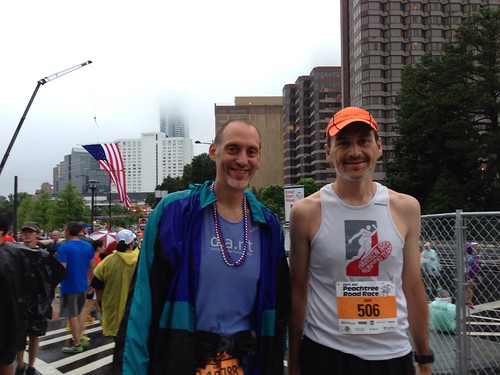
After a quick ride to Buckhead, Marc and I found our starting corrals. Here we are under the traditional gigantic American flag near the start:
Then we split up. I had managed to get placed in the "top seeded" corral by virtue of my 18:03 5K PR. I ditched the umbrella and started my warm-up. It was amazing to be warming up and seeing Olympic silver medalist Meb Keflezghi going through his strides at the same time.
Then, before I knew it, the race started, and Meb and all the Kenyans dashed off ahead, quickly putting me and the 800 or so other "top seeded" runners in our place!
To run a 40-minute 10K, you need to average a 6:26 pace per mile. But the first three miles of this race were flat or downhill, followed by two tough uphill stretches, so my plan was to run these first three miles at a 6:07 pace, which in theory would put me on track for a 38-minute 10K. Then if need be I could slow down on the hills.
Now, depending on your perspective, my race unfolded one of two ways. I think the easiest way to explain it is just to describe each race separately.
Race 1
In this race, I took off at what felt like a solid 6:07 pace, but when I reached Mile 1, I saw that I had completed it in 6:29 (!). Oh no! Fortunately the downhill second mile allowed me to recover, and I pulled of an amazingly speedy 5:49, so I wasn't too far off my planned pace.
In Mile 3, I tried to maintain my pace on the downhill, but again I struggled, especially at the end of the mile, when we began the tough uphill stretch that we'd finish in Mile 4. The rain had stopped, so instead of getting cooled by the raindrops, we ran in what amounted to a steambath. Mile 3's split was 6:39. No, no, no! I did a quick calculation in my head and figured out that I'd need to run a 6:26 pace for the rest of the race to have any chance of reaching my goal. And Mile 4 and 5 were both uphill.
The hill on Mile 4 was as brutal as it looked on the course elevation profile beforehand. I took a cup of water at the water station and dumped it over my head to try to cool off, and it helped for a while, but soon I found myself gasping for breath and feeling nearly completely spent. Mile 4 split: 6:51. It wasn't looking good.
Mile 5 was even worse. Despite my best efforts, I just couldn't seem to make my body move as quickly as I needed to in order to reach my goal. I needed to be going faster, but I just kept slowing down. My split for the mile was a pathetic 7:37. There was no way I was going to break 40 minutes... it was impossible.
Now, before I get to the end of Race 1, let me bring you up to speed on my performance in Race 2. It'll be up to you to figure out which race I really ran.
Race 2
As the race started, I noticed a big gap ahead of me and took advantage, building up my pace moment by moment. After a third of a mile I noticed I was running roughly a 5:33 pace, so I backed off just a touch. I was breathing heavily but it felt like this pace was sustainable. As I passed the first mile marker I hit my lap button and was very close to my target pace: 6:08 per mile. On the downhill Mile 2, I continued at a similar pace, but things felt easier since I had the aid of the hill. I checked my pace frequently and found that I was pretty much in the zone I needed to be in. My pace as I passed the Mile 2 marker was 6:06. Perfect!
The race continued downhill and I continued to perform well, though I was worried about the hill coming up in Mile 4. It was amazing to be among so many runners at a similar ability level to myself, running so fast -- Boston had been like this in terms of the other runners' abilities, but we were running 7:30s, not 6:07s! I was slowed a bit by the uphill at the end of Mile 3, but still turned in a respectable 6:13 pace for the mile.
For Mile 4 I told myself I could slow down to as much as a 6:45 pace -- this was the biggest hill on the course. I had thought I might be passing some other runners here but everyone seemed to be holding their pace about as well as I was. I noticed my pace getting slower, slower, slower, but then I saw the crest of the hill ahead and tried to give an equal effort as the course leveled off and then went into a brief downhill stretch. I managed to pick it up quite a bit at the end of the mile, finishing in a 6:37 pace. I just might be able to do this.
Mile 5 was in some ways tougher than Mile 4 -- there wasn't the same sustained uphill, but the rolling hills had a net uphill of 85 feet. I tried to remind myself that there were just two miles left, but I slowed a bit anyways, finishing the mile in a 6:43 pace. Still, with a downhill Mile 6 ahead, I might be able to do this.
Race 1
I knew I wasn't going to break 40, but I figured I might as well keep pushing. As I turned the corner from Peachtree onto 10th Street, I saw my wife Greta cheering me on, and I gave it another push, striding as hard as I could as I ran down the hill towards the finish. Mile 6 split: 5:34. Fast, but certainly not fast enough, right?
Race 2
I kept pushing, knowing there was just a mile to go. I waved to Greta as I saw her on the corner of Peachtree and 10th, then strode purposefully down the hill towards the finish line. If I could keep my pace under 6:26 for this mile, I should be able to make it. As I passed the mile marker, my pace was 6:21.
Both Races: The finish
The finish unfolded pretty much the same way in Race 1 and Race 2. The only difference was my attitude. In Race 1, I was resigned to a slow finish, but determined not to give up. In Race 2, I picked up the pace as I always do over the final yards of a race. I looked up and saw the finish line clock, just 50 yards away. It read 39:40. In both races, it read 39:40. I was going to make it. I did make it. My official chip finishing time was 39:46 (accounting for the few seconds it took me to get to the start)! On a warm, exceptionally humid day, I had managed to overcome my usual poor performances in these conditions and put in a very solid 10K on a very tough course. I couldn't believe it!
So what was the difference between Race 1 and Race 2? It was the mile markers. The official mile markers must have been placed inaccurately, so despite the fact that the overall distance of the race was recorded as a reasonably accurate 6.28 miles on my Garmin, there was substantial variance in each mile. Here's the distance I recorded for each mile marker:
1. 1.06
2. 0.96
3. 1.07
4. 1.04
5. 1.12
6. 0.88
Final 0.2 miles: 0.15
So through the Mile 5 marker I had actually run about 5.25 miles! Then the last 1.2 miles was actually 1.03 miles, so I made up all the time I thought I had lost. The actual mental experience I had was Race 1 -- Race 2 is how I would have experienced the race if I had only paid attention to my Garmin-reported pace instead of my actual times for each marked mile.
Crazy race experience, but still neat to run among so many fast runners, through the streets of a big city, and to do well on a very humid day. Here's the photo Greta took of me near the finish line:

You can see the thousands of runners who had yet to finish the race behind me! They would continue running for at least another hour after this!
Below is my Garmin record for the race.
As it turned out, the weather was a little cooler than usual for this event -- around 70 degrees -- but it was extremely humid. In fact, at 6:15 when I met fellow DARTer Marc Hirschfield at the MARTA stop to the start line, it was raining. The forecast was for intermittent rain all day, so I had bought a cheap umbrella that I planned on ditching at the start line.
After a quick ride to Buckhead, Marc and I found our starting corrals. Here we are under the traditional gigantic American flag near the start:
Then we split up. I had managed to get placed in the "top seeded" corral by virtue of my 18:03 5K PR. I ditched the umbrella and started my warm-up. It was amazing to be warming up and seeing Olympic silver medalist Meb Keflezghi going through his strides at the same time.
Then, before I knew it, the race started, and Meb and all the Kenyans dashed off ahead, quickly putting me and the 800 or so other "top seeded" runners in our place!
To run a 40-minute 10K, you need to average a 6:26 pace per mile. But the first three miles of this race were flat or downhill, followed by two tough uphill stretches, so my plan was to run these first three miles at a 6:07 pace, which in theory would put me on track for a 38-minute 10K. Then if need be I could slow down on the hills.
Now, depending on your perspective, my race unfolded one of two ways. I think the easiest way to explain it is just to describe each race separately.
Race 1
In this race, I took off at what felt like a solid 6:07 pace, but when I reached Mile 1, I saw that I had completed it in 6:29 (!). Oh no! Fortunately the downhill second mile allowed me to recover, and I pulled of an amazingly speedy 5:49, so I wasn't too far off my planned pace.
In Mile 3, I tried to maintain my pace on the downhill, but again I struggled, especially at the end of the mile, when we began the tough uphill stretch that we'd finish in Mile 4. The rain had stopped, so instead of getting cooled by the raindrops, we ran in what amounted to a steambath. Mile 3's split was 6:39. No, no, no! I did a quick calculation in my head and figured out that I'd need to run a 6:26 pace for the rest of the race to have any chance of reaching my goal. And Mile 4 and 5 were both uphill.
The hill on Mile 4 was as brutal as it looked on the course elevation profile beforehand. I took a cup of water at the water station and dumped it over my head to try to cool off, and it helped for a while, but soon I found myself gasping for breath and feeling nearly completely spent. Mile 4 split: 6:51. It wasn't looking good.
Mile 5 was even worse. Despite my best efforts, I just couldn't seem to make my body move as quickly as I needed to in order to reach my goal. I needed to be going faster, but I just kept slowing down. My split for the mile was a pathetic 7:37. There was no way I was going to break 40 minutes... it was impossible.
Now, before I get to the end of Race 1, let me bring you up to speed on my performance in Race 2. It'll be up to you to figure out which race I really ran.
Race 2
As the race started, I noticed a big gap ahead of me and took advantage, building up my pace moment by moment. After a third of a mile I noticed I was running roughly a 5:33 pace, so I backed off just a touch. I was breathing heavily but it felt like this pace was sustainable. As I passed the first mile marker I hit my lap button and was very close to my target pace: 6:08 per mile. On the downhill Mile 2, I continued at a similar pace, but things felt easier since I had the aid of the hill. I checked my pace frequently and found that I was pretty much in the zone I needed to be in. My pace as I passed the Mile 2 marker was 6:06. Perfect!
The race continued downhill and I continued to perform well, though I was worried about the hill coming up in Mile 4. It was amazing to be among so many runners at a similar ability level to myself, running so fast -- Boston had been like this in terms of the other runners' abilities, but we were running 7:30s, not 6:07s! I was slowed a bit by the uphill at the end of Mile 3, but still turned in a respectable 6:13 pace for the mile.
For Mile 4 I told myself I could slow down to as much as a 6:45 pace -- this was the biggest hill on the course. I had thought I might be passing some other runners here but everyone seemed to be holding their pace about as well as I was. I noticed my pace getting slower, slower, slower, but then I saw the crest of the hill ahead and tried to give an equal effort as the course leveled off and then went into a brief downhill stretch. I managed to pick it up quite a bit at the end of the mile, finishing in a 6:37 pace. I just might be able to do this.
Mile 5 was in some ways tougher than Mile 4 -- there wasn't the same sustained uphill, but the rolling hills had a net uphill of 85 feet. I tried to remind myself that there were just two miles left, but I slowed a bit anyways, finishing the mile in a 6:43 pace. Still, with a downhill Mile 6 ahead, I might be able to do this.
Race 1
I knew I wasn't going to break 40, but I figured I might as well keep pushing. As I turned the corner from Peachtree onto 10th Street, I saw my wife Greta cheering me on, and I gave it another push, striding as hard as I could as I ran down the hill towards the finish. Mile 6 split: 5:34. Fast, but certainly not fast enough, right?
Race 2
I kept pushing, knowing there was just a mile to go. I waved to Greta as I saw her on the corner of Peachtree and 10th, then strode purposefully down the hill towards the finish line. If I could keep my pace under 6:26 for this mile, I should be able to make it. As I passed the mile marker, my pace was 6:21.
Both Races: The finish
The finish unfolded pretty much the same way in Race 1 and Race 2. The only difference was my attitude. In Race 1, I was resigned to a slow finish, but determined not to give up. In Race 2, I picked up the pace as I always do over the final yards of a race. I looked up and saw the finish line clock, just 50 yards away. It read 39:40. In both races, it read 39:40. I was going to make it. I did make it. My official chip finishing time was 39:46 (accounting for the few seconds it took me to get to the start)! On a warm, exceptionally humid day, I had managed to overcome my usual poor performances in these conditions and put in a very solid 10K on a very tough course. I couldn't believe it!
So what was the difference between Race 1 and Race 2? It was the mile markers. The official mile markers must have been placed inaccurately, so despite the fact that the overall distance of the race was recorded as a reasonably accurate 6.28 miles on my Garmin, there was substantial variance in each mile. Here's the distance I recorded for each mile marker:
1. 1.06
2. 0.96
3. 1.07
4. 1.04
5. 1.12
6. 0.88
Final 0.2 miles: 0.15
So through the Mile 5 marker I had actually run about 5.25 miles! Then the last 1.2 miles was actually 1.03 miles, so I made up all the time I thought I had lost. The actual mental experience I had was Race 1 -- Race 2 is how I would have experienced the race if I had only paid attention to my Garmin-reported pace instead of my actual times for each marked mile.
Crazy race experience, but still neat to run among so many fast runners, through the streets of a big city, and to do well on a very humid day. Here's the photo Greta took of me near the finish line:

You can see the thousands of runners who had yet to finish the race behind me! They would continue running for at least another hour after this!
Below is my Garmin record for the race.
Tuesday, June 25, 2013
The Awesome Epochal DART Hiking Expedition
As the DART Hiking Trip was in its late planning stages, a thought occurred to me. We were planning an epic 3-day hike through the Linville Gorge Wilderness. We wouldn't be able to start until after Tristan got off work at 5 p.m. on Friday. It was now Wednesday. Don't you usually need to get a permit to camp in a wilderness area? A quick Internet search confirmed it. I called the USFS ranger station in Nebo, NC, and they told me that they had already issued the maximum number of permits. The only way to get a permit now would be to show up at the Linville Gorge information cabin between 10 am and 5 pm Friday, where 15 more permits would be issued, first-come, first-served. Oops.
Then I realized that the gorge was just 2 hours from my house, and I didn't have to work Friday, so I decided to drive to the park Friday morning, then return home, permit in hand, in time for all of us to set off on the expedition. Three hours later, I was driving my tiny Honda Fit along a rough gravel road, wondering if I'd made a wrong turn. Finally I arrived at the cabin, which turned out to be about a half-mile off a paved highway. Outside of the cabin was a sign, "Spence Ridge Bridge is OUT." I didn't have time to wonder what that meant; I got the permit, then took the quick way home, arriving back at 1:30.
After some frantic packing, I managed to meet Tristan and Joe at Tristan's office in Lincolnton, and by 6:00 pm we were finally on the road. We arrived at the trailhead at 7:30 -- we had about an hour and a half to hike 4 miles, straight uphill, set up camp, and cook dinner, before darkness arrived. Here's a photo of us before we started up the trail.

Tristan took the lead, and as we briskly marched up the hill, I realized that I hadn't hiked with people in such good shape for decades. I was used to being the fittest and most-experienced hiker in the group, but today that wasn't the case -- we were all equally matched. It meant that I had worked up a ferocious sweat within minutes. Within 15 minutes, we had climbed at least 500 vertical feet, and the views were already quite impressive. Our planned campsite involved another 1,300 feet of climbing, though. Despite carrying around 35 pounds each, we were walking at better than a 2-miles-per-hour pace. This is how fast I usually plan for hikes on level ground when carrying this much gear. Soon we were at the edge of the gorge, at an elevation of almost 3,000 feet. Here we all are, enjoying the view:

And here's another shot of the cliffs -- you can see they descend quite steeply into the gorge:

After another mile or so of hiking, we found a nice campsite -- with no water. We did a quick bit of figuring and decided we probably had enough water to make it through breakfast, so we went ahead and started pitching our tents. We had to cook our spaghetti dinner using headlamps, but the meal was quite satisfying. Tristan had even brought a box of wine for us to share with our meal. Delicious! There was only one problem. Joe had neglected to bring any kind of bowl or utensils for eating. Joe then reminded Tristan that he was supposed to bring utensils for him. "No problem," Tristan said. He had purchased some oatmeal that came in its own cup, so they dumped the oatmeal into a ziploc bag and used the oatmeal cups as beverage containers / bowls for the rest of the trip!
The next morning we got up and enjoyed coffee overlooking the gorge.

Then we packed up and got ready for a challenging day of hiking. The plan was to hike about 12 miles on Saturday, then 9 or so on Sunday when we had to be home by about 6 pm. Here we're about to start the day's travels:

Now we were hiking along the ridge line, and astonishing views presented themselves quite frequently. The Linville Gorge is known as the "Grand Canyon of North Carolina," and while that may be a bit of an exaggeration, there's no doubt that the scenery was stunning:


There weren't a lot of flat sections on this trail -- everything seemed to be heading straight up or straight down. As we made our way up one of the steeper sections of the trail, we noticed a peculiar sort of trail marker:

Yep, you're seeing that correctly. Someone on the trail crew thought it would be funny to taunt hikers with a little smiley face as they slogged up this steep trail with no switchbacks.

Eventually we emerged at another viewpoint, and we began to see Table Rock in the distance. Several DARTers had run the Table Rock Ultra a couple years ago, so it was neat to see it for ourselves.
We ran in to some climbers here, and they were nice enough to take our photo in front of the rock.

Hiking further along, we were surprised to see the trail pass through a very narrow gap. Here's Joe heading into the gap:

And here's Tristan on the way out:

Over the next few miles we saw some really spectacular rock formations including the Chimneys and Table Rock, but somehow neglected to take photos of any of them. In this area we ran into a lot of day hikers and climbers because there is a parking lot a mile from the top of Table Rock. It was surreal to be working up a huge lather of sweat, carrying heavy packs, and see day-hikers in capri pants and flip-flops strolling by, asking us how far it was to the parking lot.
After lunch on the Chimneys, we headed on to Table Rock, where there were more stunning (and undocumented) views. I had planned to take a photo of the group here with my phone and post it to the DART Facebook page (the better to make my fellow DARTers drool in jealousy), but despite not having turned the phone on for the entire trip, the battery was completely drained. Oh well, you'll just have to take my word for it -- the views were stunning.
Next our trail headed down into the canyon. STRAIGHT down, that is. It was a quad-searing descent, with nary a switchback to be had, on a very technical trail. We ran into several hikers making their way up the trail or we might have thought we were going the wrong way. Eventually we reached a nicer trail, "Spence Ridge." Now, where had we heard that name before? It sounded vaguely familiar. After continuing down on a more gradual path for a half mile or so, we had our answer. We had arrived at the Linville River, but where there was supposed to be a bridge there were just a few twisted bolts embedded in a rock.
About 10 people were here, most of them wearing bathing suits. The water was deep, and where it wasn't deep, it was inaccessible. It was a beautiful day for a swim, but there was no obvious spot for a ford. Two young women in bikinis were trying to coax their reluctant dog across the river. Finally they carried him across a gap and hopped across some rocks. There were a few deep spots, perhaps two to three feet deep, with rapidly-moving current. The dog fell in the water a couple of times and didn't like it. I decided to head over to where they had made their way across and see if I could cross without getting my pack wet. Then I looked back to the large rock where the bridge had been and saw this:
A couple of kind-hearted hikers had offered to carry our packs across for us. There was no access to this spot except through deep water, but once they had established themselves, it wasn't hard for them to port our gear over!


Next, we swam across and helped haul the gear over the remaining gap:

Everything made it across, and the only thing that got wet was our shorts! We even saw a bald eagle flying overhead as we finished porting our gear. For fun, I decided to put my Garmin in swim mode for the brief water-borne phase of the trip. Here's the satellite image of my 0.02-mile swim:
It was a warm day, so we knew we'd be dry in no time. We put our shoes back on and continued up the trail, now following alongside the river. The scenery was completely different at the bottom of the gorge, at an elevation of roughly 1,400 feet. We could even occasionally look up and see the cliffs we had been hiking atop earlier in the day:

Finally, after about eight hours of hiking, we decided to call it a day. We found a great campsite along the river, and Tristan and I swam across and found a great rock for sunbathing:

Here we are back at the campsite:

After another good dinner followed by some good Scotch, we bedded down for the night. In the morning we had another breakfast with a view:


Then it was time to head out on the trail. We figured we had about 10 miles to cover. Within a hundred yards of breaking camp, the trail got rough again. Within a couple miles, we had lost the trail completely. Or perhaps the trail had simply been obliterated. We were in an area where there had been a rockslide a couple years back, and it looked to me as if the trail had never really been rebuilt. Fortunately Tristan had an excellent hiking GPS unit and a great knack for navigation, and was able to find the trail again, but it took a solid 30 minutes of bushwhacking and climbing over boulders. Did I mention we were wearing 35-pound packs while doing this?
One small consolation on this part of the trip is that we did see a few rhododendrons in bloom. In my experience, you rarely see the blooms while hiking in the mountains, so I did my best to document it:

We continued to hike along, seeing a few other campers, one of whom warned us of a major climb ahead. Tristan thought we could continue along the river, and the map seemed to indicate there was a river route, but soon we found ourselves on a different trail, and consulting the map we could see that we were indeed headed up the side of the Gorge. Tristan suggested we go back and look for the river trail, but I argued for climbing out where the trail was more obvious. Then we could hook on to the road for a couple miles and make up for whatever time we lost on the climb. Somehow my argument prevailed, but when we were about halfway up the climb, some of the members of our team seemed to think we had made the wrong decision. I don't understand why they didn't think that a 1,500-foot climb in the blazing heat on a grade that averaged about 30 percent wasn't a good idea. These photos should give you some sense of the mental state of the expedition about halfway up the climb:
Finally we arrived at the road, and took the opportunity for a group portrait with the "Bridge Out" sign:
Here's the elevation profile for Sunday's hike.

Dave's Detour is that tall section in the middle. We pretty much climbed all the way up the ridge, only to climb back down again. In my defense, there was at least a mile section along the river with no marked trail on the map, so while we did have a hard climb, we may have avoided a lot of bushwhacking. I'll leave it to you to decide whose plan was better.
In any case, we had a nice three mile walk along the road before heading back down the ridge, where progress was quite rapid and we had a pleasant discussion of our views:
Finally we headed down, down, down to the river again where there was no one to help us ford across. Fortunately once we crossed there would only be a couple more miles left to our journey, so it didn't really matter if we got our gear wet.
It was just an easy hike up what we now considered to be a very gradual slope to the car, and we were done! Until Joe noticed a tick on his leg. Then Tristan noticed a tick on his leg. Then I found one, and Joe found several more:
After tick removal we posed for our triumphant post-hike photo!
Then I realized that the gorge was just 2 hours from my house, and I didn't have to work Friday, so I decided to drive to the park Friday morning, then return home, permit in hand, in time for all of us to set off on the expedition. Three hours later, I was driving my tiny Honda Fit along a rough gravel road, wondering if I'd made a wrong turn. Finally I arrived at the cabin, which turned out to be about a half-mile off a paved highway. Outside of the cabin was a sign, "Spence Ridge Bridge is OUT." I didn't have time to wonder what that meant; I got the permit, then took the quick way home, arriving back at 1:30.
After some frantic packing, I managed to meet Tristan and Joe at Tristan's office in Lincolnton, and by 6:00 pm we were finally on the road. We arrived at the trailhead at 7:30 -- we had about an hour and a half to hike 4 miles, straight uphill, set up camp, and cook dinner, before darkness arrived. Here's a photo of us before we started up the trail.

Tristan took the lead, and as we briskly marched up the hill, I realized that I hadn't hiked with people in such good shape for decades. I was used to being the fittest and most-experienced hiker in the group, but today that wasn't the case -- we were all equally matched. It meant that I had worked up a ferocious sweat within minutes. Within 15 minutes, we had climbed at least 500 vertical feet, and the views were already quite impressive. Our planned campsite involved another 1,300 feet of climbing, though. Despite carrying around 35 pounds each, we were walking at better than a 2-miles-per-hour pace. This is how fast I usually plan for hikes on level ground when carrying this much gear. Soon we were at the edge of the gorge, at an elevation of almost 3,000 feet. Here we all are, enjoying the view:

And here's another shot of the cliffs -- you can see they descend quite steeply into the gorge:

After another mile or so of hiking, we found a nice campsite -- with no water. We did a quick bit of figuring and decided we probably had enough water to make it through breakfast, so we went ahead and started pitching our tents. We had to cook our spaghetti dinner using headlamps, but the meal was quite satisfying. Tristan had even brought a box of wine for us to share with our meal. Delicious! There was only one problem. Joe had neglected to bring any kind of bowl or utensils for eating. Joe then reminded Tristan that he was supposed to bring utensils for him. "No problem," Tristan said. He had purchased some oatmeal that came in its own cup, so they dumped the oatmeal into a ziploc bag and used the oatmeal cups as beverage containers / bowls for the rest of the trip!
The next morning we got up and enjoyed coffee overlooking the gorge.

Then we packed up and got ready for a challenging day of hiking. The plan was to hike about 12 miles on Saturday, then 9 or so on Sunday when we had to be home by about 6 pm. Here we're about to start the day's travels:

Now we were hiking along the ridge line, and astonishing views presented themselves quite frequently. The Linville Gorge is known as the "Grand Canyon of North Carolina," and while that may be a bit of an exaggeration, there's no doubt that the scenery was stunning:


There weren't a lot of flat sections on this trail -- everything seemed to be heading straight up or straight down. As we made our way up one of the steeper sections of the trail, we noticed a peculiar sort of trail marker:

Yep, you're seeing that correctly. Someone on the trail crew thought it would be funny to taunt hikers with a little smiley face as they slogged up this steep trail with no switchbacks.

Eventually we emerged at another viewpoint, and we began to see Table Rock in the distance. Several DARTers had run the Table Rock Ultra a couple years ago, so it was neat to see it for ourselves.
 |
| Yep, that's me and Table Rock |

Hiking further along, we were surprised to see the trail pass through a very narrow gap. Here's Joe heading into the gap:

And here's Tristan on the way out:

Over the next few miles we saw some really spectacular rock formations including the Chimneys and Table Rock, but somehow neglected to take photos of any of them. In this area we ran into a lot of day hikers and climbers because there is a parking lot a mile from the top of Table Rock. It was surreal to be working up a huge lather of sweat, carrying heavy packs, and see day-hikers in capri pants and flip-flops strolling by, asking us how far it was to the parking lot.
After lunch on the Chimneys, we headed on to Table Rock, where there were more stunning (and undocumented) views. I had planned to take a photo of the group here with my phone and post it to the DART Facebook page (the better to make my fellow DARTers drool in jealousy), but despite not having turned the phone on for the entire trip, the battery was completely drained. Oh well, you'll just have to take my word for it -- the views were stunning.
Next our trail headed down into the canyon. STRAIGHT down, that is. It was a quad-searing descent, with nary a switchback to be had, on a very technical trail. We ran into several hikers making their way up the trail or we might have thought we were going the wrong way. Eventually we reached a nicer trail, "Spence Ridge." Now, where had we heard that name before? It sounded vaguely familiar. After continuing down on a more gradual path for a half mile or so, we had our answer. We had arrived at the Linville River, but where there was supposed to be a bridge there were just a few twisted bolts embedded in a rock.
About 10 people were here, most of them wearing bathing suits. The water was deep, and where it wasn't deep, it was inaccessible. It was a beautiful day for a swim, but there was no obvious spot for a ford. Two young women in bikinis were trying to coax their reluctant dog across the river. Finally they carried him across a gap and hopped across some rocks. There were a few deep spots, perhaps two to three feet deep, with rapidly-moving current. The dog fell in the water a couple of times and didn't like it. I decided to head over to where they had made their way across and see if I could cross without getting my pack wet. Then I looked back to the large rock where the bridge had been and saw this:
 |
| A plan in action! |


Next, we swam across and helped haul the gear over the remaining gap:

Everything made it across, and the only thing that got wet was our shorts! We even saw a bald eagle flying overhead as we finished porting our gear. For fun, I decided to put my Garmin in swim mode for the brief water-borne phase of the trip. Here's the satellite image of my 0.02-mile swim:
 |
| You can even see the (now-nonexistent) bridge! |

Finally, after about eight hours of hiking, we decided to call it a day. We found a great campsite along the river, and Tristan and I swam across and found a great rock for sunbathing:

Here we are back at the campsite:

After another good dinner followed by some good Scotch, we bedded down for the night. In the morning we had another breakfast with a view:


Then it was time to head out on the trail. We figured we had about 10 miles to cover. Within a hundred yards of breaking camp, the trail got rough again. Within a couple miles, we had lost the trail completely. Or perhaps the trail had simply been obliterated. We were in an area where there had been a rockslide a couple years back, and it looked to me as if the trail had never really been rebuilt. Fortunately Tristan had an excellent hiking GPS unit and a great knack for navigation, and was able to find the trail again, but it took a solid 30 minutes of bushwhacking and climbing over boulders. Did I mention we were wearing 35-pound packs while doing this?
 |
| This is what a South African looks like when he has re-located the trail |

We continued to hike along, seeing a few other campers, one of whom warned us of a major climb ahead. Tristan thought we could continue along the river, and the map seemed to indicate there was a river route, but soon we found ourselves on a different trail, and consulting the map we could see that we were indeed headed up the side of the Gorge. Tristan suggested we go back and look for the river trail, but I argued for climbing out where the trail was more obvious. Then we could hook on to the road for a couple miles and make up for whatever time we lost on the climb. Somehow my argument prevailed, but when we were about halfway up the climb, some of the members of our team seemed to think we had made the wrong decision. I don't understand why they didn't think that a 1,500-foot climb in the blazing heat on a grade that averaged about 30 percent wasn't a good idea. These photos should give you some sense of the mental state of the expedition about halfway up the climb:
 |
| "WHAT WERE YOU THINKING, MUNGER?" |
 |
| "What? You'r'e not enjoying sweating off 10 percent of your body mass?" |
 |
| No, I didn't wet my pants. That's all sweat! |

Dave's Detour is that tall section in the middle. We pretty much climbed all the way up the ridge, only to climb back down again. In my defense, there was at least a mile section along the river with no marked trail on the map, so while we did have a hard climb, we may have avoided a lot of bushwhacking. I'll leave it to you to decide whose plan was better.
In any case, we had a nice three mile walk along the road before heading back down the ridge, where progress was quite rapid and we had a pleasant discussion of our views:
 |
| "Munger, we would have been there by now if we'd just gone my way..." |
 |
| And our gear definitely got wet! |
 |
| Tick Count: Tristan, 3; Dave, 3; Joe, 12! |
 |
| Soon we'll have pizza! |
The expedition was complete! We drove back to civilization, in the form of a Mellow Mushroom pizza place where we enjoyed air conditioning and slice after slice of deliciousness. My GPS record of the journey is below.
Thursday, June 13, 2013
A couple tough workouts
I'm now prepping for two big races -- the Peachtree 10K in Atlanta July 4, and the Grandfather Mountain Marathon July 13. My goal for Peachtree is to break 40 minutes despite the heat, and my goal for Grandfather is simply to survive.
So for Grandfather I'm running a lot of hills, running a lot in the heat, and running a lot of mileage.
For Atlanta I'm running a lot in the heat, doing a lot of speed work, and running a lot of mileage.
Honestly, the hills won't hurt my Atlanta training and the speed work won't hurt my Grandfather training, so I'm really doing both.
This week was fairly typical: On Tuesday I needed some speed work. On my calendar was a time-based workout: 2 minutes fast, 2 minutes slow, then 1 minute fast, one minute slow, then 30 seconds fast, 30 seconds slow, repeated 8 times. But Chas had a different plan: 400 meters fast, then 400 slow, 200 fast, and 200 slow, repeated 6-8 times. This seemed close enough, so I decided to work with Chas instead of going it alone. Claire and her friend Chad also decided to join in.
Chas wanted to hit the 400s in around 82 seconds, and the 200s as fast as possible. It was a warm morning, quite humid, but not stiflingly hot. Here are my splits:

I forgot to hit "lap" so I didn't get a time for that first 400, but everything else was pretty consistent. Ultimately I'd like to get those 400s under 80 seconds, to match my goal of hitting a sub-5:00 1500 (sub 5:20 mile), but I feel like that's a solid workout in the heat.
Then today I had another speed workout planned (some 400s, plus 5 X 1,000 meters), but no one to run with -- everyone else, it seemed, had either an easy run or a tempo planned. But the Charlotte Running Club has a group that runs from the YMCA downtown every Thursday, and since they're a lot faster than me, I figured their "easy" run would basically be a tempo run for me. Claire decided to hop in on this run as well.
When I woke up at 5:10 a.m., I looked at my thermometer, and it read 77 degrees. Really? It's still dark and the temperature was already 77? I didn't even want to know how humid it was. I wondered if this was really such a great plan -- drive 20 miles just to run 9 miles? But Claire needed a ride, so I was pretty much fully committed anyways.
I showed up at the Y and saw lots of young, skinny guys that I vaguely recognized from Facebook. They all looked like they could knock out 80-second 400s in their sleep. We took off, with Claire in the lead, and soon were knocking off 7:15-and-faster miles. A 7:15 pace isn't really too bad for me in good conditions. For a while I was even thinking of that as my marathon pace. But it was hot and humid, and after 4 or 5 miles, the pace had quickened to 6:58. I was starting to drop off the back of the pack, and I realized I had no idea how to get back to the Y. That was decent motivation for me to not completely phone in the rest of the workout, so I did my best to hang with the group, which only seemed to be running faster. Finally at around 7 miles I knew I could no longer keep up -- but fortunately I now could figure out how to get back to the Y, so I decided to slow down. I ran mile 8 in a 7:40 pace.
Thankfully, about this point, Claire decided to wait for me and she and I ran the final mile at an 8:00 pace. Overall I was pretty happy with the run -- I had averaged 7:23 over 9 miles in very hot and humid conditions, and the first 7 miles averaged about a 7:15 pace. I still need to improve -- in Atlanta I'm hoping to run a 6:26 pace -- but I think I'm still not fully adapted to the summer heat.
After making a lame joke ("I needed to make sure Claire didn't get lost"), I chatted with the CRC guys, who were quite friendly and unconcerned with how much my run had sucked compared to theirs.
Not an ideal week, but not terrible. I've still got quite a ways to go, though -- this is a 70-mile week, and I've only completed 32, with 3 days left. I'm going to run 4 more this evening, 6 tomorrow, then 10 on Saturday and 18 (!) on Sunday. Wish me luck!
Details of today's workout are below.
So for Grandfather I'm running a lot of hills, running a lot in the heat, and running a lot of mileage.
For Atlanta I'm running a lot in the heat, doing a lot of speed work, and running a lot of mileage.
Honestly, the hills won't hurt my Atlanta training and the speed work won't hurt my Grandfather training, so I'm really doing both.
This week was fairly typical: On Tuesday I needed some speed work. On my calendar was a time-based workout: 2 minutes fast, 2 minutes slow, then 1 minute fast, one minute slow, then 30 seconds fast, 30 seconds slow, repeated 8 times. But Chas had a different plan: 400 meters fast, then 400 slow, 200 fast, and 200 slow, repeated 6-8 times. This seemed close enough, so I decided to work with Chas instead of going it alone. Claire and her friend Chad also decided to join in.
Chas wanted to hit the 400s in around 82 seconds, and the 200s as fast as possible. It was a warm morning, quite humid, but not stiflingly hot. Here are my splits:
I forgot to hit "lap" so I didn't get a time for that first 400, but everything else was pretty consistent. Ultimately I'd like to get those 400s under 80 seconds, to match my goal of hitting a sub-5:00 1500 (sub 5:20 mile), but I feel like that's a solid workout in the heat.
Then today I had another speed workout planned (some 400s, plus 5 X 1,000 meters), but no one to run with -- everyone else, it seemed, had either an easy run or a tempo planned. But the Charlotte Running Club has a group that runs from the YMCA downtown every Thursday, and since they're a lot faster than me, I figured their "easy" run would basically be a tempo run for me. Claire decided to hop in on this run as well.
When I woke up at 5:10 a.m., I looked at my thermometer, and it read 77 degrees. Really? It's still dark and the temperature was already 77? I didn't even want to know how humid it was. I wondered if this was really such a great plan -- drive 20 miles just to run 9 miles? But Claire needed a ride, so I was pretty much fully committed anyways.
I showed up at the Y and saw lots of young, skinny guys that I vaguely recognized from Facebook. They all looked like they could knock out 80-second 400s in their sleep. We took off, with Claire in the lead, and soon were knocking off 7:15-and-faster miles. A 7:15 pace isn't really too bad for me in good conditions. For a while I was even thinking of that as my marathon pace. But it was hot and humid, and after 4 or 5 miles, the pace had quickened to 6:58. I was starting to drop off the back of the pack, and I realized I had no idea how to get back to the Y. That was decent motivation for me to not completely phone in the rest of the workout, so I did my best to hang with the group, which only seemed to be running faster. Finally at around 7 miles I knew I could no longer keep up -- but fortunately I now could figure out how to get back to the Y, so I decided to slow down. I ran mile 8 in a 7:40 pace.
Thankfully, about this point, Claire decided to wait for me and she and I ran the final mile at an 8:00 pace. Overall I was pretty happy with the run -- I had averaged 7:23 over 9 miles in very hot and humid conditions, and the first 7 miles averaged about a 7:15 pace. I still need to improve -- in Atlanta I'm hoping to run a 6:26 pace -- but I think I'm still not fully adapted to the summer heat.
After making a lame joke ("I needed to make sure Claire didn't get lost"), I chatted with the CRC guys, who were quite friendly and unconcerned with how much my run had sucked compared to theirs.
Not an ideal week, but not terrible. I've still got quite a ways to go, though -- this is a 70-mile week, and I've only completed 32, with 3 days left. I'm going to run 4 more this evening, 6 tomorrow, then 10 on Saturday and 18 (!) on Sunday. Wish me luck!
Details of today's workout are below.
Monday, June 10, 2013
Race Recap: Powerade State Games 1500 meters
I'm not really a track runner, but I did run track for one year in college, and I have a vague recollection of breaking 5:00 in the 1500. So when I noticed that the Powerade State Games were going to be in Charlotte this year, I decided to sign up and see if I could break 5:00, over 25 years after I think I remember doing it before.
For those of you not well-versed in standard metric track distances, the 1500-meter run is just under a mile in length. Modern tracks are 400 meters around, with 4 laps -- 1600 meters -- equal to almost exactly a mile (though technically a mile is 1,609.34 meters). So the 1500 is 3 and 3/4 laps. To break 5 minutes you need to average 1:20 per lap, plus 1 minute for the final 3/4 lap. But before you do that, you must wait...and wait...and wait.
I had to arrive at the track before 9:30 a.m. to check in. Then I took a look at the program of events:
There were no times listed for any of the events -- one event would simply start as soon as the previous one was finished.
So I decided to settle in on a shady knoll above the track. It was the only shaded area with a view of the track itself, and the day was already stiflingly hot. I had a Kindle loaded with William Faulkner's The Sound and the Fury, so I was quite certain I would not run out of reading material. First up was the 3,000-meter race walk, 7 and a half laps. For fun, I timed one of the laps -- it took nearly 3 minutes to complete. This was going to be a looooong day.
The 3,000-meter run was a little quicker, but it still took nearly 20 minutes.
Next came the hurdles. It took nearly as long to set up the hurdles as it did for the race-walkers to complete their event. After all that, there was just one heat, lasting 15 seconds!
Finally I figured out what the main attraction of this meet was: The 100-meter dash. Wave after wave of men competed, each one fiddling with his blocks for quite some time before the start.
Meanwhile there were four competitors in the Pentathlon, so those running events (a 200-meter and 1500-meter dash) also took up some track time. By the time my event was finally called, it was 3:15 PM. It was a sweltering day, and even warmer down on the track. But it had cooled just a touch from some of the early competitions. I decided to do a very limited warm-up, figuring I was already plenty warm. I did a few strides while the women competed, and that was that.
Finally it was the men's turn. There were about 10 men competing, so they put us all together in a single heat. Most of the men looked to be quite a bit older than me, and it didn't look like any of them would be faster than me -- but you never know! In a flash, we were off. In hindsight, I probably should have taken the lead right away, but a fellow who looked like he had a spare 15 pounds or so around his waist ended up cutting in front of me.
I had my Garmin on, and while I knew it wasn't going to be perfectly accurate with my pace, I hoped it would at least give me a good sense of how fast I was going. I would need to do slightly better than 5:20 per mile in order to break 5:00 flat. Then I could hit "lap" at every lap to see if I was making my 1:20 splits. The guy was actually running about a 5:10 pace according to Garmin, so I stayed behind him. As we rounded the second corner, he seemed to be slowing a bit, so I strode past him on the outside. From here on out, I'd be running against the clock. I hit "lap" as I crossed the starting line and saw 1:22. Crap. Too slow.
But each breath of hot air told me that I shouldn't try to speed up too much. The watch continued to read a sub-5:20 mile pace, so I felt like I was doing okay. But as I finished my second lap, I forgot to hit "lap" right away. I remembered a second or two later and pressed the button, but my lap time was 1:27. That didn't seem possible! Oh well, there was nothing to do but keep going. I was breathing harder than ever, and I started to doubt whether I could finish. Was anyone in line to catch me? I didn't dare look back. I tried to pick up the pace, and strode as hard as I could to finish lap 3: 1:21. Faster, but still not fast enough.
I put everything I could into the final 300 meters. I was running all-out as I rounded the last corner and headed into the final straight. I couldn't imagine keeping this up all the way to the finish, but it was just 100 meters...I had to. Somehow, I did, and I powered across the line. My time: 5:09 on my watch, officially, 5:08.85. Not what I was looking for -- that works out to a 5:31 pace, or slower than what I had done for a mile on the road last year about this time. Granted, this time it was much hotter, and I had no one ahead of me to pull me along, but still, it was depressing to see I had made no progress.
Another problem with my performance is that I was relying heavily on my Garmin, and as it turned out, the Garmin was WAY off. It measured the total distance as a full mile. According to Garmin, I had run much faster than I'd ever gone; if I'd really run a 5:09 mile, then I could have completed 1500 meters in 4:48!
Despite being off by over 7 percent, the Garmin record did tell me something about the race. Here are my splits according to Garmin:

Assuming the Garmin was off by the same percentage throughout the event, my pace improved with each lap. That's probably not ideal. Really I should have run lap 1 faster than laps 2 and 3, when I was more fatigued, before picking it up again for the final lap. That means I should have taken the lead right from the start, instead of settling in behind another runner.
I think if I had done that I might have been able to shave a considerable amount off my time. Could I have shaved off a full 9 seconds? I'm not sure. It was a very hot day, and surely that was costing me as well. Perhaps if I had had a perfect pacer to follow I might have been able to do it, but since that wasn't in the cards, I'd say the best I could have done yesterday would have been about 5:04. If I ever want to break 5:00 in a 1500, I'll also need to be in better shape than I am right now.
I'd be interested to know if I could get a more accurate pace out of a Garmin if I used a footpod instead of the GPS. Let me know if you've had success going that route on a track.
(Inaccurate) GPS details of my race are below.
For those of you not well-versed in standard metric track distances, the 1500-meter run is just under a mile in length. Modern tracks are 400 meters around, with 4 laps -- 1600 meters -- equal to almost exactly a mile (though technically a mile is 1,609.34 meters). So the 1500 is 3 and 3/4 laps. To break 5 minutes you need to average 1:20 per lap, plus 1 minute for the final 3/4 lap. But before you do that, you must wait...and wait...and wait.
I had to arrive at the track before 9:30 a.m. to check in. Then I took a look at the program of events:
Track Events
Race Walks
3,000 Meter Run
80/100/110 Hurdles
100 Meter Dash (Finals)
800 Meter Dash
400 Meter Dash
4 x 100 Meter Relay
1500 Meter Run
300/400 Meter Hurdles
200 Meter Dash
4 x 400 Meter Relay
There were no times listed for any of the events -- one event would simply start as soon as the previous one was finished.
So I decided to settle in on a shady knoll above the track. It was the only shaded area with a view of the track itself, and the day was already stiflingly hot. I had a Kindle loaded with William Faulkner's The Sound and the Fury, so I was quite certain I would not run out of reading material. First up was the 3,000-meter race walk, 7 and a half laps. For fun, I timed one of the laps -- it took nearly 3 minutes to complete. This was going to be a looooong day.
The 3,000-meter run was a little quicker, but it still took nearly 20 minutes.
Next came the hurdles. It took nearly as long to set up the hurdles as it did for the race-walkers to complete their event. After all that, there was just one heat, lasting 15 seconds!
Finally I figured out what the main attraction of this meet was: The 100-meter dash. Wave after wave of men competed, each one fiddling with his blocks for quite some time before the start.
Meanwhile there were four competitors in the Pentathlon, so those running events (a 200-meter and 1500-meter dash) also took up some track time. By the time my event was finally called, it was 3:15 PM. It was a sweltering day, and even warmer down on the track. But it had cooled just a touch from some of the early competitions. I decided to do a very limited warm-up, figuring I was already plenty warm. I did a few strides while the women competed, and that was that.
Finally it was the men's turn. There were about 10 men competing, so they put us all together in a single heat. Most of the men looked to be quite a bit older than me, and it didn't look like any of them would be faster than me -- but you never know! In a flash, we were off. In hindsight, I probably should have taken the lead right away, but a fellow who looked like he had a spare 15 pounds or so around his waist ended up cutting in front of me.
I had my Garmin on, and while I knew it wasn't going to be perfectly accurate with my pace, I hoped it would at least give me a good sense of how fast I was going. I would need to do slightly better than 5:20 per mile in order to break 5:00 flat. Then I could hit "lap" at every lap to see if I was making my 1:20 splits. The guy was actually running about a 5:10 pace according to Garmin, so I stayed behind him. As we rounded the second corner, he seemed to be slowing a bit, so I strode past him on the outside. From here on out, I'd be running against the clock. I hit "lap" as I crossed the starting line and saw 1:22. Crap. Too slow.
But each breath of hot air told me that I shouldn't try to speed up too much. The watch continued to read a sub-5:20 mile pace, so I felt like I was doing okay. But as I finished my second lap, I forgot to hit "lap" right away. I remembered a second or two later and pressed the button, but my lap time was 1:27. That didn't seem possible! Oh well, there was nothing to do but keep going. I was breathing harder than ever, and I started to doubt whether I could finish. Was anyone in line to catch me? I didn't dare look back. I tried to pick up the pace, and strode as hard as I could to finish lap 3: 1:21. Faster, but still not fast enough.
I put everything I could into the final 300 meters. I was running all-out as I rounded the last corner and headed into the final straight. I couldn't imagine keeping this up all the way to the finish, but it was just 100 meters...I had to. Somehow, I did, and I powered across the line. My time: 5:09 on my watch, officially, 5:08.85. Not what I was looking for -- that works out to a 5:31 pace, or slower than what I had done for a mile on the road last year about this time. Granted, this time it was much hotter, and I had no one ahead of me to pull me along, but still, it was depressing to see I had made no progress.
Another problem with my performance is that I was relying heavily on my Garmin, and as it turned out, the Garmin was WAY off. It measured the total distance as a full mile. According to Garmin, I had run much faster than I'd ever gone; if I'd really run a 5:09 mile, then I could have completed 1500 meters in 4:48!
Despite being off by over 7 percent, the Garmin record did tell me something about the race. Here are my splits according to Garmin:

Assuming the Garmin was off by the same percentage throughout the event, my pace improved with each lap. That's probably not ideal. Really I should have run lap 1 faster than laps 2 and 3, when I was more fatigued, before picking it up again for the final lap. That means I should have taken the lead right from the start, instead of settling in behind another runner.
I think if I had done that I might have been able to shave a considerable amount off my time. Could I have shaved off a full 9 seconds? I'm not sure. It was a very hot day, and surely that was costing me as well. Perhaps if I had had a perfect pacer to follow I might have been able to do it, but since that wasn't in the cards, I'd say the best I could have done yesterday would have been about 5:04. If I ever want to break 5:00 in a 1500, I'll also need to be in better shape than I am right now.
I'd be interested to know if I could get a more accurate pace out of a Garmin if I used a footpod instead of the GPS. Let me know if you've had success going that route on a track.
(Inaccurate) GPS details of my race are below.
Subscribe to:
Posts (Atom)