Friday, July 22, 2011

A run dripping with comedy and error - mostly error

I knew the run would be off to a bad start when I got up and looked at our thermometer. At 6:30 a.m., it registered 78 degrees. Then I looked in my drawer for running gear; my usual shorts weren't clean, so I unthinkingly grabbed an older pair. They had an internal pocket which should be fine for storing the gel pack I'd need to get through my planned 11 miles, so they should be okay, right?

I went downstairs and plotted out a course on gmap-pedometer. I didn't want to do the usual thing, so I planned something a little more ambitious, heading out of town. It might be closer to 12 miles than 11, but I could handle that, right?

Next I noticed that Jim had unplugged my Garmin so he could recharge his computer. I hoped I'd have enough battery life to record the whole run. Then I loaded a podcast in the iPod and headed out the door. It was a steamy morning, with cicadas already at full buzz. Four miles in, I was already completely drenched with sweat. I had 20 ounces of water, and I needed to make it last until Mile 10, when there would be a water fountain. At Mile 4 I took a brief walk break, then kept running. At Mile 6 I ate my gel and drank some water. At Mile 6.5 I had to climb a fence, but kept running.

Then the trouble began. Around Mile 7, I noticed my GPS was flashing an alarm: "Battery Low. Press Enter." Why did I have to press enter just because my battery was low? I know my battery is low, now move on--there's nothing I can do about it.

At Mile 7.42 I saw the first other runner, Will, who I've run with before. We exchanged sweaty glances and kept running. I ran a little further up the trail and glanced down at the GPS again. The distance had barely changed: Was I really going that slow? After what seemed like another mile, I looked down at the GPS and it still was in Mile 7. This mile just wouldn't end!

Finally, after what felt like another half mile, I looked down again and realized that my GPS timer had stopped. I was still at Mile 7.42. It must have stopped over a mile back, when it flashed the "battery low" warning. What idiot came up with that feature? I can just imagine the conversation among the engineers at Garmin:

ENGINEER 1: What should we do when the battery runs low?
ENGINEER 2: Well, runners should be warned about a low battery. After all, you wouldn't want the timer to stop recording in the middle of the run.
ENGINEER 1: Hmm... what to do, what to do? I know! When there's an hour's worth of battery left, we'll stop the timer and tell the runner that their battery is low!
ENGINEER 2: Brilliant! Why didn't I think of that?

After swearing quite loudly in the middle of the staid neighborhood I was running in, I restarted the timer, which successfully recorded the remainder of my run. But it missed a good chunk, as these maps illustrate:

What it should have recorded

What it actually recorded

Notice the straight line from the lower-right to the upper-left of the picture on the bottom? That's the part my Garmin skipped. From the first map, you can see that's at least 1.5 miles.

Meanwhile, it was getting hotter and hotter, and I was running slower and slower. I was nearly out of water. Finally, I reached the soccer fields about 1.5 miles from home, where there was a water fountain. I took huge gulps of water, filled my bottle halfway, and walked about 100 meters while I downed the rest of the water. Then I ran home, sopping with sweat.

As I changed into dry clothes, I caught a glimpse of myself in the mirror. There was a thin red line all the way around my waist, where the crummy old shorts I had thrown on had worn my skin raw. It made for an incredibly painful shower as my sweat washed into the wound.

Still, I managed 11.8 miles (or 10.3 according to Garmin) at a 9:44 average pace -- not bad, given the conditions. Time for a tall glass of water. (Partial) details of the run are below:

Thursday, July 21, 2011

Feeling the heat

I've always thought of August as the hottest month of the year in North Carolina, but according to most of the statistics I've looked up on the subject, July is. That's fine with me, because it's plenty hot out there right now, and I'll be glad if it cools down next month. When I started my run today, it was about 75 degrees. When I finished, it was 80. At 7:30 a.m.! The dew point today was 75, which is considered by some to be dangerously high for strenuous activities. But if you live in the south, you pretty much need to embrace this kind of weather or just skip training outdoors for two to three months out of the year. Given my aversion to the treadmill, that's not happening.

The best I could do was to carry lots of water and slow down, so that's what I did. I had eight miles on the schedule and decided to take to the trails carrying two full bottles of water. While I'm getting used to running while carrying water bottles, it still definitely slows me down. So does trail running, and so does the heat. Instead of my planned 9-minute-mile pace, I ran about a 10-minute pace, and it still felt quite difficult to complete my planned 8 miles. Naturally, I was drenched with sweat by the finish.

Yesterday was the first "quality" workout on my Jack Daniels plan; I ran into town, then did the 6-mile DART loop with Adam and Chas at "marathon pace." My marathon pace is 7:48 per mile, but we ended up starting a little fast: 7:25. I tried to ease off a bit, but I was still quite fatigued by the time we got to the uphill Mile 4, which meant that I had to slow to an 8:00 pace. I managed to pick things up again for Miles 5 and 6, 7:51 and 7:49, and the overall average pace was 7:43, so pretty close to target. It wasn't quite as warm or as humid yesterday as today; I don't think I could have kept that pace up in today's weather.

Details of both runs are below:

Monday, July 18, 2011

My workout plan for the Richmond Marathon

My next marathon will be in Richmond, Virginia, on November 12. Believe it or not, that's just 17 weeks away, so it's already time to create a workout plan. My plan is based on Daniels' Running Formula by the legendary running coach and perennial butt of drinking jokes, Jack Daniels.

The formula is very flexible, but it also requires you to do a lot of calculations! Daniels has you estimate five different training paces, all based off of your VDOT, which is basically just a way of guesstimating your VO2max based on your best 5K time. You use tables in the book to get the VDOT, which in my case, based on a 5K PR of 20:37, is 48. Then you use a different table to get your marathon pace, tempo pace, interval pace, repetition pace, and easy pace. Instead of using the table, which gives me a 7:32 marathon pace, I'm using my target pace of 7:48 per mile (which would give me an overall time of 3:25, good enough to qualify for Boston).

I used the table for the other times, which are as follows: Tempo: 7:02; Interval: 6:27, Repetition: 6:00, Easy, 8:49. One big difference between Daniels and the Pfitzinger Advanced Marathoning book I followed this spring is that there is no pace easier than "easy." With Pfitzinger, I used basically that pace for all my long runs, then slowed down to a 10-minute pace for recovery runs. Now there's no slowing down-- the slowest I'll be going is 8:49 (though I will probably be adjusting all these times to account for the summer heat).

Tempo pace is used for short periods of between 10 minutes and about 40 minutes; the idea is to get close to VO2max pretty quickly and then try to sustain it. Interval pace is for even shorter runs, 1 mile or less. Repetitions are near-sprint pace, typically 400 meters. They are designed primarily for working on running form; you generally want to recover fully between reps. Marathon pace is used in a variety of situations to accustom you to running at marathon pace at varying levels of fatigue.

Daniels has a lot more intervals and reps than Pfitzinger -- basically the difference in philosophy is that Pfitzinger feels intervals and tempo runs accomplish the same thing for runners, so he favors the tempo runs. Daniels has just two "quality" workouts in a week while Pfitzinger has three. Daniels' workouts are also much more complicated. Pfitzinger generally just said something like "16 miles with last 8 at marathon pace," where Daniels might say "2 mi easy, 15 min tempo, 7 miles easy, 15 min tempo, 2 mi easy."

This graph gives you a sense of the mileage I'll be doing. Just like in the spring, I'll be peaking at around 70 miles per week:


There are five long runs of 20+ miles (not counting the marathon itself on the final week). I do 70-mile weeks three times, though only on one of those weeks is there a 20-miler; generally the long runs are on shorter weeks. The weeks (9/11 and 9/18) with the short long runs are due to races those weeks -- Blue Ridge Relay and the Davidson Half Marathon. The toughest part of staying on the plan will probably be the weeks ending 8/7 and 8/14, when I'll be on vacationing in Hawaii. Here's hoping I can stay injury free and complete this workout schedule as planned. You know where to look for updates!

Details of yesterday's long run are below:

Saturday, July 16, 2011

On Bojangles and Trail Running

Consider the Bojangles Sausage and Egg Biscuit. It's got 545 calories, 38 grams of fat, and 17 grams of saturated fat. It's about as unhealthy as it gets, and Bojangles currently sells them at a price of $3 for two of them -- 1090 calories, not counting your beverage.

Today I availed myself of this deal, consumed both of them in their calorie-laden, fatty goodness  (along with a large Diet Pepsi), and lost two pounds. How did I do it?

Before dining, I pre-de-caloried with a 20-mile trail run. According to the simple calorie estimator on the Garmin Connect website, this means I burned about 3,000 calories -- more than enough to merit double-dipping on the sausage and egg biscuit. But this post suggests I may have burned much more than that. How much more? Well, just take a look at the elevation profile of my run:

Count 'em, 4 major climbs!

As you can see, "flat" doesn't come close to describing this trail, in Crowders Mountain State Park. There are two 800-foot climbs, a 700-foot climb, and a 400-foot climb. I think I'm safe saying this is the hilliest route I've ever run. The post I linked suggests that runners on treadmills double their calorie consumption when running on a 20% steeper grade. Are there any 20% grades on this course? Probably not; most of them appear to be closer to a 10 percent grade (with the certain exception of the steep climb -- on stairs! -- in Mile 17). But a treadmill hill is also not the same as a real hill -- you don't have to actually lift your body mass when you run up an incline on a treadmill. I'd venture a guess that a 10 percent grade in real life also comes close to doubling your calorie consumption -- especially on a trail run. If the 3600 vertical feet in this run average a 10-percent grade, that means that 36,000 feet (or 6.81 miles) of running was uphill. So we should add an extra 150 * 6.81 = 1022 calories to the amount I consumed today.

That means the hills alone may have justified my consumption of two Bojangles sausage and egg biscuits; the rest of the run was just bonus calorie-burning!

So why did I do a 20-mile trail run today, and what was it like? I did it because Dave and Jeremy invited me and it sounded fun. Was it fun? About the first fifteen miles were; the last five were quite difficult. That makes some sense -- although I've run farther in marathons, I've never run for as long a duration. This run took 4 hours and 22 minutes -- longer even than my very slow performance at Steamboat.

There were some spectacular views from the summit of King's Pinnacle and Crowders Mountain, and doing a long trail run was an eye-opening experience. I've done some shorter runs, typically on much easier trails than this one. Even though most ultrarunners walk the steepest uphill sections, they're still expending a lot of effort on those sections; arguably more than they do on the flat.

Will I make this type of trail-running a regular part of my workout routine? Almost certainly not. But I'm glad I did it -- and those biscuits were delicious!

Details of today's run are below.

Friday, July 15, 2011

Race Recap: The Streetlight 5K

This summer I've been feeling like I haven't been performing up to my potential in training runs. I realize that it's partly due to the high temperatures and humidity, but it can be frustrating to feel exhausted after a run that wasn't even especially fast.

So I decided I needed to find a summer 5K race, to see how I could perform when running all-out in the heat. I picked the Concord Streetlight 5K, a 7:30 p.m. race that should be positively steamy in the North Carolina summer. Earlier this week, we've had temperatures in the 90s and even over 100 degrees one day. But for some reason the weather cooled off considerably today, so instead of 90-degree heat, at race time it was a comfortable 69 degrees -- almost unheard of around here this time of year. So much for seeing how I perform in the heat.

Oh well, I thought, I might as well give it my best race. Yesterday I previewed the race, finding this elevation profile of the course:

Note the large hill in the middle!

As you can see, the primary feature of the course is the large hill halfway through the race. What the profile doesn't show you, for some reason, is that the race starts with a short but significant downhill. And since it's an out-and-back race, you finish up the same hill. I much prefer flat or even slightly uphill starts, but clearly I was just going to have to suck it up and run the course I was given.

The plan was to run Mile 1 in 6:30, Mile 2, with its big hill, in 6:45, then see if I could hang on until the finish. At the start, the race announcer made the usual plea for racers to move to the front and more casual runners to head to the back. I was about where I wanted to be, in the second row, but a couple of girls clearly didn't think I was worthy, and pushed their way past me!

At the gun, we took off down the hill. The first challenge was a sharp left turn from the street onto a greenway -- nearly a hairpin turn. I was extremely impressed with a guy ahead of me who expertly negotiated it with a stroller! Stroller Guy ended up with a sub-19-minute time. Then the route was basically flat for the next mile. I passed a couple guys along this stretch and was breathing quite heavily. Could I maintain this pace?

We arrived at the Mile 1 marker, where a girl was calling out splits: "5:57, 5:58..." What? Had I really taken off that fast? I looked down at my own watch and saw it ticking 6:27, 6:28. She was a solid 30 seconds off, and I was right on pace. I swear it's more common for people calling splits in a race to be wrong than to be right. We ran through a playground and then finally hit the hill. It wasn't actually very steep, just a gradual incline, but it clearly was causing problems for some of the runners. I passed 3 or 4 people in this section. Then, before I knew it, the turnaround was 50 meters ahead. I sped up as I approached, knowing I'd get a bit of a rest on the way back down. Heading down, I saw quite a few runners walking on the way up this hill. Methinks some people need to get off the treadmill and run in the actual world, hills and all.

The next couple runners were about 60 meters ahead of me. Would I be able to pass them before the finish? I reached the 2-mile marker without gaining ground. "12:58, 12:59..." I looked at my watch and saw 13:15. Sigh. My Mile 2 pace according to Garmin was 6:52 -- pretty close to my target.

Now it would just be a matter of hanging on until the finish. I wasn't feeling like I could pick up the pace, but I definitely didn't want any of the guys I had passed on the hill to pass me. I kept it up and reached Mile 3 at a 6:50 pace. Now all I had to do was run up that steep hill to the finish line. Somehow I managed to pick up the pace, even with the uphill finish, and I stopped my timer at 20:39. My official time was 20:37 -- a definite PR for the 5K, beating my previous best of 21:30 by almost a full minute. The average pace per mile was a smokin' 6:37.

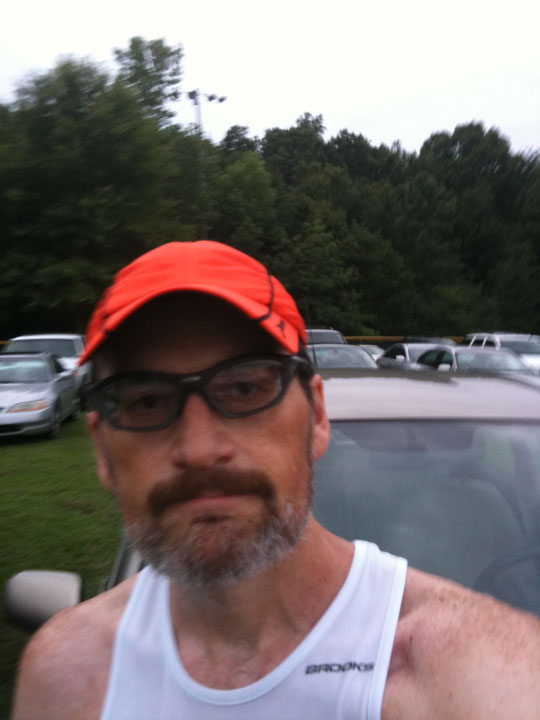
When I went to see the results posted, I grimaced. My time was listed as "Dave Munor." That's what I get for filling out my application by hand 30 minutes before the race instead of registering online in advance! Oh well... It was still good for 19th overall out of 330 competitors, and third place in my age group. Here are the official results. Here's the obligatory self-portrait after the race:


And here's the award I got -- pretty snazzy for a race with a $15 entry fee!


I also got a nice tech t-shirt, and the race was timed with D-tags, so it was a real bargain.

My Garmin record of the race is below:

Thursday, July 14, 2011

Race Strategy: The Streetlight 5K

Tomorrow evening I'll be running the Concord Streetlight 5K, a 7:30 p.m. race that I'm planning on using to set my training paces for the summer. I haven't run a 5K road race since the UNCC Homecoming 5K last February, and given the likely warm temperatures, I'm not quite sure what to expect. The weather forecast for tomorrow says it should be around 78 degrees at starting time, which is actually unseasonably cool, but I believe still the warmest temperature I've ever raced in. There's also a threat of thundershowers, so that ought to be quite exciting!

So how should I approach this race? I found a Garmin plot of last year's course, which looks to be the same as this year. The course is an out-and back along a greenway. Here's the elevation profile:

Yikes! Look at that hill!

There's a fairly large hill right in the middle of the race. The good news: that means the second half is primarily downhill; the bad news: Look at that hill!

It looks like about a 100-vertical-foot climb in roughly a half mile. That sounds pretty bad, but compared to the UNCC homecoming 5K where I set my PR of 21:30, it's actually rather tame. Here's the profile of that race:

Yikes! Look at those hills!

There are three hills in this race comparable in size to the one hill in the Streetlight 5K. Streetlight's cumulative vertical gain is about 160 feet, compared to about 330 at UNCC. Then again, the weather was perfect at UNCC. So how should I approach Streetlight?

My average pace during the UNCC run was 6:55. I actually ran the first three miles of the Elizabeth 8K faster than that, about a 6:45 pace. Could I complete this race in a sub-6:45 time? I think I might be able to. Even though the heat will be daunting, there's not much chance of getting dehydrated in such a short race. I think I'm going to shoot for a 6:30 over the first mile, then a 6:45 in Mile 2 with its big hill, and see if I can hang on for Mile 3. If I maintain that 6:45 pace for the last mile, then I will be comfortably under 21 minutes. Even if I slow to a 7:00 pace for the last mile, the time I banked in Mile 1 would put me under 21 minutes. And if I'm feeling strong, I could run a 6:30 or better for that last mile and go sub-20:30.

Details of today's run are below:

Wednesday, July 13, 2011

A better way to measure cadence

I promise, this will be my last post about cadence for a while. But today I got to play with a new gadget, a foot pod for my Garmin Forerunner 305. It attaches to your shoe and syncs with your GPS trainer, allowing it to count your steps. I had been measuring cadence occasionally during runs by counting 30 steps of my right foot and seeing how long that takes -- if it takes 20 seconds, that means I'm running at a cadence of 180 steps per minute for both feet.

I had been wondering if I subconsciously was increasing my cadence during those spot-checks, so I borrowed Chad's foot pod while he was out of town. It took me a couple days to get it to work: I could find the menu on my Garmin that asked "do you own a foot pod," but I couldn't figure out how to activate the menu -- it wouldn't let me answer. Finally Marc pointed out that I needed to press "enter" in order to then make my yes/no answer. Bafflingly simple.

Anyways, the end result is that for the first time I have cadence data for the whole run. How did I do? I was taking this morning's run fairly easy -- about an 8:30 pace, in very hot, humid weather. The Garmin gives you cadence based on just the one foot, so instead of a number in the high 100s, mine was in the 80s and 90s. To hit my target cadence of 180 I'd need to register a 90 on Garmin. I ended up averaging 84 for the run, or about 168 when counting both feet. So my cadence isn't quite as fast as I had thought; my spot-checks probably overestimated my real cadence.

For each mile split, the cadence didn't change much, varying from 83 to 85. There was a slight trend to slow down over the course of the run, with my 85 in Mile 2 and 83s in Mile 6 and the last .35 miles.

One thing I had been hoping for with the foot pod was a smoother pace curve; typically with the Garmin the graph of my pace during the run is pretty much useless, looking something like this:


As you can see, it's pretty hard to tell from this graph whether I did better on Mile 2 or 3. I had thought this was due to GPS artifacts like trees blocking the satellite signal. Since the footpod isn't affected by trees, I thought the data might be cleaner. Below is the same graph for today's run:


While the vertical axis is slightly different, the result is the same: It's hard to tell how I did at all. It's just not very useful. That said, it's nice to have the cadence data. I'll keep using the foot pod over the next couple weeks until I have to give it back to Chad, then decide whether I want to spend the $50 for one of my own. Details of today's workout are below.